
America's National Guard – Any Challenge, Any Time, Anywhere
Published June 25, 2020 • Read time: 5m
It is one of life’s curious ironies that tumultuous times generate both the abject worst – and the inspirational best – in people. Likewise, the value and standing of an institution are forged in times of disruption and uncertainty. Times when the presence of that institution is needed most by the citizenry. One of these institutions – quintessentially American in both its origins and organization – is the U.S. National Guard.
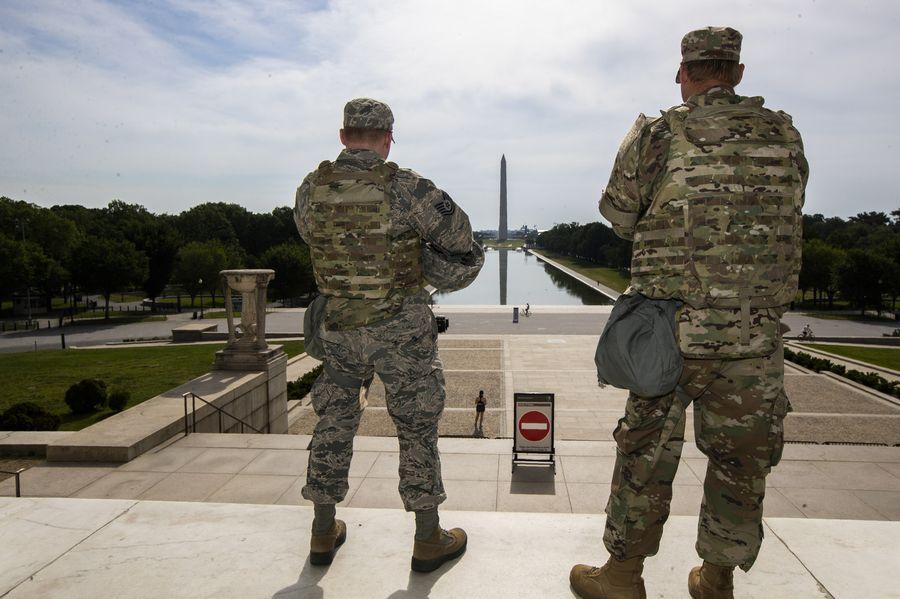
Our National Guard forces – Army and Air together – number roughly 431,000 in total personnel. Hailing from all 54 states and territories, the National Guard represents a diverse cross-section of the country. Most members of the Guard serve in a reserve part-time status, maintaining their civilian callings and careers when not in uniform, epitomizing the American ideal of the “citizen-soldier.” And while the National Guard is known for its close community ties – witness throngs of cheering citizens lining American streets to support their local Guardsmen and women – units are often deployed to places unfamiliar, both at home and abroad.
America’s National Guard also typifies our “can do” ethos. To suggest that the National Guard can perform any mission, anywhere may sound cliché – but there is undeniable truth inherent in this refrain. National Guard units perform an extremely diverse breadth of missions and duties – from responding to natural disasters and aiding in recovery, to being activated under Federal Title to fight in war. Most recently, Guard units have worked tirelessly to assist in the COVID-19 response – only to be quickly re-tasked across the country to restore order in the wake of unrest.
That the National Guard is relied upon for so many different functions and needs should not be news. After all, Guard units have been perpetually deployed oversees since the attacks of Sept 11th, 2001, and recent major natural disasters have required the Guard to assist the afflicted. But as current incidents have vectored public attention toward the service, needed is a review of how the Guard is legally activated to execute the wide spectrum of missions they’re called upon to perform. This understanding also reinforces the uniqueness, flexibility, versatility and dedicated professionalism of the service.
Under State Active Duty, a Governor can activate National Guard personnel to "State Active Duty" (SAD) in response to natural or manmade disasters or Homeland Defense missions. SAD is based on State statute and policy and utilizes 100 percent State funds. Under this activation status, soldiers and airmen remain under the command and control of the Governor. Under SAD, many federal benefits and protections such as TRICARE, GI Bill accrual, and death gratuity are not authorized. According to their respective State’s employment laws, policies, and programs, Guard members receive pay, benefits, and retirement credit.
Another activation status falls under Title 32 Full Time National Guard Duty. Here, Title 32 of the U.S. Code provides the President or the Secretary of Defense the ability to place National Guard service-members in a full-time duty status under the governor's command and control, but with their state mission being directly funded with federal dollars. Historically, this authorization has been utilized in response to national disasters and homeland defense needs, such as the response to Hurricane Katrina and the attacks of 9/11. Under Title 32, Guard members serve full-time and receive equivalent benefits, service credit, and protections as federal active duty service-members, such as access to TRICARE, GI Bill accrual, and retirement credit. These missions are at the request of the Governor with Department of Defense approval.
And finally, a third status for National Guard activation falls under Title 10 of the U.S. Code – Active Duty for Federal-level missions of the U.S. It allows the President to “federalize” National Guard units by ordering them to active duty in their Reserve Component status or by calling them into Federal service. Here, command and control are transferred from the Governor to the President. Title 10 is the main statute utilized to deploy service-members – both Active and Reserve Component – overseas in support of U.S. contingency operations. Under Title 10, Guard members receive the full extent of benefits and leave as an active duty component.
Under any activation status, and regardless of demand or situation, the National Guard swiftly pivots to address any challenge facing community and country. At any one time, Guardsmen and women may be airlifting citizens stranded by flood, constructing field hospitals during an outbreak, or sending rounds downrange towards an enemy abroad. Moreover, they are often mobilized with scant notice, on limited orders, and unknown timelines for mission completion. And yet – without these advancements or assurances – they always pack their gear, salute smartly, and support the Nation’s purpose.
The first half of the year 2020 – the first year of a new decade which may be defining for the future of the Nation – has seen the resolve, unity, and principles of the country tested and pushed. But is in these times of strife and pressure that the Nation will look to our institutions and our steady civic heroes – that hometown citizen-soldier – to show us the way. The patient and patriotic men and women of the National Guard represent the very best of what America has to offer – in good times and bad – for any challenge, any time, anywhere.
Connor Martin is a U.S. Marine veteran and policy analyst in Washington DC.

The Army’s AI Cyber Defenders Need a Proven Stand-Down Order
By Gleb Tsipursky • RealClearDefense
After the Silence
By Chase Skylar DeMayo • RealClearDefense
Defense Chip Procurement Needs a Recovery Test
By Percy Yixuanchen Yu • RealClearDefense
FORTRESS America Must Measure Missions, Not Megawatts
By Burak Oktenli • RealClearDefense
After the Midterms, the Right Strategy Against Iran
By Lance Gordon • RealClearDefense
After the Silence
By Chase Skylar DeMayo • RealClearDefense
Underwater Arms Race Puts U.S. Naval Supremacy at Risk
By Tom O'Connor, Newsweek
New Facilities To Pump Out Upgraded F/A-18E/F Super Hornets
By Trevithick, WarZone
U.S. Navy Expands Tomahawk Warhead Production
By Naval News Staff, Naval News
SSN(X) Attack Boat Will be a Swift, Lethal Mothership for Undersea Drones
By USNI N.