
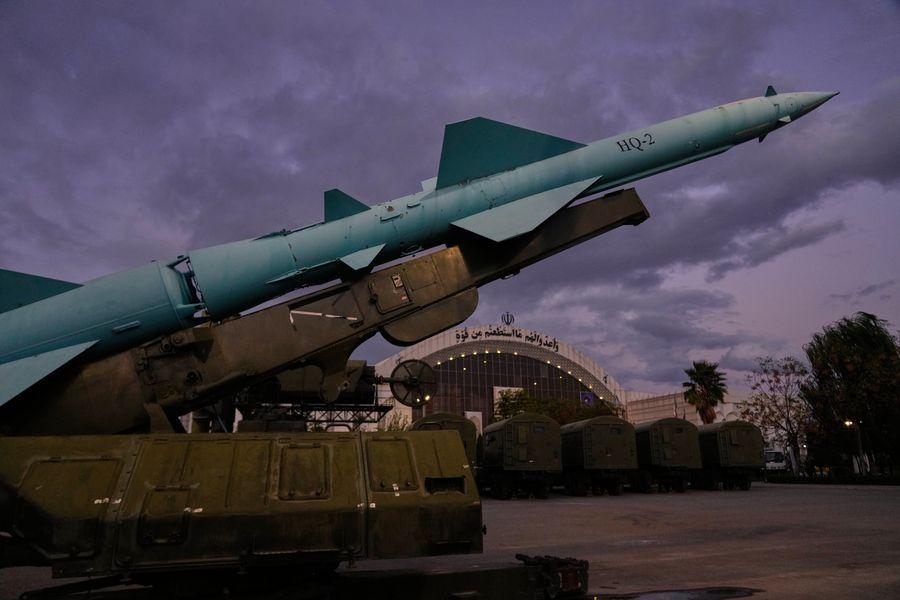
A domestically-built missile is displayed in a permanent exhibition of the National Aerospace Park of the Revolutionary Guard, just outside Tehran, Iran, Monday, Nov. 9, 2026. (AP Photo/Vahid Salemi)
After the Midterms, the Right Strategy Against Iran
Last updated 07:02 AM EST • Read time: 10m
Join the Conversation
0Keep the Strait Open, Cut Off the IRGC’s Oil Money
What the Election Decided
On November 3, voters handed President Trump what The Wall Street Journal called one of the most decisive repudiations of a president in modern history. Pump prices rose 40 percent, the Iran war has cost taxpayers more than $47 billion, and more than 20 American servicemembers have died. The war has not been won: the strait remains contested, and Tehran has not accepted Washington’s core terms on nuclear weapons, missiles, and proxies.
Trump acknowledged, “Iran was a piece of it.” Vice President Vance went further: “The reason we lost is the war.” He urged Republicans to “change our relationship to Israel.” Iran’s chief negotiator apparently agreed: “Americans said NO TO WAR.”
The polls do not bear Vance out: voters ranked the economy and the state of democracy ahead of foreign policy. Nor do they establish a mandate to change course on Iran and Israel.
The election exposed a serious problem with the war’s conduct and cost. In The AP Voter Poll, about 6 in 10 voters said attacking Iran was the wrong decision, but only about a third called the war crucial to their vote, against roughly half who said that of the cost of living or government corruption. Just 4 percent put foreign policy first, and Republicans won those voters.
These results do not mean Americans will accept an Iranian nuclear weapon and the missiles to deliver it. In an April Economist/YouGov poll, most Americans opposed the war, yet 54 percent said preventing an Iranian nuclear weapon must be achieved before it ends. The distinction matters: opposition to how a war is conducted is not necessarily opposition to its strategic objective.
The election demands a different strategy, not abandonment of the objective. It changes the means, not the end.
Tehran has met wave after wave of dissent with violence, killing thousands of protesters in December 2025 and January 2026. It executed at least 1,639 people in 2025, the most since 1989, and has since executed dozens of protesters and political prisoners. It has called America “the Great Satan” and led “Death to America” chants for decades. Iran has been a state sponsor of terrorism since 1984 and arms Hezbollah, Hamas, and the Houthis. Its proxies killed 241 American servicemembers at the Marine barracks in Beirut in 1983 and, the Pentagon assessed, at least 603 U.S. troops in Iraq. The Justice Department has charged an Islamic Revolutionary Guard Corps (IRGC) asset in a plot to assassinate President Trump.
An Iran armed with nuclear weapons and missiles capable of threatening its neighbors, and eventually the United States, would be a generational strategic failure.
Enforced Containment, Not Another War
The war’s political cost was foreseeable. Iran’s cheapest weapon was always the Strait of Hormuz, yet the campaign struck Iran’s arsenal before securing the waterway that gave Tehran leverage over American gasoline prices.
Nor will renewed large-scale war fix it. After more than 30,000 American and some 8,500 Israeli combat sorties, Brookings’ Michael O’Hanlon estimates perhaps one-third to two-thirds of Iran’s missile force was put out of action, yet some has likely been rebuilt and drone production continues. Kinetics degrade. Denial starves regeneration. Air strikes alone are unlikely to topple the regime, and a ground campaign would require a force far larger than Washington has deployed.
The alternative follows from Joint Publication 5-0 and the center-of-gravity framework of Joe Strange, Ph.D., of the Marine Corps War College. For this campaign, the IRGC is the regime’s center of gravity. It commands internal security, the missile forces, and the Quds Force, and controls up to half of Iran’s oil exports. Oil revenue is its critical requirement for sustaining and rebuilding that power; Kharg Island’s loading terminals and the payment channels that carry that revenue are its critical vulnerabilities. Trump has two years to keep building a containment architecture that outlasts him.
The Squeeze Is Working
That architecture is beginning to produce measurable results. On October 16, CENTCOM commander Adm. Brad Cooper reported that the blockade had cost Iran an estimated $25 billion in oil revenue and that Tehran is withholding pay from its security forces, including the Guard. A Treasury assessment found Iran has loaded no oil onto tankers since August 25. Year-over-year inflation neared 90 percent in September. History supports the link: a peer-reviewed study of six decades of data found that multilateral sanctions sharply reduced Iran’s military spending; U.S.-only sanctions showed no statistically significant effect.
Survival is not reconstitution. A regime struggling to pay its guards may also struggle to rebuild its missiles at scale, though only intelligence can confirm that. Denial stops income, not spending, so reserves and the Guard’s businesses will carry it for a time. And Tehran can print rials, but not the foreign currency needed for imported missile components and operations abroad.
Reuters found that Iran imported at least $2 billion in military hardware, explosives, and trucks usable as missile launchers between January 2025 and June 2026, through a network of more than 5,000 Defense Ministry agencies. Ninety-seven percent of the shipments it reviewed were settled without cross-border currency transfers. The data predates the collapse but identifies the channels interdiction must still close.
Six Lines of Effort
First, hold the blockade. It is an instrument, not the objective; the objective is an IRGC without the resources to regenerate. Not a dollar of oil revenue should reach the Guard. Iraq’s closure of the Sheeb crossing and Pakistan’s suspension of trade at Taftan and Gabd-Rimdan show the land corridors can be closed too, though Pakistan’s partial reopening shows how quickly gains lapse. CENTCOM’s Task Force Iron Gate, formed November 7, extends the effort to Iran’s land borders and the Caspian Sea; its effectiveness is untested. CENTCOM, Treasury, and Justice lead, measured by loadings and seizures.
Second, cutting off demand. China remains the buyer of last resort, so enforcement must reach beyond teapot refineries to their affiliates, registries, insurers, and payment intermediaries, firms whose Western business is worth far more than Iranian oil. Freezing Iranian balances held offshore matters as much as stopping new revenue. Treasury and Justice lead, measured by Chinese intake of Iranian crude and designations of the firms that handle it.
Third, keep the strait open. Kpler data show Gulf crude flows briefly topped pre-war levels in late September, then slipped in October amid record attacks on shipping. The strait is open but contested, held by escorts, mine countermeasures, and strikes like those near Qeshm Island on November 2. The goal is not risk-free passage, which no navy can promise against missiles, drones, and mines, but enough traffic that Tehran cannot hold energy markets hostage. Asian and European importers, far more dependent on Gulf energy, should provide escorts, minesweepers, and shared costs. War-risk premiums reached as much as 10 percent of hull value by July; insurance backstops and hardened bypass pipelines bring prices down over time. CENTCOM, State, Energy, and Treasury lead, measured by transits, premiums, and gasoline prices.
Fourth, support the Iranian people without arming them. Internet access, documentation of abuses, and sanctions on enforcers of repression keep faith with Iranians without betting the strategy on an uprising. State and Treasury lead.
Fifth, use force with precision. Attacks on Gulf oil and shipping should put Iran’s exports at risk. Disabling Kharg Island’s loading equipment while sparing its storage tanks remains the conditional option if Tehran escalates or blockade enforcement becomes too costly. The U.S. view that war-sustaining export facilities may qualify as military objectives is contested under international humanitarian law, so proportionality, precautions, and foreseeable environmental harm must be assessed in advance. Within the armed conflict that began February 28, confirmed nuclear reconstitution should trigger an immediate decision on precision strikes, weighed against the threat and the closing denial window, not another round of pressure. Renewed work at Pickaxe Mountain’s tunnel entrances is a warning sign to confirm before acting. The President decides; CENTCOM leads.
Sixth, integrate American and Israeli warning and decision-making. Shared indicators should track nuclear reconstitution, missile and drone production, proxy resupply, and attack readiness, each with a threshold, a decision window, and agreed responses. The International Atomic Energy Agency (IAEA) has had no access to the attacked sites since June 2025, so intelligence, not economic data, must establish whether Iran is rebuilding. The Intelligence Community and Joint Staff lead with Israeli counterparts, measured by indicator-to-decision time and independently assessed reconstitution.
Risks and the Red Team
The gravest risk is that strangulation produces war rather than concessions. On October 31, Supreme Leader Mojtaba Khamenei ordered that a renewed U.S. or Israeli attack be met with “an immediate and effective response, without geographical limitations.” Iran’s likeliest answer is attacks on Gulf energy and shipping, which the third line of effort is built to absorb. That risk is worth running. A second major war carries greater risk.
Brig. Gen. (res.) Itai Shapira, Ph.D., argues in Early Warning Revisited that strategic surprise can arise from a “relevancy gap,” when the operational concept no longer fits the adversary it faces. For Iran, the most dangerous gap would be assuming deprivation produces negotiation when the regime concludes escalation offers its best chance of survival. A joint U.S.-Israeli red team, independent of the planners and reporting to senior leaders, should test six assumptions continuously.
• Does pressure produce negotiation, or escalation?
• Can reconstitution be detected without IAEA access?
• Can Treasury reach the channels Beijing uses to keep buying?
• Does support for civil society build resistance, or invite repression?
• Do threats deter Tehran, or persuade it an attack is coming anyway?
• Will Washington hold, or will fuel prices, divided government, or a premature declaration of victory end the squeeze too soon?
If reconstitution continues while revenue falls, the campaign must change. Economic distress alone is not success.
The Exit, and Why It Must Not Be Traded Away
Pressure without an exit invites defiance. Relief should come in phased, reversible steps and require three things: a verified end to any path to nuclear weapons with restored IAEA access, verified limits on offensive missiles and long-range drones, and an end to arming proxies and threatening neighbors. A fully open strait is not a concession to be purchased, and it does not end the blockade.
The June Islamabad Memorandum of Understanding shows the cost of getting this wrong. It provided for lifting the blockade, offering oil waivers, and releasing frozen funds while leaving missiles unaddressed, and construction at Pickaxe Mountain continued while it was in force. Washington should negotiate with the blockade in place and the terms fixed in advance. As The Wall Street Journal’s editorial board warned of Vance’s post, announcing that Washington needs the war to end turns lifting the blockade into “an Iranian concession for which the U.S. will be required to pay.”
The new Congress should codify the sanctions architecture in statute, fund the naval mission, and oversee it.
If Tehran refuses, containment continues. George F. Kennan’s containment did not require Soviet collapse on an American president’s timetable. It need not defeat the IRGC on a political timetable either.
CAPT Lance B. Gordon (U.S. Navy, ret.) is a retired Navy intelligence officer, graduate of the Army War College and NYU School of Law, and former Partner/Principal at Ernst & Young LLP. He has written on the 2026 Iran campaign at RealClearDefense and Small Wars Journal.
After the Midterms, the Right Strategy Against Iran
By Lance Gordon • RealClearDefense
The Color Revolution Came Home
By Emzari Gelashvili • RealClearDefense
When Access Becomes the Fight
By Richard Byno • RealClearDefense
What the 2026 Midterm Results Mean for U.S. Strategic Competition with Rivals
By Dean Chen • RealClearDefense
Measurable by Design: Project Meridian
By Alex Willard • RealClearDefense
New USAF Force Design Bets on Technology
By Stephen Losey, Air & Space Forces
DoD Pushes $450M in Loans To Bolster U.S. Space Companies
By Hitchens, BrDefense
The U.S. Navy Needs a New Battlecruiser. Will It Get One?
By Sadler & Ouellette, NatInt
U.S. Army Rehearses Rapid HIMARS Rocket Launcher Deployment
By Global Defense N.
Coding Commander's Intent into Unmanned Systems
By Thomas Baumstark, Proceedings