
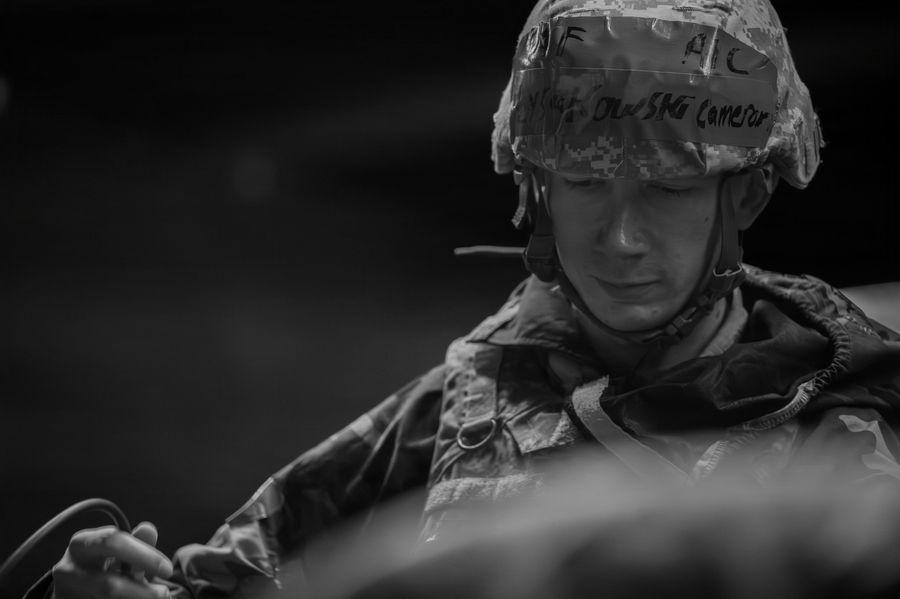
U.S. Air Force Airman 1st Class Cameron Lysakowski, 374th Communications Squadron expeditionary communications journeyman, organizes the power cords of a Starshield system during exercise Beverly Morning 27-1 at Yokota Air Base, Japan, Oct. 21, 2026. During the exercise, Airmen worked around the clock to execute mission-critical tasks, such as aircraft generation, emergency response and maintaining communications.
FORTRESS America Must Measure Missions, Not Megawatts
Published Nov. 13, 2026 • Read time: 6m
Join the Conversation
0A reported 90-day endurance goal will mean little unless bases can sustain combat missions and trustworthy local control when power, software and supply chains fail together.
A military base can keep its generators running for three months and still be unable to launch aircraft, move ammunition, repair equipment, or sustain medical care. Power may be available while a damaged water system, a failed supplier or a compromised control network makes the mission impossible. That is the distinction FORTRESS America must get right: mission endurance is not the same as electrical endurance.
The Pentagon announced FORTRESS America on September 30 to strengthen independent energy, supply chains, strategic reserves, installation defenses and space and spectrum resilience. On October 20, a senior defense official said the department was still assessing costs and requirements across roughly 500 continental U.S. installations. A subsequent report described a goal of keeping major bases operating independently for at least 90 days. That remains a reported objective, not a publicly validated, completed department-wide standard.
There is an immediate decision point. The September memorandum gave the department 30 days to establish its FORTRESS program office, and implementation instructions followed in October. The office should make clear from the beginning what each investment must prove. Megawatts, fuel inventories, and project milestones are inputs to readiness, not its outcome.
Begin with the mission
An air base should identify the minimum sorties, maintenance cycles and airfield functions it must sustain. A logistics center needs a measurable cargo throughput; a medical installation, a level of care. The exact thresholds may be classified or mission dependent. Each can still be tested against the same question: what useful military output continues when civilian infrastructure does not?
A hypothetical constant critical load of 10 megawatts consumes 21.6 gigawatt-hours over 90 days before losses or reserves. That is not an estimate for any actual base. It shows why the capacity on a generator label cannot establish 90-day performance without fuel, spares, water, trained crews and safe controls. An independent power plant with no way to verify the state of the equipment it serves is not an independently functioning installation.
There are already sensible starting points. Marine Corps Air Station Miramar used its microgrid in a 2023 simulated blackout, while also identifying the workforce needed to sustain extended operations. Fort Knox announced an October 13 exercise to disconnect briefly from commercial power and operate on local generation. Such tests demonstrate switchover and restoration conditions; neither is evidence of 90 days of uninterrupted combat output.
Longer-term projects have moved forward. An October 16 site survey at Fort Benning advanced Army planning for Janus microreactors, and the Navy selected a supplier for Naval Weapons Station Crane. These are useful development and procurement milestones. They must not be counted as operating capacity before their systems are installed, qualified and exercised.
The digital dependency inside the fence
FORTRESS also needs a test that an electricity-only program could miss. A base may separate from the commercial grid while still depending on outside identity services, a vendor cloud, remote maintenance access or networked controllers to operate essential equipment. Losing one of those services can disable a process even while every generator is healthy.
The adversary has reason to exploit such dependencies. A 2024 U.S. and allied warning on Volt Typhoon assessed that China-linked operators had pre-positioned in civilian critical-infrastructure networks for possible disruption during a crisis. It was not evidence that a particular military base had failed, nor proof of an autonomous-AI attack. It was a reason to test common points of dependence before a conflict.
AI-enabled maintenance or scheduling tools introduce one more possible route for an error. Consider a hypothetical assistant that reads an untrusted contractor report and recommends an unauthorized change to a pump or generator. A well-designed installation should be able to reject the change without taking the underlying physical process offline. The control must reside in tested permissions and equipment safeguards, not in a model’s promise to behave.
This is consistent with NIST guidance for operational technology and the December 2025 guidance from U.S. and allied cyber agencies on AI in operational technology. Both put safety and continuity alongside cyber defense. They support bounded access, local control, and preplanned fallback. Disabling a suspect software connection must not inadvertently shut down water treatment, fuel handling or protective functions needed to keep people and equipment safe.
The acceptance question is practical: can trained installation personnel identify an untrustworthy digital service, revoke its access, switch to verified local operation and restore trusted configurations without losing the essential mission? If that procedure works only when an outside login service or contractor help desk is available, independence remains conditional.
Measure the work that still gets done
Endurance also crosses the base perimeter. Military personnel may depend on municipal water and roads; relief crews may be unable to reach work if their families face the same emergency. Two suppliers may share one substation, refinery or port. The Civil Reserve Manufacturing Network can help prepare commercial production for defense demand, but a listed factory is not the same thing as an exercised source of accepted parts.
FORTRESS should require progressive, safely controlled tests that combine these failures rather than examine them one at a time. Begin with grid separation. Then remove an external communications or identity dependency, degrade a water service, interrupt resupply, and introduce a simulated unauthorized automation request in an isolated test environment. Measure what the mission still produces, not simply whether each component reports green.
The product should be a concise mission-endurance record for each essential function: required output, dependency map, disruptions actually tested, time sustained at that output, safe degraded mode, time to recover trusted control and resources consumed. Records must separate observed results from modeled projections. A full 90-day live blackout would often be unsafe or impractical; validated engineering and logistics analysis should cover the untested duration, with its assumptions plainly identified.
Those records would make funding decisions more discriminating. The next most valuable purchase might be a microgrid, but it might also be water-treatment consumables, backup authentication, an independently maintained controller, spare parts or a second shift of qualified technicians. None of those is glamorous. Each may determine whether costly infrastructure can deliver its intended military effect.
Allies that depend on U.S. reinforcement need confidence that aircraft, equipment, and sustainment will reach them even when the American homeland is under pressure. A self-powered base helps deterrence. A base that can maintain its mission while digital services, civilian utilities and suppliers fail together makes that deterrence more credible.
The next FORTRESS milestone should not be the number of megawatts installed or the number of days a base can sit off grid. The test is what the force can still do on day 90, and whether commanders can trust the systems that let it do it.
Burak Oktenli is an independent researcher based in Washington, DC. He holds a bachelor's degree in Computer Science and Engineering from the University of South Florida and an MBA, and is completing a Master of Professional Studies in Applied Intelligence at Georgetown University. His work focuses on defense technology, AI assurance, and dependable systems.
The Army’s AI Cyber Defenders Need a Proven Stand-Down Order
By Gleb Tsipursky • RealClearDefense
After the Silence
By Chase Skylar DeMayo • RealClearDefense
Defense Chip Procurement Needs a Recovery Test
By Percy Yixuanchen Yu • RealClearDefense
FORTRESS America Must Measure Missions, Not Megawatts
By Burak Oktenli • RealClearDefense
After the Midterms, the Right Strategy Against Iran
By Lance Gordon • RealClearDefense
After the Silence
By Chase Skylar DeMayo • RealClearDefense
New USAF Force Design Bets on Technology
By Stephen Losey, Air & Space Forces
DoD Pushes $450M in Loans To Bolster U.S. Space Companies
By Hitchens, BrDefense
The U.S. Navy Needs a New Battlecruiser. Will It Get One?
By Sadler & Ouellette, NatInt
U.S. Army Rehearses Rapid HIMARS Rocket Launcher Deployment
By Global Defense N.