
Marine Maxims: Turning Leadership Principles Into Practice
Last updated 08:09 AM EST • Read time: 11m
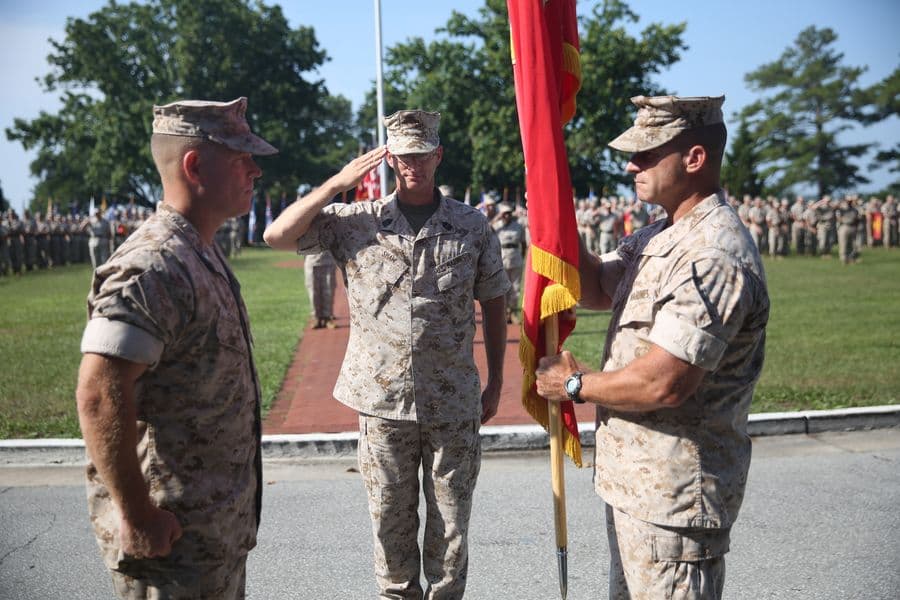
After 30 years of service, Col. Thomas J. Gordon, USMC (Ret.) has a few leadership lessons to share. Actually, Col. Gordon has every bit of 50 leadership lessons to share, and he’s captured all of them with style and punch in his new book Marine Maxims: Turning Leadership Principles into Practice (Naval Institute Press, 2021). The book is a practical tool and guidebook for leaders, written in a way that delivers the goods “on time and on target,” each lesson combining research with the wisdom earned through experience in command. Though Gordon draws heavily from his time leading Marines at First Tank Battalion and II MEF Headquarters Group, some of his most astute reflections come from his time as a junior officer serving under senior leaders. “Many of the senior leaders I was exposed to as a lieutenant and junior captain ascribed to a Machiavellian philosophy of leadership. Since they knew they could never make all of us love them, they elected instead to make us fear them,” he writes in an early chapter about doing right by subordinates. “Authoritarian leaders can achieve short-term gains, but their potential will always be limited to what they can directly coerce.” The theme of toxic leadership runs throughout the book, affirming the notion that some of the best leadership lessons are learned by observing poor leaders, the kind who end up teaching us what not to do. Colonel Gordon took a short break from his work as Commandant at The Citadel to talk with me about the book. What follows is a lightly edited transcript of our conversation.
Why did you write the book?
I wanted to give back for having a blessed Marine Corps career. Over the many years I was a Marine, I kept a journal – one of those 5 x 8 hardback notebooks, the green ones – and put down the leadership things that resonated with me. When I worked for somebody I didn’t like, I’d flip the book around and write an entry into the back on the leadership things I didn’t like about that person, his style and so on. Eventually, the two sections of the notebook met each other, but I had many more positive entries than negative. When I became a battalion commander, I packaged all that stuff up and gave it to my lieutenants in a series of professional military education seminars. Later, as I was crossing the finish line of my career in the Marines, I had the idea to re-work the notes into an outline for a book.
What was the most common failure or shortcoming of leaders you knew in the Marine Corps?
Toxic leadership. It’s the inability of senior leaders to see toxic leaders among them, and especially beneath them in the chain of command. If you take a look at people who’ve been relieved for toxic leadership, the Marines underneath that person can see it clearly; the peer group can see it, too. But for some reason, senior leaders don’t see it the same way so long as those toxic leaders are able to produce. As an example, I was working at the Pentagon when a senior leader was relieved. I remember my boss was shocked, but I was not surprised. There was something he couldn’t see that I could see right away. Similarly, there was a Marine who had worked for me who was later relieved of his command. This Marine officer was someone I could always depend on, but I didn’t realize how abusive he was to those around and beneath him. So, I used my book to open up the aperture and look at leaders outside the Marine Corps, at business and sports and the Church. One of the things I found outside the Marine Corps is something called the “360-degree evaluation” – it’s a best practice in corporate America. This is a process where subordinates, peers, and supervisors all get involved in providing feedback on performance. When you submit to a 360 evaluation, you see something totally different. I think it would be difficult for the military to incorporate on promotion boards under Title X constraints, but it would be very useful and applicable on a command board because they aren’t statutory. The Commandant of the Marine Corps should be able to pull in more data points to make sure Marines get the highest and most qualified to command. In my own experience, I incorporated the 360 evaluation as a personal development tool and not an evaluation tool. “I know what you said, but let me tell you what they heard,” is a common point of feedback – it lets you know how you’re coming across.
If you could go back in time, what advice would you give yourself as a battalion commander?
I continued to journal after I was a battalion commander, and then I became a group commander and had the opportunity to observe battalion commanders under my leadership. I learned many things watching them. My biggest mistake as a battalion commander was not firing somebody under my command. I didn’t fire a company commander I knew to be toxic because I thought I could fix him. That was the epitome of arrogance. I learned when leaders fail to address toxicity within the command, regardless of the reason, they become the problem. When I became a group commander, I didn’t suffer fools like that and fired the toxic leaders. Nobody should take pride in firing somebody, but inaction to hold subordinates accountable can ruin command climate. People see what’s going on and the senior leader can become the problem. I do have a lot to say about trust. There’s a huge gap that’s forming right now and we have to do our best to fill it. You build trust by extending trust, and that’s counterintuitive. Mistrust is earned but trust must be extended.
Let’s look at leadership more broadly. What are some differences between leading in the military and leading a company or business?
Incentives. In the civilian sector, it comes down to incentives, and most of the time, it's monetary incentives or time, which the military doesn't have per se. Most people who aspire to be promoted in the military aren't doing it for the money, and so the military's incentive has to be more intrinsic. The most powerful tool I had in the military was the 39-cent stamp—the "letter bomb" I called it. If Sergeant Major and I were walking around the tank ramp and we saw Waters doing something right, I'd get back to my office and write a letter and personalize the letter and send that to mom and dad, saying, "I know Waters wouldn't be so successful without your support." It's a letter bomb because it has a 96-hour fuse. In four days, we’d go back down and check on Waters because snail mail takes a couple days to hit the mailbox. On that fourth day, I’d find Waters down on the tank ramp and he might be working 10 times harder. I might just light him on fire with motivation and enthusiasm. One of the reasons he joined the Marine Corps was to make somebody proud, and so the letter encourages that. He wants recognition and that’s healthy. How do you make a Marine stop performing? Easy—stop noticing him. I always say leaders need to break “laptop defilade” and identify your hard-workers and bear witness to that in a letter bomb.
That’s a great tip. Does it apply in private industry?
I think these same techniques can be applied to corporate America. Leadership is easy but being a leader is hard. You get my own personal definition of leadership in the book and it’s about creating the “will” and helping people find the “way” to accomplish the mission. You mentioned working for General Craparotta. The loyalty he was able to create was tremendous, you know, working for General Craparotta was a great place to be. He took care of his people who delivered for him, and there’s no reason corporate America can’t replicate these same techniques to engender loyalty and commitment. We try to build cohesion here at The Citadel. Cohesion fosters the “will” that has been decisive in battles going back to antiquity. I define “will” as resilience and resolve. You’re going to get knocked down in the Marine Corps; you’re going to get knocked down in corporate America. You get a young person. Give the person some adversity. Encourage him or her to meet the challenge and recognize achievement. Then rinse and repeat. Every time you overcome adversity, you gain in resolve and resilience. There’s a tremendous amount of plasticity in young people, and adversity should be viewed as a challenge to be overcome.
How do you avoid complacency or stagnation in any organization, whether in government or private industry?
When you take over an organization, you immediately see all the warts and problems. After a while, you don’t see them as much. Time in an organization erodes your awareness, and so you have to be aggressive about your feedback loops. Surround yourself with truth-tellers who have access to you, who bring you problems and concerns. The “open door policy” is not as effective as we intend—it could become a way to circumvent the chain of command. Instead, I advise people to get out in the organization and find the truth-tellers. Keep those people close. For example, General Neller was outstanding about building and maintaining feedback loops. He had a rolodex of commissioned and noncommissioned officers, and he’d call them up and invite them over to 8th and I to have a beer in the backyard, talk over an issue of the day. There was still disagreement, but there was a spirited dialogue and debate that at least challenged his assumptions. But not all feedback is the same, in my opinion, and I’m thinking about the overused electronic surveys. Whenever I did a command climate survey or other type of survey, I would ask open-ended questions in an artful way to draw out the type of feedback that might help clarify ambiguity. My favorite question to ask is: “What are you going to tell me that nobody else is going to tell me?” It’s an awesome question. It appeals to a person’s pride but also generates candid responses.
Speaking of candid responses, how do you generate fresh ideas?
Stop talking. If you’re a leader and you’re trying to get fresh ideas, creative ideas, then the worst thing you can do is start giving your opinion. In my experience, I would throw out the problem set in the most general terms, define what success looks like and then just be quiet. Don’t be afraid of the awkward silence. I was poor at this as a battalion commander, but I learned to get comfortable with the awkward silence. Let it build and be shocked by the creative ideas that come from people. Give people the opportunity to work up the courage to come forward.
Do you block off periods of time on your calendar for thinking? I’m wondering how you refresh yourself amidst a chaotic and overloaded schedule.
When I was the operations officer for Marine Corps Forces Central Command, I thought it was the busiest job I ever had until I became the military secretary to the Commandant. Things just got busier and busier. But I found time to sit quietly and reflect while traveling on an airplane. So, my first tip is that you have to be disciplined about building white space time into your schedule. When I worked for General Neller, I was ruthless about building in two hours per day for the Commandant to do reflection and critical thinking. The time was not consecutive, but he could easily become too overscheduled, and it doesn't allow for critical thinking. My second tip is that you have to build in safeguards between your work and your family. I had a five-block commute from work to home when I worked for the Commandant, and though it was great for the ease of commute, it didn’t allow me the time I needed to mentally transition from work to home. I had to pull the car over sometimes to collect my thoughts, to make the mental transition. So, both are important: white space for thinking and transition time from work to home.
Back to ideas, as we wrap up our conversation. I wonder who you surround yourself with—who is in “your circle?”
I surround myself with very strong personalities because I have a very strong personality. I need somebody who will come back at me in my office, and I can’t stand sycophants and “yes men.” I find it condescending and patronizing when someone sucks up. I look for people who have an edge on them, and I’ve been better for the spirited debate and dialogue that happens behind closed doors. I’ve had really good luck working with people who are smarter than I am; it helps my confidence, actually. If I feel like I’m the smartest person in the room, it makes me nervous.
John Waters is a writer in Nebraska.

Trump's Disrupt First, Negotiate Second: Greenland in Focus
By Meda Parameswara Reddy • RealClearDefense
In Seeking Peace With Beijing, Taipei Is an Asset, Not a Burden
By Alexandru Filip • RealClearDefense
Strike First: Israel's Inevitable Doctrine for the Iranian Axis
By Lance Gordon • RealClearDefense
It’s Not President Trump but Thomas Friedman Who Should Be Ashamed
By Francis P. Sempa • RealClearDefense
Putin, Plague, and America’s Biodefense Gap
By Ryan Kane • RealClearDefense

U.S. and Japan Begin Naval Exercises Near Taiwan
By Mari Yamaguchi • Associated PressU.S. and Japan Begin Naval Exercises Near Taiwan
By Mari Yamaguchi, AP
U.S. Navy, Gecko Robotics Surge AI Maintenance Contract
By Ceder, Simkins, Navy T.
Ghost Shark XL-AUV Payload Bay Seen For First Time
By Thomas Newdick, The WarZone
Dakota Meyer Tapped As Barracks Task Force Senior Advisor
By C. Stassis, MC Times