
Proximity to Power
Last updated 07:13 AM EDT • Read time: 9m
How Institutionally Tolerated Boundary Failures Become Procedural Leverage - The Pattern Everyone Knows But No One Stops
Inside military formations and other large organizations, boundary problems often appear early, leadership waits too long, and unresolved failures later become leverage.
Most institutional failures do not begin with formal complaints. They begin inside ordinary unit culture: jokes, texts, field problems, drinking, travel, and repeated proximity that gradually blur professional boundaries. Those interactions may appear mutual or harmless until leadership fails to address warning signs.
These failures are rarely hidden. People see who is texting whom, who pushes limits, who seeks protection, and who uses informal access for advantage. Good order and discipline erode in plain view.
The problem is not simply individual misconduct. It is institutional delay. When leaders ignore visible boundary failures long enough, ordinary disciplinary problems can evolve into procedural leverage. By the time formal complaints emerge, context has often been lost, and decisive action is mistaken for accurate judgment.
The pattern often moves from peer relationships to subordinate involvement, creating visible instability. Leadership knows enough to be concerned. Sometimes findings are substantiated and still ignored. The individual learns a dangerous lesson: repeated boundary violations may be tolerated when the individual possesses institutional value, personal relationships, or proximity to power.
That is the part many soldiers recognize. Someone shares the language, habits, and blurred atmosphere of the group. Then, when pressure comes, the same shared conduct is no longer described as mutual. It is recast as something done to them, while their own participation drops out of the story.
Once misconduct is tolerated without consequence, it becomes leverage.
Nothing here diminishes the reality of sexual assault, coercion, retaliation, or abuse of authority. Those cases deserve swift investigation and meaningful accountability. This argument concerns a narrower pattern: leadership ignores known boundary problems, then evaluates later allegations without the context that produced them.
When the complainant is also part of the misconduct landscape—known boundary violations, credibility issues, threats, improper relationships, or a pattern of using institutional processes—the failure to examine their conduct does not protect justice. It leaves institutions vulnerable to manipulation.
Personalizing this argument is easier than confronting the pattern. The issue is not whether misconduct should be excused. It should not. The issue is whether institutions can enforce accountability without stripping away the context necessary for truth.
Why Leadership Allows It
This pattern survives because too many leaders are afraid of what it looks like to ask hard questions.
Following the Fort Hood Independent Review Committee, the Army appropriately emphasized sexual harassment and assault prevention. That correction was necessary and overdue. The challenge came when some commands began to equate visible action with accurate action. Under outside pressure, demonstrating responsiveness could become more important than fully examining context, especially when leaders feared being seen as indifferent or dismissive.
Those findings showed that inconsistent command action—not merely individual misconduct—can become the institutional problem when leaders fail to intervene early.
That avoidance teaches the wrong lesson. The person crossing boundaries learns leadership fears optics. The accused learns prior command knowledge may not protect him. The formation learns standards are enforced by risk to the command, not always by conduct.
This did not come out of nowhere. Military culture has long tolerated some fraternization, favoritism, and informal closeness, especially in high-tempo units. Newer emphasis on sexual harassment and assault prevention did not create every gray area. It exposed and amplified old ones. Recent risk aversion layered on top of years of inconsistent enforcement, turning institutionally tolerated boundary failures into leverage.
These concerns became more visible as combat-arms units integrated more diverse formations and operated in closer mixed-gender environments. Integration itself was not the problem. The failure was leadership’s inability, or unwillingness, to enforce clear standards early and consistently as unit culture changed. Units can adapt to new expectations, but only when commanders are willing to address misconduct before it becomes a crisis.
When Process Becomes Leverage
Not every complaint is false, and many reflect real harm. This critique focuses on a gray-zone pattern: prior mutual contact, complaints following disciplinary risk or personal conflict, documented boundary problems involving the complainant, or command knowledge predating the allegation.
Consider a familiar organizational pattern. An individual develops a reputation for crossing boundaries, cultivating informal access to senior leaders, and testing limits without meaningful intervention. The conduct becomes widely known, but no one wants to own the problem while it is still manageable. Later, when that individual’s conduct comes under scrutiny, allegations against another service member emerge. Rather than examining prior relationships, command awareness, and documented boundary concerns, the process narrows to the allegation itself.
Context matters in allegations involving workplace language. Investigators should distinguish genuinely unwelcome conduct from language or behavior reflecting longstanding mutual participation in unit culture. Prior participation does not excuse harassment, but it should inform credibility, intent, and whether conduct was objectively unwelcome when it occurred.
The system does not need complete fabrication to produce injustice. It only needs timing, narrative, and institutional pressure to align while context is pushed aside.
The System Moves—and Stops Asking Questions
Commanders act under pressure because hesitation carries visible risk and overreaction usually does not. Investigations begin. Administrative actions follow. The focus narrows to the allegation itself, not the environment that produced it.
The accused cannot meaningfully defend himself when the allegation is examined in isolation while the complainant’s substantiated misconduct, credibility problems, timing, and prior conduct are treated as off-limits. Then the system is no longer testing truth. It is preserving a narrative.
Accused service members are often subjected to immediate professional consequences before full context is examined. Careers are disrupted, reputations damaged, promotions delayed, and retirements lost while the complainant’s own conduct may receive comparatively little scrutiny.
The pressure does not always stay inside the command. When information concerning an investigation is leaked before facts are established, disclosure shapes the narrative before due process has run its course. Once a public story forms, correcting it becomes harder than preventing it, and leaders may feel pressure to validate the narrative rather than question how it formed.
Asymmetry of Risk
Whether intentional or not, institutional incentives create an asymmetry of risk. Leaders often face greater consequences for questioning a complaint than for aggressively pursuing one. Once that imbalance is understood, some personnel become cautious in ordinary interactions, while others trust procedural momentum to carry allegations forward before context is examined.
This is not discomfort with accountability. Accountability requires truth, and truth requires context. A process that punishes without examining prior conduct, command awareness, and environmental factors may produce action, but not justice.
Misconduct accountability and due process are not competing priorities. They depend on each other.
The Data Gap and the Reality Inside the Force
DoD annual sexual assault reports consistently show low rates of cases formally categorized as unfounded or false. But “false” is narrow. A complaint can be based on something that happened while still leaving out mutual conduct, command tolerance, timing, or the complainant’s own misconduct. That gap is where trust breaks down.
The military has gotten much better at tracking victimization. It has not gotten as good at tracking misuse, distortion, or command failure to preserve context early enough to prevent leverage.
Existing DoD reporting measures substantiated offenses, unrestricted reports, and cases formally determined to be unfounded. Less attention is paid to partially accurate but materially incomplete allegations, failures to preserve contextual evidence, or decisions shaped by reputational risk rather than evidentiary completeness. Those categories are difficult to quantify, but they matter because they reflect the gap between formal reporting and lived experience inside formations.
Yet they are precisely the kinds of failures most likely to erode confidence among the personnel expected to trust the system.
The effect is corrosive. Trust weakens because people no longer know whether ordinary closeness will stay ordinary. Soldiers learn to protect themselves from the culture that once held them together.
Restoring Standards Before Leverage Forms
The solution is not weaker protections for legitimate victims. It is earlier intervention, consistent standards, preserved context, and accountability for every actor.
1. Enforce visible boundary violations early with documented counseling, no-contact orders, and administrative action before patterns escalate.
2. Preserve contextual evidence early—communications, counseling, witness observations, command concerns, relationship history, and prior informal interventions—before administrative actions narrow the inquiry.
3. Mandate independent review when conflicts are obvious: prior command knowledge, personal relationships, public pressure, or allegations tied to promotion, discipline, or retaliation.
4. Track anonymized process-integrity data: withdrawn complaints, credibility issues, mutual conduct, timed allegations, early command failures, and cases where context emerged too late to affect the outcome.
5. Hold leaders accountable on both sides—ignoring known violations and railroading the accused both damage the force.
6. Require commanders to document observed boundary concerns when first identified rather than waiting until formal allegations arise.
7. Shift training to emphasize mutual accountability and healthy cohesion, not just individual risk avoidance.
Conclusion
The issue is not lack of regulation. It is selective enforcement under pressure.
When leadership tolerates repeated boundary violations, avoids early intervention, allows informal access to become personal advantage, and then lets fear drive the response, the complaint process becomes more than a tool for justice. It becomes a mechanism that can distort the standards it was meant to protect.
The challenge is no longer recognizing the pattern. Most experienced leaders already do. The challenge is acting before tolerated misconduct becomes procedural leverage.
Institutions rarely lose legitimacy because they lack rules. They lose legitimacy when people conclude the rules are applied differently depending on who is accused, who is protected, or what narrative serves the organization. Justice requires preserving context before power reshapes the story. Leaders who enforce standards early, consistently, and without favoritism reduce opportunities for both predation and manipulation. Only then can confidence in military justice be restored.
Mark W. Castillon served in the Army National Guard from 2004 to 2024, with deployments in support of Operations Iraqi Freedom and New Dawn, and emergency response from Hurricane Katrina through the COVID-19 pandemic. He advocates for veteran mental health, whistleblower protection, leadership accountability, and due-process reform in military personnel systems.
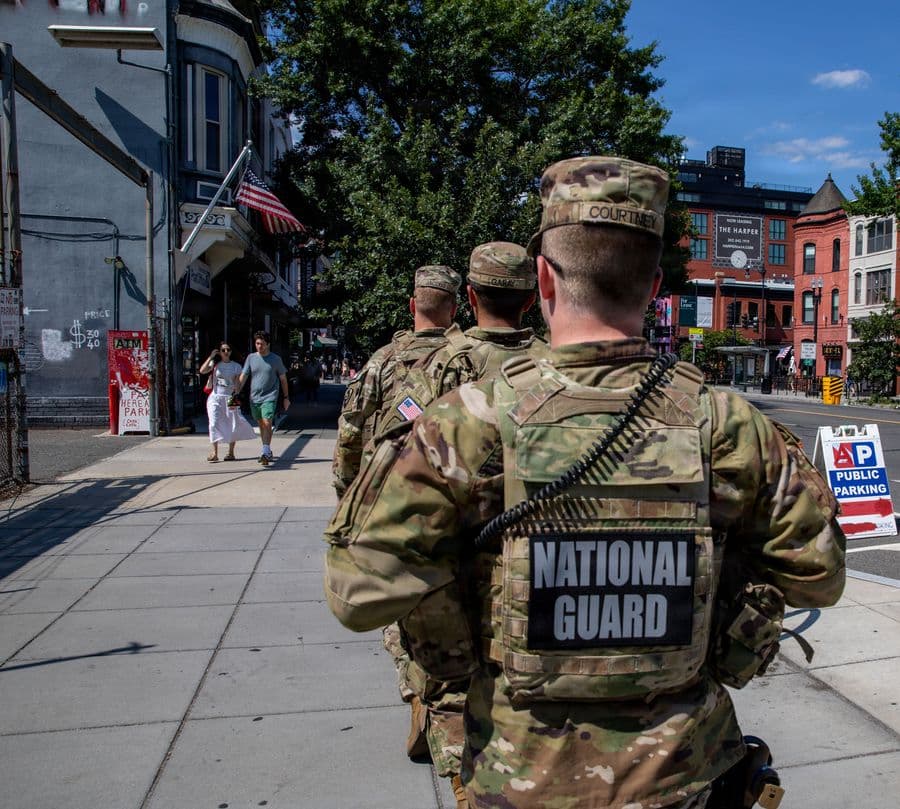
image: U.S. Army Sgt. Hunter Shull and Spc. Benjamin Armas with the Idaho National Guard, assigned to Joint Task Force-District of Columbia in support of the DC Safe and Beautiful mission, continue patrol in Washington, July 25, 2026. About 5,000 National Guard members are supporting the mission, providing critical assistance to the Metropolitan Police Department to help ensure the safety of residents, commuters, and visitors throughout the District. (U.S. Army National Guard photo by Sgt. Keyra Moolenaar)

The Unfinished Reform
By Mark W. Castillon • RealClearDefense
Winning the Data Advantage
By Turin Pollard • RealClearDefense
The Pentagon’s Quantum Race Needs a Warfighter’s Scorecard
By Burak Oktenli • RealClearDefense
The F/A-XX and the AIM-260 Reclaim the Perimeter
By Bruce Allen Lubbering • RealClearDefense
Iranian Cyber Operations
By Michael Groen • RealClearDefense
Winning the Data Advantage
By Turin Pollard • RealClearDefenseThe F/A-XX and the AIM-260 Reclaim the Perimeter
By Bruce Allen Lubbering • RealClearDefenseWinning the Data Advantage
By Turin Pollard, RealClearDefenseThe F/A-XX and the AIM-260 Reclaim the Perimeter
By Bruce Allen Lubbering, RCD
F-22 Pilot Directs CCA in Flight as ‘Airborne QB’
By Stephen Losey, Air & Space Forces