
"The Shot" and the Sixth Sense of Combat
Last updated 11:40 PM EDT • Read time: 11m
Bill Bee grew up in rural Ohio. He enlisted in the Marine Corps at the age of 17 and earned the MOS 0311, infantryman. Bee deployed once to Guantanamo Bay, Cuba and four times to Afghanistan.
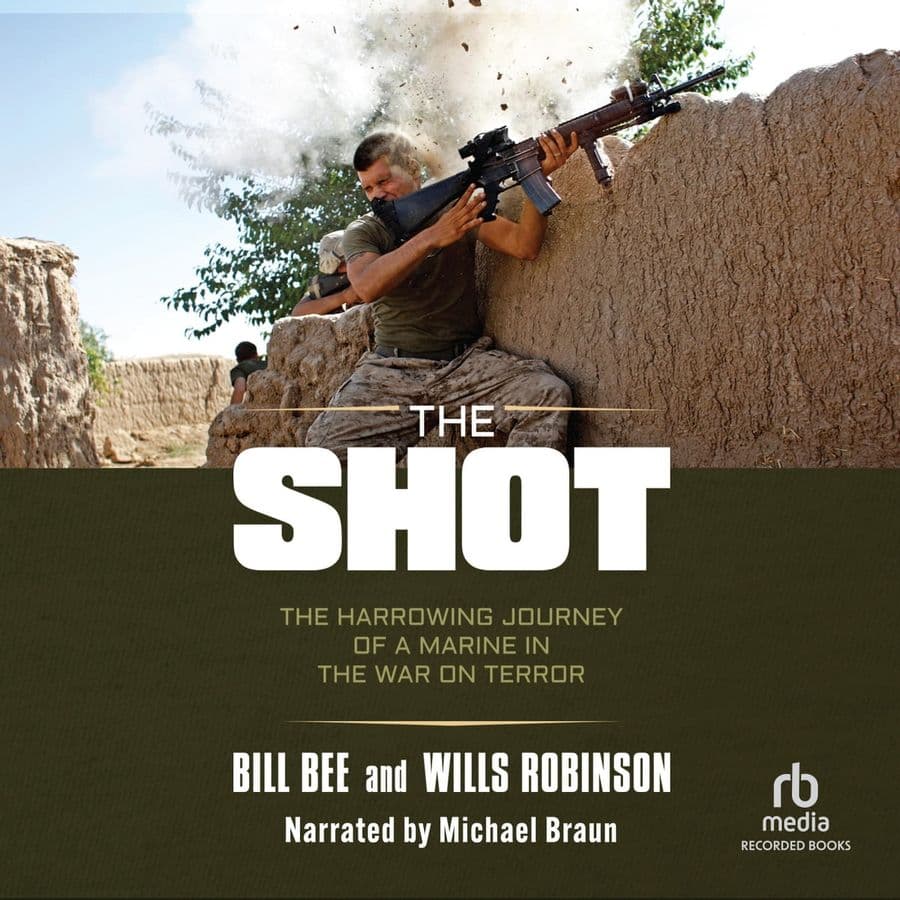
On May 18, 2008, while deployed to Garmser District in southwestern Afghanistan, Bee narrowly escaped death when a marksman’s bullet smashed into a dried mudbank inches from his head. Reuters photographer Goran Tomasevic first captured the moment on camera, and then checked to make sure Bee was alive. “Where is the blood,” Tomasevic said later. “The bleeding? And I look around and there is nothing, man, no bleeding." The shot left Bee briefly unconscious, but the photograph soon appeared on television and media around the world.
Bee’s new memoir The Shot (Knox Press, 2022) recounts this story and many others from a career cut short by wounds sustained in the final days of his 2010 deployment to Marjah. After suffering multiple traumatic brain injuries and receiving diagnoses of post-traumatic stress disorder and depression, Bee returned home to Jacksonville, North Carolina to raise his family. What follows is a lightly edited transcript of our conversation about Afghanistan, friends, and the “sixth sense” of combat.
“We wore our Kevlar, flak jacket, and helmet everywhere. Sometimes we even slept in them,” you write. Ironically, the picture that adorns the cover of The Shot is you dressed in only a skivvy shirt with your M-16, receiving fire from the enemy. Tell me about the photo that made you famous.
Kind of funny. That’s one of those things that didn’t translate so well in the book. One of those things that must have gotten lost in translation. We did have the high-speed plate carrier at the time, but our command didn’t allow us to wear the thing when we walked outside our compound in Garmser. We had to wear the heavy flak jacket and the rest of that gear. So, basically, we lived inside the compounds—if you’re inside the walls, nobody cares what you’re wearing.
But as soon as that shit goes down, I’m rushing to the wall slick. When the picture came out, the company commander didn’t really have an issue with it. My battalion commander thought it was hilarious and laughed and supposedly got chewed out by the Commandant when he saw the photo. My battalion commander was then-Lieutenant Colonel Anthony Henderson, probably the best commander I ever worked for in combat. He was a PT god. Spartan mentality. Hated being stuck inside the command operations center and was always out with the line platoons. We just flat-out liked the guy. When my son was born—about a month after that photo was taken—Henderson printed out some pictures my wife had sent and brought those out to our company position, which was maybe two or three miles outside the FOB. He brought those pictures out and it really sealed the deal for me. Our next battalion commander was the polar opposite.
Both of those commanders have made general, is that right?
That’s right.
But that gear was ridiculous. Gear saved lives but its size and weight were ridiculous given the conditions. “I went from 160 pounds to around 250 pounds,” you write about the weight of everything you carried in temperatures well over 100 degrees. Explain how it felt to walk a patrol in southern Afghanistan.
I’ll give you a story from the day we did the actual assault on Garmser in 2008. Word on the street was that one of our other companies had fucked up so badly at the start of the operation that we had to hike three or four klicks to secure their LZ before carrying on with our mission. We knew there would be no logistics resupply during the mission. No vehicles to carry our shit. It was just everything you could fit into a main pack and carry on your back. So, we start off early in the morning on foot to secure this LZ. It wasn’t long before our war correspondent had to call in a casevac for himself because he couldn’t keep up.
My squad has point for the company. We take contact. Crack—crack. Contact front. It was the first time in my life I had ever done a no-shit immediate action drill. As we all hit the deck, I hear the guy behind me say “Oh, thank God!” I look back and watch him just face plant into the dirt. The guy was so happy just to fall over, hit the prone, and get rest for a few seconds.
The heat was insane. Marjah was hot but Garmser was hotter and more humid. 115 and 120 degrees during the day. There were days it was too damn hot to patrol. You would just lay there for hours, sweating. The heat tortured us and took getting used to. We could not stand sitting in those compounds like ovens and baking all day. I came back from Garmser about 20 pounds lighter than when I left.
Do you believe in karma?
I believe in karma more than anything else. Good shit happens to good people and bad shit happens to bad people.
“The hairs started standing up on the back of my neck because something wasn’t right,” you write of one patrol. It might not be karma, but there’s some special knowledge or anticipation that you developed fighting the enemy. Is there a sixth sense of combat?
I think there is a 100 percent subconscious thing about knowing combat. You learn things through experience that you’re not cognitively aware of during the actual patrol or firefight. The perfect example is turning down a street and getting that tingly feeling. Ten minutes ago you were surrounded by kids and now everything has cleared out. You might not know you’re going to get jumped, but your curiosity is piqued. There’s a heightened awareness or a sense of dread.
At what stage in your career did you develop this “heightened awareness?”
I got it in Kabul. In that case it was my second deployment. My first deployment we didn’t do much urban but on my second tour we were at the embassy in Kabul and it was the first time I was ever surrounded by high-rises and unknown buildings packed together. Half that city had been destroyed by the opening salvoes. Buildings were beaten up. That was the first time I had ever led patrols before, too. Small patrols at first but they built up and you started getting the sense that people were watching, you started noticing when your stomach turned. That was a subconscious thing. My body was learning things my mind hadn’t processed, and I don’t know if it saved my life but it definitely gave me a head’s up on things I otherwise would have missed.
Sometimes it’s not enough, though.
You’re thinking about the IED explosion that killed two men in your patrol and caused the wounds that ended your career. You made a decision to enter a compound without sweeping for IEDs, right?
Yeah. I wish that the feeling had been a little stronger on my last patrol when my squad got hit by the IEDs that killed Shanfield and Walters. I remember looking at Gonzales’s back as I followed him into the compound, staring at the metal detector and thinking that it was stupid not to have him sweep the building before clearing it. But I had made a decision to kind of give up security for speed on that patrol. I thought we were close enough to our base. We were going to stop into that building, watch the gas station for 5 minutes, and then return to base. It’s one of those things you “what if” for the rest of your life. I don’t lose sleep about any of the artillery calls I made, or any of the times I pulled the trigger. I don’t lose any sleep over that stuff, but it’s the decision not to sweep the compound that wakes me up at night.
Do you regret enlisting in the Marines and going to combat?
No. I don’t regret it all. It was the best of times and the worst of times, you know? Up until last year, I thought that everything I did over there had made a difference. In 2001, there was not a single female walking around without a burqa. By 2008, you saw a few women without burqas and then even more in 2010. This was progress that we saw and that meant something. But serving in combat gave me fulfillment. All those workups. All the training. You go to deploy and you see everything you worked for come to reality. That was an awesome feeling.
But you lost friends?
Yes.
There are two times in the book where you write candidly about holding a Marine’s hand as he dies.
Both were headshots. Both got criked. Most people call it a tracheotomy though it’s not. They cut a hole in the throat to get an airway. It was heartbreaking being with them. Both of these guys had horrible head wounds. There are cases of guys making it through that kind of thing but it doesn’t happen often. No matter how strong they are or what they’ve done before, you can’t do anything for them. I felt helpless. They have to go through that all on their own. I’d seen a few bodies but none of the locals or the enemies killed hurt me. The mental image of the Marines never goes away and it pops into my head sometimes. The corpsmen were doing their best, and I was just sitting there with nothing to do, and so I held their hands and talked to them. It was all I could do.
You served with Rob Richards. He was a scout sniper on your Marjah deployment, where he suffered grievous shrapnel wounds to his legs, back, left arm, and throat. He died in 2014 as a result of an accidental overdose of prescription medications. You say that Richards should be known as one of the most skilled and deadly scout snipers to have served in the Marine Corps. What was so unique about Rob Richards?
His mentality was unique. When a class of Marines graduates from the School of Infantry, the battalion sends over a bunch of noncommissioned officers to be assholes and take ownership of the new boot infantrymen. I remember Richards’ boot drop. I was his platoon sergeant in Alpha Company and I remember him coming up and asking me if I thought he should do the STA indoctrination. I told him not doing the indoc was one of my biggest regrets, and so I encouraged him to go. Later, in Marjah, when we did the feint down south by Fiddler’s Green, I finally got to work with Richards and his sniper team. They were great. There was one occasion where my patrol got lit up in an L-shaped ambush. I remember Richards climbed up onto a rooftop and got out his long gun. He was just laughing up there. He went ham on that long gun and covered our asses.
I remember the night he got hit and took a nut through the throat, too. Like, a 5/16ths kind of nut. When I was going through Landstuhl with my own injuries, Rob was there. He was in horrific shape. Somehow, like nine months later, he was healing up and had transferred to 3/2 to deploy again to combat. Taking a nut through the throat is God’s way of telling you to slow down but Richards basically said “fuck that.” He had a great family life. His wife, his mom, everybody was great and wanted him back but Richards wanted to be out there with the guys. He was like the rest of us, you know. We all drank and self-medicated that way to do what we had to do. The best way to put it would be to call him a warrior. He did things few other people have done and that’s how he should be remembered.
How did your experiences in war change you?
I was a band geek and bible thumper when I joined, but my outlook on life is now a lot darker than it probably would have been otherwise. Besides the brain injuries and physical injuries, I would say my outlook on life has changed dramatically from when I was a kid growing up in Ohio. On the other hand, I’m still a reader. I was deep into science fiction. “Dude, what the fuck are you reading now?” That’s what my guys would say. Wheel of Time is my favorite, 100 percent. I jacked that one off the shelf of the ship’s library and carried it with me in my pack for the entire tour and read it maybe a dozen times. Yeah, my guys always gave me mad shit for my reading. That part of me never changed.
John Waters is a writer in Nebraska.

Putin, Plague, and America’s Biodefense Gap
By Ryan Kane • RealClearDefense
From Hormuz to the South China Sea: Defending Freedom of Navigation in Contested Waters
By David F. Lasseter • RealClearDefense
Checklist for Modern Conflict Readiness
By Sergey E. Ivashchenko • RealClearDefense
AUTOWARCOM Is Heading for a Command-and-Control Collision
By Michael Carvelli • RealClearDefense
The Unfinished Reform
By Mark W. Castillon • RealClearDefense
From Hormuz to the South China Sea: Defending Freedom of Navigation in Contested Waters
By David F. Lasseter • RealClearDefense
National Guard Soldier Shot While Breaking Up Fight in Washington D.C.
By Military.com
‘No Marine Fights Alone’
By Gidget Fuentes, USNI News
Sea Services Weigh How to Embrace Autonomous, Attritable Tech
By Reeves, NatDef
Lockheed Delivers C-130J to Become Navy’s TACAMO Plane
By Stephen Losey, A&SF