
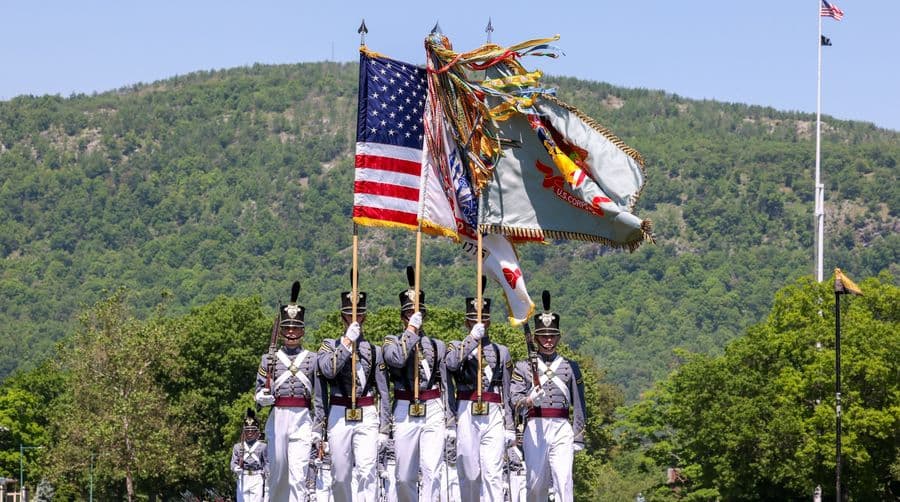
West Point's Class of 2025
Last updated 04:12 AM EDT • Read time: 5m
A Testament to Institutional Strength and Future Readiness
On Saturday, May 24, nearly 1,000 cadets will graduate from the United States Military Academy at West Point. They will raise their right hands, take the oath of office, and commission as second lieutenants in the United States Army. In doing so, they will join a lineage of service and sacrifice that stretches back over two centuries—but more importantly, they will mark the beginning of a chapter uniquely shaped by the times we live in and the demands of what lies ahead.
This is not a routine graduation. This is a moment that calls attention to the enduring strength of the institution and the character of those who choose to lead at its edge. The Class of 2025 is more than a milestone. It’s a signal. A signal that West Point continues to evolve—quietly, deliberately, and with purpose—to meet the future of warfare, leadership, and national service.
I’ve observed this class closely over the past four years. As a West Point graduate, a combat veteran, and someone who remains deeply engaged with the Academy, I’ve seen firsthand the strength, intelligence, and moral clarity this group brings to the profession of arms. Their class motto— “Together We Thrive”—is not just a slogan. It’s been lived out in how they’ve trained, struggled, and grown together through one of the most dynamic periods in recent memory.
Anchored in Constitutional Leadership
At a time when civil-military relations are under constant scrutiny, West Point has doubled down on its foundation: developing leaders who are loyal to the Constitution, not to any political party or ideology. Every member of this class has taken that oath—first as new cadets, and again as graduates—and it remains the bedrock of their training.
Through programs like the Oath Project, and coursework that bridges political science, law, and ethical reasoning, cadets learn the legal and moral weight of their commission. They are taught to lead with independence of thought, responsibility to civilian control, and fidelity to lawful authority. That kind of training matters more now than ever.
A Modern Military Education That Delivers
Since my time in the 1980s, West Point’s academic rigor has transformed. Through donor-funded initiatives, cadets now access summer programs placing them in cutting-edge research labs, policy think tanks, and Army commands. At this spring’s Projects Day, I saw cadets prototyping field-ready systems and collaborating with Pentagon sponsors—work that’s already shaping the Army’s future. The results speak for themselves: more graduate scholars, Fulbrights, and Rhodes Scholars ready to lead strategically.
A Class Forged Under Pressure
This class arrived in the summer of 2021, still under COVID protocols and in the aftermath of America’s withdrawal from Afghanistan. They trained while the world shifted around them—through war in Ukraine, rising tensions in the Pacific, and a shifting cultural and political climate at home.
And yet, the Class of 2025 didn’t flinch. They embraced the mission. They navigated a tough curriculum, physical rigor, and the emotional demands of 47-month leadership development. They learned how to lead teams through adversity, to build trust across differences, and to focus on the mission above all else.
Some headlines may try to portray cadets today as somehow softer or politically distracted. From what I’ve seen, the opposite is true. They are focused, purposeful, and ready. In a moment when institutional confidence is waning in much of American life, these cadets still believe in duty, service, and sacrifice—and they’re acting on it.
Positioned at the Bottom of a Historical Cycle
It’s not lost on me that the Class of 2025 is graduating at a strategic inflection point—one that feels eerily familiar. When I graduated in the early 1980s, the military was still recovering from Vietnam, facing internal skepticism, and preparing for whatever came next. Few saw Panama, Desert Storm, or the Balkans coming—but we were ready when called.
Today’s new officers are entering a similar moment. The DOD budget is rising again, set to exceed $1 trillion. Strategic competition is intensifying. The U.S. is reevaluating its force posture, doctrine, and technological edge. This class is stepping into a military that is rebuilding for a new era, and they’re well-positioned to be the junior leaders who will help shape its trajectory.
They are ready for the next fight—whatever form it takes.
Leadership That Starts with Cohesion
One of the most important lessons this class embodies is that unity matters more than uniformity. At a time when national discourse often emphasizes difference and division, West Point has stayed focused on building teams. Cadets are trained to lead across lines of race, gender, politics, and background—not by avoiding difficult conversations, but by embracing shared values and common goals.
Leadership, especially in the military, is about earning trust under pressure. This class has done that—day after day, through rain and heat, on the field and in the classroom, in the barracks and in the brigade. Together We Thrive wasn’t just a motto—it became a lived experience, and it will serve them well in the Army they’re about to join.
A Reason to Be Inspired
There’s no question West Point is evolving. But that evolution is grounded in purpose. It produces officers who are academically strong, morally grounded, and operationally ready. It is producing leaders who are not afraid to ask hard questions, but who are equally unafraid to lead in hard places.
This weekend’s graduation is more than a ceremony. It’s a reminder that even in a time of uncertainty, institutions like West Point continue to deliver on their promise. The Class of 2025 stands as proof that our Army—and our nation—still has reason to be confident in the future.
They walk off the Plain this Saturday carrying more than a diploma and a commission. As these lieutenants step into service, they remind us all that investing in principled, prepared leaders is the surest way to secure our nation’s future.
Mike Lyons is a 1983 graduate of the “Proud to be” class of 1983 by way of New City, NY.
This document reflects only the opinion of the author and not the United States Military academy, the Association of Graduates, or the Department of the Army.

The Unfinished Reform
By Mark W. Castillon • RealClearDefense
Winning the Data Advantage
By Turin Pollard • RealClearDefense
The Pentagon’s Quantum Race Needs a Warfighter’s Scorecard
By Burak Oktenli • RealClearDefense
The F/A-XX and the AIM-260 Reclaim the Perimeter
By Bruce Allen Lubbering • RealClearDefense
Iranian Cyber Operations
By Michael Groen • RealClearDefense
Winning the Data Advantage
By Turin Pollard • RealClearDefenseThe F/A-XX and the AIM-260 Reclaim the Perimeter
By Bruce Allen Lubbering • RealClearDefenseWinning the Data Advantage
By Turin Pollard, RealClearDefenseThe F/A-XX and the AIM-260 Reclaim the Perimeter
By Bruce Allen Lubbering, RCD
F-22 Pilot Directs CCA in Flight as ‘Airborne QB’
By Stephen Losey, Air & Space Forces