
Afghanistan in 2018: When Policy Outran Strategy
Last updated 06:09 AM EDT • Read time: 8m
Afghanistan exposed a gap between immediate military pressure and the smaller long-term U.S. presence envisioned by national strategy. Seventeen years into the war, U.S. defense priorities were shifting toward competition with China and Russia. At the same time, the Trump administration sought greater pressure on the Taliban while pushing Afghan forces to assume more of the fighting. U.S. and coalition forces sustained that effort through advisers, enabling units, intelligence, counterterrorism operations, infrastructure, and other support. National guidance demanded two things at once: intensify the campaign and move toward a more sustainable posture. The strategy never defined how greater military pressure would reduce future U.S. military requirements or establish the conditions for a smaller enduring presence.
Competing Policy Goals
United States policy regarding Afghanistan in 2018 combined greater military pressure with a long-term goal of reducing resource demands. The 2018 National Defense Strategy made long-term competition with China and Russia a central defense priority and directed the Department of Defense to consolidate gains in Afghanistan and move toward a resource-sustainable approach. President Trump’s South Asia Strategy used a conditions-based approach, expanded commanders’ authority, increased pressure on the Taliban, placed greater responsibility on Afghan forces, and added roughly 3,500 U.S. troops along with more advisers and support forces. Military strategy had to reconcile increased near-term pressure with a smaller long-term commitment.
Events during the summer of 2018 reinforced burden sharing and suggested that military pressure might create room for negotiations. President Trump’s remarks at the NATO summit focused on alliance defense spending and asked allies to carry more of the security burden without setting an Afghanistan withdrawal timeline or changing the force posture. Taliban leaders agreed to a brief ceasefire for Eid during the same summer. Images of Taliban fighters posing for photographs with Afghan soldiers showed both sides temporarily stopping combat before the ceasefire ended and attacks resumed. The episode supported the administration’s view that military pressure might create space for a political settlement.
Four Missions, One War
Afghanistan supported several overlapping U.S. and coalition missions in 2018. Each mission served a different purpose and created its own demand for forces, bases, aircraft, intelligence, and support. Military leaders had to sustain these missions as national policy called for a smaller long-term commitment. Four efforts show why reducing the U.S. footprint required more than cutting troop numbers.
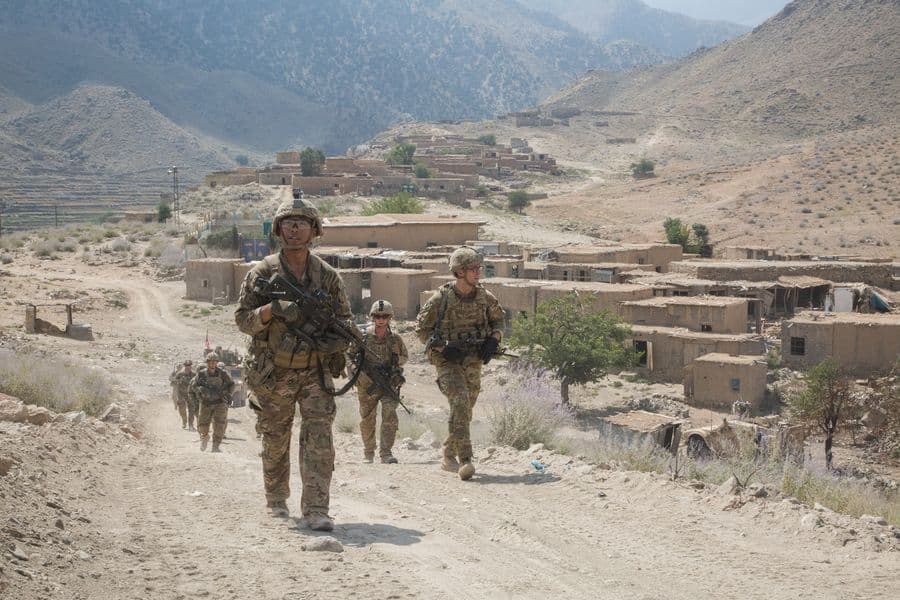
First, NATO’s Resolute Support mission created a large advisory requirement across Afghanistan. NATO and U.S. forces advised the Ministries of Defense and Interior and other national security institutions, as well as senior army and police commands and Afghan corps. Under the South Asia Strategy, advisers increasingly worked below the corps level with brigades, kandaks, and police districts. Supporting this dispersed advisory network required personnel, transportation, security, communications, aviation, and other enablers across the country. Resolute Support therefore tied the advisory mission to a wider network of forces and infrastructure.
Second, Afghanistan became a proving ground for the U.S. Army’s new advisory force structure. The Army deployed the 1st Security Force Assistance Brigade (SFAB) in March 2018 on the first operational deployment of the new SFAB concept. The Army designed SFABs as permanent formations dedicated to security force assistance, reducing reliance on conventional brigade combat teams for advisory missions. The Afghanistan deployment allowed the Army to validate the concept under combat conditions and apply those lessons as additional SFABs were formed. The brigade entered a theater already supporting two complementary missions under Operation Freedom’s Sentinel: the U.S. counterterrorism mission and U.S. participation in NATO’s Resolute Support mission.
Third, counterterrorism created another reason to retain U.S. forces and support capabilities in Afghanistan. U.S. special operations and conventional forces fought Islamic State-Khorasan under U.S. authorities separate from NATO’s advisory mission. General John Nicholson described U.S. counterterrorism forces as focused on terrorist groups that threatened the United States and its interests. Counterterrorism also required intelligence, aviation, protected bases, and supporting forces as leaders worked to reduce the broader U.S. commitment.
Fourth, Afghanistan provided regional intelligence access that extended beyond the war. Earlier reporting documented U.S. use of Afghanistan as an intelligence collection platform, including facilities supporting drone operations into Pakistan and surveillance flights over Iran. Afghan bases and airfields gave U.S. agencies access to a region that included Iran, Pakistan, and China. Reducing the U.S. footprint required leaders to accept some loss of regional access and intelligence capacity. Together, the four missions created separate demands for forces and infrastructure as leaders sought a smaller long-term U.S. commitment. Each also depended on different conditions for reducing U.S. involvement. Advising depended on Afghan capacity, counterterrorism on the terrorist threat, and regional access on broader U.S. interests. A smaller posture required leaders to establish priorities among missions and determine which risks the United States was willing to accept as forces and capabilities declined.
Expansion Without Transition
The South Asia Strategy expanded the U.S. footprint as national defense guidance called for a more sustainable commitment. The Pentagon increased troops, equipment, offensive strikes, and tactical advising, bringing the U.S. force to roughly 14,000 by the end of 2017. Force accounting had already obscured the size of the commitment because the Pentagon acknowledged that earlier reporting listed about 8,400 troops when the number on the ground was closer to 11,000. Camp Dahlke West showed the physical growth in 2018, expanding to support more than 800 advisers, contractors, and support personnel near a former base transferred during the 2014 reduction in U.S. forces. Near-term expansion supported the South Asia Strategy, but a sustainable posture required conditions for reversing that expansion. Leaders needed to determine when advisers could consolidate, which supporting capabilities Afghan forces could assume, and what operational risk the United States would accept as forces, aircraft, and infrastructure declined.
Expansion also created support requirements far beyond the number of advisers deployed. The 1st SFAB deployment strained the Army’s ability to provide sufficient enabling forces for the mission. Air Force leaders moved additional aircraft and Airmen to Kandahar in January 2018 to provide close air support, personnel recovery, intelligence, surveillance, and reconnaissance for the expanded advisory effort. A strategy that increased pressure in the near term also needed clear conditions for reducing those supporting forces, aircraft, and bases over time.
Regional missions gave U.S. leaders additional reasons to preserve access and infrastructure. Afghan bases supported the ability to launch drones and stage long-range raids such as the 2011 operation against Osama bin Laden that departed from Jalalabad. Operations against ISIS-K also depended on airpower, intelligence, and protected bases inside Afghanistan. Each mission gave leaders a reason to retain capabilities, which made a smaller overall footprint harder to achieve without clear priorities and accepted risk.
Repeated changes in U.S. force levels made long-term posture planning harder. Bush administration leaders shifted resources toward Iraq before the 2003 invasion, and the Obama administration later ordered a major troop surge in Afghanistan. U.S. forces then began a major drawdown before the Trump administration reversed the trend under the South Asia Strategy. Camp Dahlke expanded only four years after U.S. forces had spent significant effort closing or transferring bases. Repeated shifts in force levels consumed resources and made rapid changes in posture harder to execute.
Later events show how U.S. policy moved from a conditions-based commitment toward a defined withdrawal. Trump’s earlier political promises increased pressure for an eventual exit, even as the South Asia Strategy tied the U.S. commitment to conditions in 2018. Direct U.S.-Taliban negotiations accelerated in 2019, and the Doha agreement established a withdrawal timetable in February 2020. Later drawdowns reduced the force through 2020 and early 2021 before the final U.S. departure in August 2021. Events after 2018 reinforce the central gap: the 2018 strategy did not define how expanded military operations would transition to a smaller U.S. force.
Conclusion
Afghanistan in 2018 exposed a gap between national policy and the military strategy needed to carry out both goals. National guidance called for greater pressure on the Taliban and a more sustainable long-term commitment. Military leaders expanded advising, support forces, airpower, and infrastructure without defining how those efforts would lead to a smaller enduring U.S. posture. Later negotiations, the Doha agreement, and the 2021 withdrawal showed how quickly policy changed once leaders established a defined path toward withdrawal. Long wars require a transition strategy that connects military pressure to changes in missions, forces, infrastructure, and accepted risk as the campaign moves toward its intended political outcome.
Matt Russell is a retired Army infantry officer and strategist. Currently, he is the co-founder and managing partner of Attain Leadership Solutions, LLC, a consulting firm focused on strategy, leadership, and team performance.
Michael Carvelli is an Army officer who writes on strategy, operational planning, protection, and engineering. He has written on large-scale combat operations for Real Clear Defense, War on the Rocks, Parameters, Modern War Institute, and Small Wars Journal.
The views expressed are his own and do not represent those of the U.S. Army, the Department of Defense, or any part of the U.S. government.

In Pursuit of Nuclear Abolition
By Peter Huessy • RealClearDefense
Innovation Alone Won’t Prepare the U.S. for the Future Battlefield
By Joshua Segal • RealClearDefense
The sUAS Tactical Trifecta
By Bryan T. Woody • RealClearDefense
The Revolutionary War: When Strategic Options Share the Same Weakness
By Henry Yep • RealClearDefense
The Houthis Are Testing the Limits of Collective Defense
By Saima Afzal • RealClearDefense

Who Shoots Down the Drone Over the Shipyard?
By John Ferrari & Dillon Prochnicki • RealClearDefense
Northrop Grumman Breaks Out the Big Guns at AUSA
By Daniel Terrill, Defense News
Army Pursuing Diverse Array of New Anti-Air Interceptors
By Trevithick, The WarZoneWho Shoots Down the Drone Over the Shipyard?
By John Ferrari & Dillon Prochnicki, RCD
F-35C Lands for the First Time on a Ford-Class Aircraft Carrier
By The Aviationist