
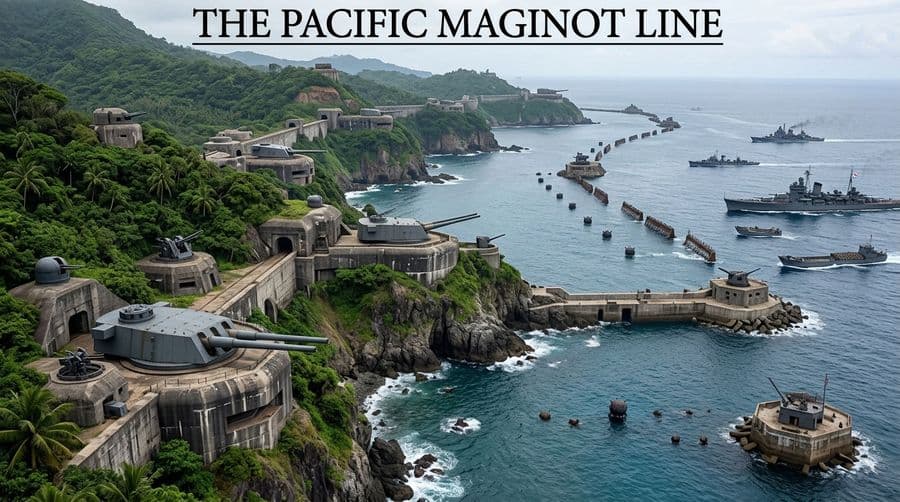
The Pacific's Maginot Line
Last updated 06:15 AM EDT • Read time: 4m
How China Outflanked Western Strategy
In the spring of 1940, the French military discovered that its multi-billion-franc investment in the Maginot Line was entirely useless. The concrete fortresses and heavy artillery were formidable, but the planning rested on an outdated premise. The German army saw no tactical need to assault the fortification; it simply went through the Ardennes and around it.
Western defense planners are now repeating that exact mistake in the Pacific.
Consider the recent study from the United States Studies Centre (USSC) at the University of Sydney, Australia, Japan, and the United States: Implementing a trilateral denial strategy along the First Island Chain. The report is a capable piece of operational planning. It details how Canberra, Tokyo, and Washington should integrate coastal missiles, disperse air power, and align command structures to deter Beijing along the archipelagic rim stretching from Japan to the Philippines. That baseline security matters. No serious strategist ignores the danger of a clash in the Taiwan Strait or the South China Sea.
Yet this mindset confuses an operational buffer with the wider theater of competition.
The warning is not entirely foreign to military circles. Strategic thinkers have periodically noted the risk of turning the First Island Chain into a Pacific "Maginot Line," cautioning that fixed island batteries and shallow airfields could be neutralized early by Chinese missile barrages. But while naval theorists spent years debating whether Beijing could punch through those choke points militarily, China took a much simpler route. It did not waste energy assaulting the second chain around Guam. Instead, it boarded commercial container ships, signed bilateral financing deals, and established itself on the opposite side of the ocean.
That front is Latin America: the strategic rear of the Pacific basin.
While allied forces run denial drills in the Philippine Sea, Beijing has quietly settled into South America’s Pacific coast. In Peru, the Chinese-built port of Chancay will soon route mineral and agricultural exports straight to Shanghai, bypassing North American shipping lanes altogether. In Argentina’s Patagonia, China runs a deep-space station operated by personnel linked to its military space program. In the Southern Cone, Beijing has already dislodged Washington as the top trading partner for Brazil, Chile, and Peru.
The diplomatic erosion tells the same story. Beijing has methodically picked off Taiwan’s former partners: Panama, the Dominican Republic, El Salvador, and Honduras. In doing so, it has secured logistical footholds near the Panama Canal and locked down long-term supply lines for the lithium and copper essential to Western industry.
Fortifying the First Island Chain is a sensible precaution, but a shield accomplishes little when your opponent is already behind you. Military deterrence turns into an expensive distraction if China controls the ports, builds the power grids, and dictates the regional trade routes.
This blindness is particularly visible in Australia. Canberra is committing hundreds of billions to nuclear-powered submarines under AUKUS, its trilateral defense pact with the United States and the United Kingdom, while treating Latin America as an irrelevant periphery. It closed down its regional aid program a decade ago and maintains only seven embassies across the entire continent. Canberra effectively relies on Japan to carry the load alone. Tokyo has done the heavy lifting through the Comprehensive and Progressive Agreement for Trans-Pacific Partnership (CPTPP), the high-standard trade pact linking Pacific economies, and its bilateral economic agreements with Mexico, Chile, and Peru, while Australia looks the other way.
If Canberra and Washington want a genuine Free and Open Indo-Pacific, they need to recognize that the Pacific does not end at Guam. Allied missile drills are standard operational work, but the real balance of power is shifting on the other coast. Unless Western capitals deploy serious economic diplomacy and engage Latin America directly, the First Island Chain will end up just like the French bunkers of 1940: an impressive display of tactical defense guarding against an opponent that arrived from the rear.
Efraín Vázquez-Vera is Full Professor at the University of Puerto Rico. A graduate of the Diplomatic School of the Ministry of Foreign Affairs and Cooperation of Spain, he holds a Doctorate and a Master's degree in International Relations from the Universidad Complutense de Madrid. He previously served as Chancellor of the University of Puerto Rico.