
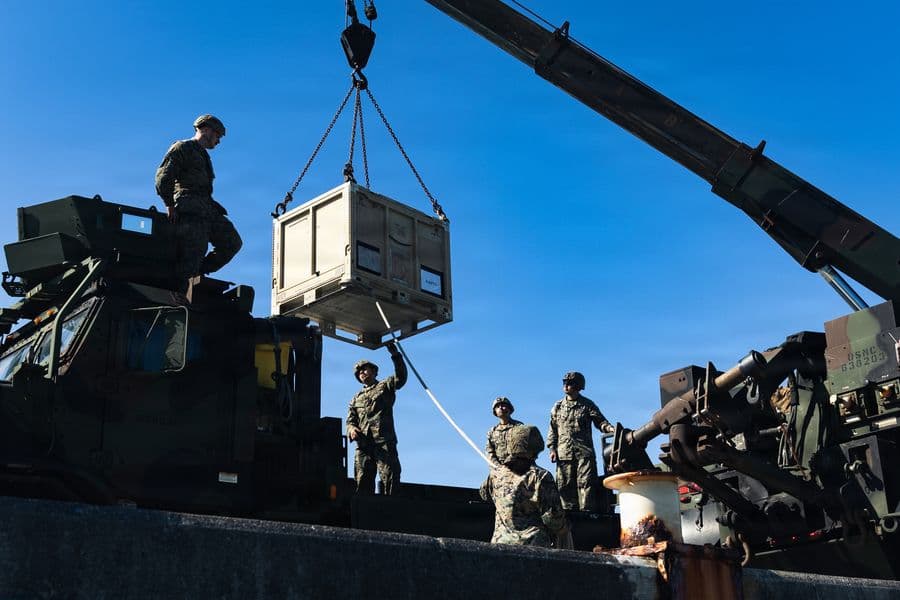
The Achilles' Heel of Force Design 2030
Last updated 06:25 AM EST • Read time: 7m
Why Logistics Must Lead the Marine Corps’ Maritime Strategy
As the United States shifts its defense posture toward the Asia-Pacific, the Marine Corps faces a crucial decision. Force Design 2030 seeks to bring about a significant transformation, aiming to keep the Corps relevant amid great power competition, especially against peer rivals like China.[i] However, beneath the surface of innovative ideas, stand-in forces, distributed operations, and advanced platforms, there is a constant and often overlooked weakness: logistics.
The Strategic Context: Why Logistics Matters More Than Ever
The Indo-Pacific region features vast distances, limited infrastructure, and restrictions on basing due to political reasons.[ii] The era of unrestricted access to secure ports and airfields has come to an end. The Marine Corps now must operate ahead of fixed bases, often at the edge of contested areas, where the ability to sustain forces is just as vital as projecting power.
China’s military modernization, especially its navy, has become the primary focus of U.S. defense planning.[iii] With anti-access/area-denial (A2/AD) systems, long-range missiles, and an expanding fleet, China can threaten U.S. logistical hubs and supply routes, making traditional hub-and-spoke strategies less sustainable.
Force Design 2030: Ambition Meets Reality
Force Design 2030 aims to reshape the Marine Corps for competition and conflict with peer adversaries. It introduces stand-in forces (SIF), small, lethal, mobile units designed to operate inside contested areas, disrupt enemy plans, and enable quick responses. The idea is solid, but its success depends on maintaining these forces across all domains.
Wargames and exercises consistently show that the Marine Corps’ logistics enterprise is “not yet organized, trained, or equipped” to sustain expeditionary forces as envisioned.[iv] The transition from a force optimized for sustained operations ashore to one capable of supporting maritime and littoral operations remains incomplete.
The Tyranny of Distance and the Limits of Amphibious Lift
The geography of the Asia-Pacific presents significant logistical challenges. Guam, considered “forward," remains 1,500 nautical miles from Manila and 3,000 from Jakarta.[v] The ability to move, exercise, train, and fight from these locations depends on overcoming the tyranny of distance.
More amphibious ships are often seen as the solution, but budget limitations make large-scale expansion unlikely for decades. The current fleet—Marine Expeditionary Units (MEU) and Amphibious Ready Groups (ARG)—is stretched thin, with little capacity for additional forward presence. Other platforms must step in, but integration and sustainment still face challenges.
Vulnerabilities in the Current Logistical System
The Defense Logistics Agency (DLA) moves billions of pounds of cargo each year, depending on centralized regional hubs. These hubs, with publicly known locations, are easy targets for enemies with precision strike weapons.[vi] The hub-and-spoke system's biggest weakness is its vulnerability in a conflict with China, which can attack and disrupt supply routes using ballistic and cruise missiles.
Historical examples, from Pearl Harbor to the Punic Wars, highlight that logistics, not tactics, often decide victory.[vii] The failure to defend or adjust supply lines can turn strategic advantages into serious vulnerabilities.
Asymmetric Logistics: A Doctrine for Survival
The plan promotes “asymmetric logistics”—a concept of contingency, mobility, and adaptation. Instead of depending on large, fixed hubs, the Marine Corps should build a network of small, quickly deployable logistical nodes. These nodes, set up in advance and operated by small teams, can move rapidly, making it harder for adversaries to target them.
This approach echoes the “island hopping” strategy of World War II, but with modern technology. Lightweight gear, autonomous vessels, and distributed inventory management can support sustained operations even in harsh environments. The aim is to transform the logistical system into a Hydra—cut off one head, and several more appear.
The Role of Platforms and Innovation
Innovative platforms such as Joint High-Speed Vessels (JHSV), Mobile Landing Platforms (MLP), and autonomous low-profile vessels (ALPV) offer new options for distributed logistics.[viii] These platforms can support selective offload, rapid resupply, and flexible basing, but they require doctrinal and organizational changes.
Exercises like Archipelago Endeavor 2022 showcase the potential of small, agile platforms, such as Swedish CB90s, hovercraft, and unmanned surface vessels, to quickly move people and equipment in contested littoral areas.[ix] The U.S. needs to learn from allies and incorporate these lessons into its own force planning.
Deterrence and Offense: Logistics as a Warfighting Tool
Asymmetric logistics is more than just about survival; it serves as a tool for both deterrence and offense. By making it harder for the enemy to target and increasing operational tempo, distributed logistics can help the Marine Corps get inside the enemy’s decision-making process.[x] Fast, adaptable resupply maintains pressure and maneuverability, transforming logistics into a force multiplier.
In a non-conflict environment, these capabilities also improve humanitarian aid, disaster relief, and allied cooperation. The infrastructure for quickly establishing and supplying austere environments becomes an asset for both war and peace.
Recommendations: What Must Change
- Institutionalize Asymmetric Logistics:
The Marine Corps must formally adopt asymmetric logistics as a contingency capability, preparing locations in advance, training small teams, and leveraging autonomous platforms. - Integrate Platforms and Doctrine:
Platforms like JHSV, MLP, and ALPV need to be incorporated into operational concepts, with exercises and experiments fostering innovation. - Invest in Survivable Connectors:
High-water-speed, survivable surface connectors are essential for future forcible entry operations. The Corps must maintain its decision-making timeline and invest in interim solutions as technology evolves. - Develop a Clear Roadmap:
The Marine Corps must outline how it will make amphibious assaults effective against peer powers, informing ship design and procurement decisions. - Leverage Allied Lessons:
Exercises with allies like Sweden provide valuable insights into distributed logistics and platform integration. The Corps should incorporate these lessons into their own doctrine.
Conclusion: Logistics as the Decisive Factor
Force Design 2030 is an ambitious vision, but its success relies on solving the logistical puzzle at the core of maritime strategy. The challenges of distance, the weakness of centralized hubs, and the limitations of amphibious lift are not just operational issues; they pose existential threats to the Marine Corps’ relevance in the Indo-Pacific.
By adopting asymmetric logistics, investing in innovative platforms, and learning from allies, the Marine Corps can transform its Achilles’ heel into a strength. In the words of General Omar Bradley, “Amateurs talk tactics; professionals talk logistics.”[xi] It is time for the Marine Corps to lead with logistics, ensuring that its forces are not just present but prepared to prevail in the contested waters of the 21st century.
James M. Deitch served as the Motor Transport Operations Chief for 6th Motor Transport Battalion, 1st Fleet Service Combat Support Group during Operation Desert Storm from 1990 to 1991. He served in the Marine Corps from 1984 to 1996.
Notes:
[i] U.S. Marine Corps, Force Design 2030 (Washington, DC: Department of the Navy, 2020), 1–2.
[ii] Charles McEnany, Contested Logistics in the Indo-Pacific: Joint Sustainment Through Positional Advantage (Arlington, VA: Association of the United States Army, July 2025), 2–3.
[iii] Andrew Feickert, U.S. Marine Corps Force Design Initiative: Background and Issues for Congress (Washington, DC: Congressional Research Service, October 3, 2024), 1–2.
[iv] U.S. Marine Corps, Installations and Logistics 2030 (Washington, DC: Department of the Navy, February 2023), 4–5.
[v] Ronald Ti, “Sustaining an Indo-Pacific Fight: The Contested Logistics Triad,” Modern War Institute, June 4, 2025.
[vi] Defense Logistics Agency, Supply Chain Security Strategy 2021–2026 (Washington, DC: DLA, 2021), 6–7.
[vii] Adam Reilly, “Beans before Bullets: Asymmetric Logistics as Deterrence and Offense in Near-Peer Competition,” Expeditions with MCUP, January 2025.
[viii] Naval Sea Systems Command, Expeditionary Fast Transport (EPF) (Washington, DC: NAVSEA, 2024).
[ix] Edward Lundquist, “Distributed Operations Require Small Platforms to Distribute Logistics,” National Defense Transportation Association Journal, October 23, 2023.
[x] Jason Wolff, “The Department of Defense’s Digital Logistics Are Under Attack,” Brookings Institution, July 2023.
[xi] Omar N. Bradley, quoted in Matthew B. Ridgway, Soldier: The Memoirs of Matthew B. Ridgway (New York: Harper, 1956), 108.

Innovation Alone Won’t Prepare the U.S. for the Future Battlefield
By Joshua Segal • RealClearDefenseThe sUAS Tactical Trifecta
By Bryan T. Woody • RealClearDefense
The Revolutionary War: When Strategic Options Share the Same Weakness
By Henry Yep • RealClearDefense
The Houthis Are Testing the Limits of Collective Defense
By Saima Afzal • RealClearDefense
Radio Frequencies in the Intelligence Ecosystem
By Craig Brower • RealClearDefense