
The Army's Concept Cannot Keep Pace With Strategy
Last updated 06:36 AM EDT • Read time: 11m
In March 2026, unauthorized drones approached Barksdale Air Force Base, forcing a lockdown at a strategic bomber installation. During the same period, Russian military aircraft probed Alaskan air space, requiring a major North American Aerospace Defense Command response. Now, more than ever, U.S. forces face potential threats to the homeland while conducting operations in the Middle East and elsewhere.
The 2026 National Defense Strategy made homeland defense the Defense Department’s top priority and placed deterring China second. The Army’s primary operating concept, however, has not changed since 2018. Multi-Domain Operations (MDO), now embedded in doctrine, remains the Army’s operating framework and continues to shape force design, modernization, training, and operational planning even as strategic priorities shift and the conflict with Iran tests existing capabilities.
MDO addresses persistent observation, long-range strikes, degraded communications, contested logistics, and attacks emanating from multiple domains. These ideas reflect some of what is happening in the Russia-Ukraine war and the conflict with Iran. Its weakness lies in the assumption that the U.S. can project force into forward theaters and employ MDO concepts. As adversaries develop hypersonic missiles, cyber capabilities, and other weapons, they gain more ability to reach into the U.S. homeland and frustrate force projection.
Homeland defense is a thorny problem on the strategic, operational, and tactical fronts. The Army must preserve military power, protect critical infrastructure, and sustain operations when U.S. territory becomes the supported theater. Although the Army's capstone operations field manual contains a homeland defense annex, there is no complete operating concept for operating in and projecting power from the homeland.
The strategic shift exposes a widening gap. The Army needs a holistic framework for sustained operations. It must simultaneously defend the homeland, project forces, and conduct combat operations in a forward theater while under constant observation and threat of attack.
A Strategic Shift
When the 2018 National Defense Strategy identified long-term competition with China and Russia as the principal challenge the Army developed MDO in response. Both adversaries would require U.S. forces to penetrate anti-access and area-denial systems and enable the joint force to maneuver. MDO provided direction for force design, doctrine, and modernization.
MDO remains the Army’s primary framework even though the strategic problem that produced it no longer leads national defense priorities. Either because of the Army’s inability to rapidly adjust its concepts to strategic priorities or a belief that MDO remained adequate for the new strategy, the Army remains ill-postured to operate in a contested homeland. MDO does not propose to solve all the strategic problems the Army may face. MDO proposes to solve only narrowly defined operational and tactical problems when conducting offensive operations against certain adversaries. To meet the nation’s strategic objectives, the Army needs a concept that addresses the full scope of missions it might undertake and stop assuming that because the homeland was a sanctuary in the past it will always be so in the future.
The Homeland as an Operational Area
In 2026, the homeland is no longer a sanctuary. Strategic installations, transportation networks, communications systems, and critical infrastructure face persistent pressure from drones, aircraft, cyber actors, and long-range weapons. The Army must account for those threats while continuing to generate forces for operations abroad.
The drone incursions at Barksdale exposed the vulnerability of strategic installations to low-cost systems. Barksdale supports the B-52 bomber mission, yet repeated drone activity forced local leaders to restrict movement and request added capability. A small system disrupted a strategic base and created demands for authorities, sensors, and weapons that may not exist at the installation level.
Russian military aircraft penetrating Alaskan airspace created a different problem. U.S. forces committed aircraft, crews, fuel, and command-and-control capacity while simultaneously supporting combat operations abroad. The event showed how homeland defense and overseas operations compete for the same high-demand resources.
Cyber access to American infrastructure adds another layer. Foreign actors have targeted operational technology in power generation, water treatment, transportation, and other domestic sectors. The Army depends on many of those systems but does not own or control them. A sustained campaign against the homeland would force military commanders to operate through damaged civilian networks, divided authorities, and incomplete information.
Barksdale, Alaska, and foreign cyber activity reveal a common operational reality: the joint force must defend the homeland while continuing operations abroad. The existing Army concept addresses contested deployment and attacks on support networks, but it does not provide a complete framework for simultaneous domestic and foreign operations.
Where Multi-Domain Operations Stops
Multi-Domain Operations addresses many conditions that would shape a conflict in the homeland. It accounts for persistent observation, long-range strikes, degraded communications, contested logistics, dispersed formations, and attacks across multiple domains. Homeland defense requires the Army to preserve military power, protect critical infrastructure, and sustain movement while operating inside the United States. Operationally, MDO focuses on creating advantages over the enemy in contested forward theaters without the restrictions that are inherent in homeland operations.
Operating in the U.S. homeland creates command and authority problems that do not exist in the same form overseas. Active-duty forces, National Guard units, federal agencies, state governments, local authorities, and private infrastructure owners may all operate in the same area under different legal authorities. Military commanders may depend on civilian systems they neither own nor control. Federal, state, and local officials will likely have different priorities for using a finite resource pool, including Army forces. A concept for homeland operations must explain how those relationships function before communications fail and infrastructure begins to break down.
The Legal Architecture Problem
Domestic military authority is divided by mission, force status, location, and agency. Title 10 active-duty forces and Title 32 National Guard forces operate under separate chains of command. Each chain requires different approvals, follows different rules for use of force, and answers to different civilian leaders. When communications degrade and decisions accelerate, this division becomes an operational constraint.
Counter-UAS authority demonstrates the constraint. The installation commander at Barksdale possessed authority under 10 U.S.C. § 130i to defend the base against drones, but only within defined limits and subject to compliance with federal criminal law and aviation regulations. The FBI, Department of Homeland Security, and FAA retained separate authorities over investigation, infrastructure protection, and airspace. No single commander held unified authority to detect, identify, respond, and investigate.
Cyber operations reveal the same pattern at national scale. When Iranian-affiliated actors accessed operational technology across critical infrastructure in April 2026, U.S. Cyber Command, U.S. Northern Command, the Cybersecurity and Infrastructure Security Agency, state governments, and private companies each retained separate authority. GAO documented in 2016 that this fragmentation existed and remains unresolved. The Army provided support but did not control the defense.
Distributed resilience requires commanders to act autonomously within their area. Layered local advantage requires organic capability and delegated authority. Current law constrains both by requiring approval through multiple chains of command and restricting the scope of independent action. The legal structure worked when the homeland was a base for operations elsewhere. It does not support a theater where the homeland is the defended area and communications may fail. That structure also changes the operating environment upon which MDO was based.
An Enduring Operational Problem
The Army has changed operating concepts when strategy and the character of conflict changed. The 2014 concept, Win in a Complex World, addressed uncertainty, adaptation, and a wide range of threats. The 2018 Multi-Domain Operations concept narrowed the focus to competition and conflict with China and Russia. The narrower focus gave the Army clearer priorities, but it also tied the concept closely to the strategic problem of that era.
A durable operating concept should balance specificity with endurance. It should give the Army enough direction to shape force design, doctrine, training, and modernization without becoming obsolete when national priorities shift. Building a concept around one adversary can provide focus, but it also risks forcing the Army to rebuild its framework each time the strategy changes.
The Army needs a holistic concept grounded in conditions that persist across theaters and threats. Army forces should create and support positional advantage on land while operating under persistent observation, contested logistics, long-range strikes, and accelerated adaptation. Those conditions shape operations in the Pacific, Europe, the Middle East, and the homeland. An updated Army operating concept should provide a framework that addresses all these conditions and truly describes how they operate in those conditions.
Principles for a Contested Homeland
A holistic Army operating concept built around persistent conditions needs principles that apply across theaters. Distributed resilience, layered local advantage, and delegated execution provide a foundation for forces operating under observation, disruption, and attack.
Distributed resilience would organize the force around redundancy rather than efficiency. Concentrated systems create vulnerable nodes. Dispersed command posts, logistics sites, communications paths, and support networks reduce the risk that a single attack would disrupt the entire operation. This principle applies to installation defense, force projection, and campaigning abroad.
Layered local advantage gives commanders the capability, information, and authority to respond before outside support arrives. Military installations, logistics hubs, and combat forces need enough organic capacity to preserve freedom of action during the opening stages of an attack. Regional and national forces can reinforce the response, but local commanders should be able to contain the threat, protect critical functions, and sustain operations until that support arrives.
Delegated execution allows the Army to continue operating when communications break down or decisions move faster than the chain of command. Commanders need clear intent, defined authorities, and enough understanding to act with incomplete information. Homeland operations make those requirements more demanding because military forces may operate beside civilian agencies, state governments, local authorities, and private companies.
The three principles reinforce one another. Distributed forces need local capability, local capability depends on delegated authority, and delegated authority works when commanders understand the larger mission and can act within clear limits. Together, they allow the Army to preserve combat power, protect critical systems, and continue operating after disruption.
A concept built on those principles can support peer campaigns abroad and homeland operations at home. The application will change by theater, but the overarching concept will endure.
Counter Argument
Supporters of MDO may argue that the concept already accounts for many of the conditions described. It assumes persistent observation, long-range strikes, degraded communications, and contested logistics. Joint and allied partners have tested the concept through years of exercises, experimentation, and operational planning.
Those strengths should remain part of the Army's approach. The problem lies in scope rather than quality. MDO explains how Army forces create advantages against peer military systems and enable campaigns in contested theaters. Homeland defense requires a different organizing purpose. The Army should defend installations, preserve national movement, protect critical infrastructure, sustain military power, and restore damaged systems while operating through overlapping civilian and military authorities. If it cannot do so, then Army forces will never reach the forward theaters.
A concept designed for power projection can account for attacks on deployment networks without dictating how to campaign when the homeland becomes the supported theater. An Army operating concept should include the most important tenets of MDO and include a conceptual vision of how to defend the homeland while ensuring force projection.
Conclusion
MDO is out of step with current strategic priorities and fails to address the full scope of the Army’s missions in large-scale combat. Persistent observation, contested logistics, long-range strikes, and accelerated adaptation will shape Army operations at home in even more profound ways than they do abroad.
The 2026 National Defense Strategy exposed a gap between the Army's primary operating concept and the Department's top priority. Closing it requires an operational concept focused on defense, continuity, and restoration when the United States becomes the supported theater.
Matt Russell is a retired Army infantry officer and strategist. Currently, he is the co-founder and managing partner of Attain Leadership Solutions, LLC, a consulting firm focused on strategy, leadership, and team performance.
Michael Carvelli is an Army officer who writes on strategy, operational planning, protection, and engineering. He has written on large-scale combat operations for Real Clear Defense, War on the Rocks, Parameters, Modern War Institute, and Small Wars Journal.
The views expressed are his own and do not represent those of the U.S. Army, the Department of Defense, or any part of the U.S. government.
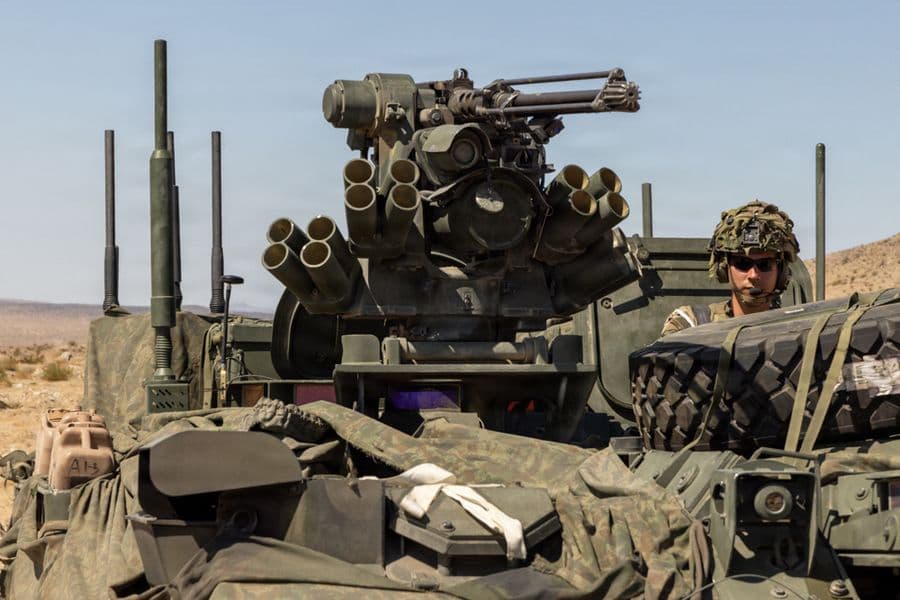
image: A U.S. Army soldier, assigned to the 4th Infantry Division, uses the L-band Tactical Satellite for beyond-line-of-sight communications during Project Convergence Capstone 6 (PC-C6) at Fort Irwin, California, July 21, 2026. PC-C6 allows the Army, joint force and multinational participants to experiment and collect data on emerging capabilities in support of transformation efforts.

In Pursuit of Nuclear Abolition
By Peter Huessy • RealClearDefense
Innovation Alone Won’t Prepare the U.S. for the Future Battlefield
By Joshua Segal • RealClearDefense
The sUAS Tactical Trifecta
By Bryan T. Woody • RealClearDefense
The Revolutionary War: When Strategic Options Share the Same Weakness
By Henry Yep • RealClearDefense
The Houthis Are Testing the Limits of Collective Defense
By Saima Afzal • RealClearDefense

Who Shoots Down the Drone Over the Shipyard?
By John Ferrari & Dillon Prochnicki • RealClearDefense
Northrop Grumman Breaks Out the Big Guns at AUSA
By Daniel Terrill, Defense News
Army Pursuing Diverse Array of New Anti-Air Interceptors
By Trevithick, The WarZoneWho Shoots Down the Drone Over the Shipyard?
By John Ferrari & Dillon Prochnicki, RCD
F-35C Lands for the First Time on a Ford-Class Aircraft Carrier
By The Aviationist