
The Fourth Offset: A Dragon Named 'Capacity'
Last updated 06:04 AM EDT • Read time: 4m
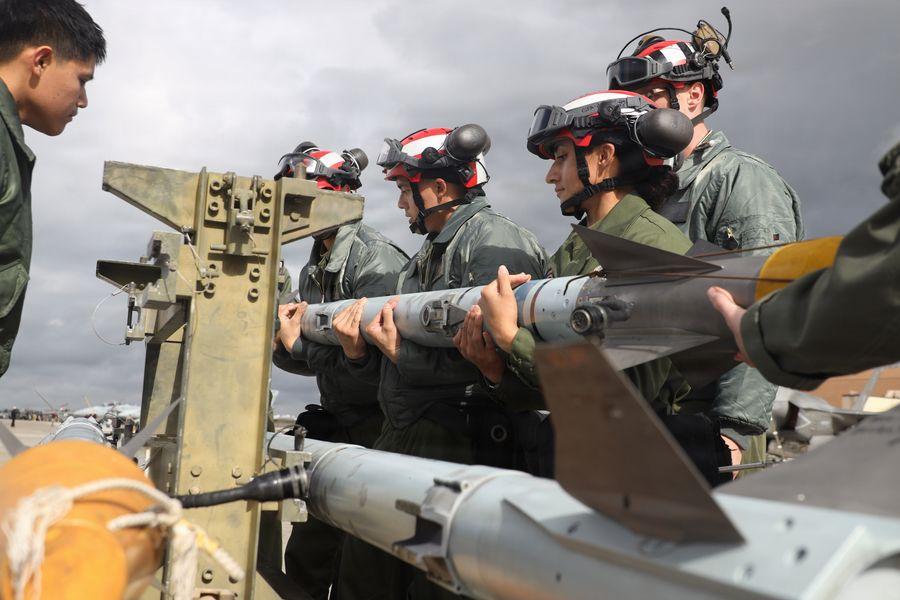
America does not lack advanced weapons. We lack enough of them.
That distinction may determine whether we deter the next war - or lose it. And this is not a problem created by today’s conflicts. America’s capacity challenge has been more than a decade in the making, driven by underinvestment, unpredictable budgets, and procurement policies that weakened our defense industrial base while China expanded its own.
For 70 years, America has used “offset strategies” to overcome peer adversaries’ advantages. The First relied on nuclear deterrence. The Second combined precision weapons, stealth, and surveillance. The Third pursued artificial intelligence and unmanned systems.
Each followed the same principle: America should never fight a peer adversary on the enemy’s terms.
Those offsets worked. But China studied them, copied their advantages, and added scale. Beijing’s state-controlled industrial system is no model for America, but its military implications are undeniable.
America now needs a Fourth Offset - built around a dragon named “Capacity.”
The point of owning a dragon is never having to use it. Its power is deterrence.
Capacity means building and replenishing combat power faster than an enemy can destroy it. It means enough weapons for the first salvo, the tenth, and the hundredth. And it means American weapons, built by American workers, in American factories, without dependence on Chinese components or vulnerable foreign supply chains.
We have been starving this dragon for years.
The Budget Control Act of 2011 and sequestration accelerated the decline. In 2013 alone, 19 weapons programs lost $713 million in R&D funding and $2.2 billion in procurement, while overall defense funding fell roughly 17 percent from 2012 to 2015.
The message to industry was clear: Do not invest in production Washington cannot guarantee.
Suppliers disappeared. Companies stopped investing in factories, tooling, and workers. Critical supply chains moved overseas. China went the opposite direction, building a layered arsenal designed to sustain a campaign - not simply dominate its opening days.
President Trump and Secretary Hegseth have rightly prioritized capacity. But the “frozen middle” of the defense bureaucracy and acquisition system still moves too slowly. Today’s warfighter is paying for decisions made years ago.
Nowhere is capacity more important than the Pacific. Distance magnifies every weakness. Ships carry finite magazines, logistics nodes will be contested, and sustained long-range strike will be essential.
America has extraordinary weapons. The Tomahawk remains one of the world’s most effective cruise missiles, while the Army’s Dark Eagle hypersonic weapon can hold heavily defended targets at risk. We need more of both.
But exquisite weapons cannot be our only answer.
If every target requires a missile costing millions - or tens of millions - China’s strategy becomes simple: survive the opening salvos and wait for America’s magazines to run dry.
We must make that strategy impossible.
America needs large numbers of lower-cost, long-range missiles, unmanned systems, and aircraft operating from dispersed locations. We need exquisite weapons and affordable mass - produced at scale in America.
A Fourth Offset dependent on Chinese rare-earth processing, electronics, or critical components is no offset at all. Rebuilding capacity means rebuilding America’s defense industrial base - from major factories to machine shops, foundries, and small manufacturers.
That requires moving beyond “just-in-time” defense acquisition. Continuing resolutions, lengthy competitions, and small annual buys prevent industry from expanding production.
The Trump administration’s Low-Cost Containerized Missile and Family of Affordable Mass Missiles initiatives are important steps. The goal of procuring more than 10,000 low-cost cruise missiles across these portfolios in three years reflects the scale America needs.
Congress and the Department of War must provide stable, multiyear demand so companies can invest in American factories, workers, tooling, and suppliers. We need multiple vendors, second sources, open architectures, and faster contracting.
But stable demand cannot mean blank checks. Multiyear contracts must come with firm costs, delivery schedules, production targets, and consequences for failure. Industry deserves predictability; taxpayers and warfighters deserve results.
Production rate must become a key performance measure. Every major weapons program should answer: How far does it go? What effect does it deliver? What does it cost? And how many can America build each month?
If we cannot answer that last question, we have not solved the capacity problem.
China is betting America can strike hard but not for long. The Fourth Offset must make that assumption catastrophically wrong.
Beijing should see more weapons than it can intercept and an American industrial base it cannot exhaust.
America has done this before. We won World War II by combining superior warfighters and technology with an industrial base our enemies could not outproduce.
This problem was years in the making. Solving it requires a strategy built to last.
That is how America deters the next war - with a dragon named Capacity.
Mike Garcia is a former U.S. Congressman, F/A-18 Navy combat fighter pilot, and aerospace executive. He is Chairman of America First California at the America First Policy Institute and serves on the Department of War’s Defense Policy Board.

A Defense Win for Americans and Israelis in Arkansas
By Bradley Bowman • RealClearDefense
A Path to Success Against Iran
By Michael Schwartz • RealClearDefense
The World Cup Is Over. The Drone Threat Isn’t.
By Mitzi Perdue • RealClearDefense
AI Should Speed Veterans’ Benefits, Not Decide Them
By Rob Schroder • RealClearDefense
Don’t Be Swayed by Tactical Nukes
By Benjamin Giltner • RealClearDefense
Big Surface Combatants are so Hot Right Now
By CDR Salamander
USS Stout Loses Power During Port Visit Due to ‘Engineering Casualty’
By USNI News
Air Force Lessons Learned From Operation Epic Fury
By Tabitha Reeves, National Defense
Marines Need Nine More Amphibious Warships To Carry Out Its Missions
By TWZ
AFRL, ACC Fly XQ-67A Drone To Test Autonomous Teaming
By Airforce Technology