
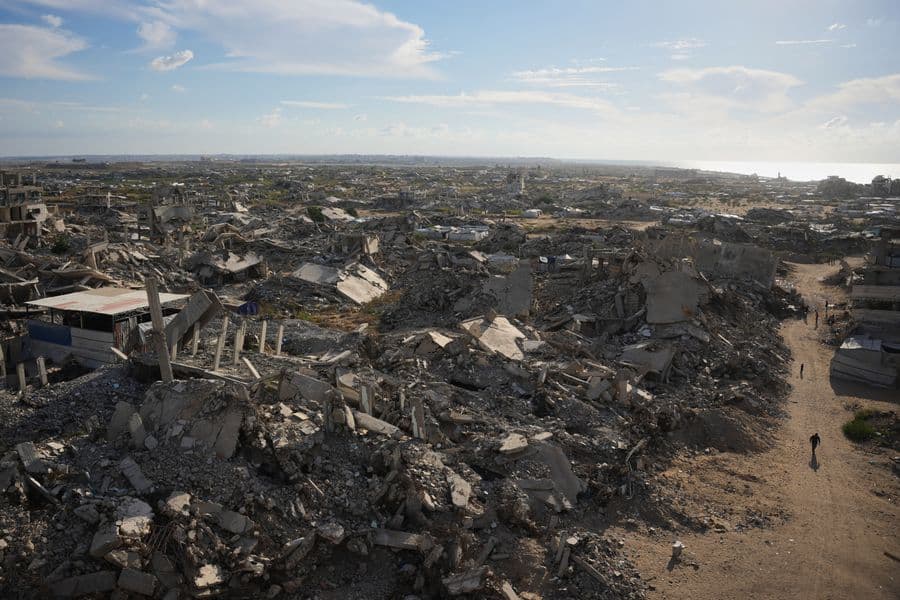
Palestinians walk past buildings destroyed during the Israel-Hamas war in Gaza City Tuesday, Oct. 20, 2026. (AP Photo/Abdel Kareem Hana)
The Necropolitics of the Wasteland
Cognitive Envelopment and Remote Control
Last updated 04:59 AM EDT • Read time: 12m
Join the Conversation
0The Strategic Obsolescence of Clausewitzian Occupation in the Twenty First Century
Modern power can increasingly control an adversary’s resilience through remote warfare. Therefore, occupation is no longer necessary to impose and sustain a chosen reality and has become a strategically inefficient model of victory.
Resilience means the capacity to recover and reconstitute material and political power. The chosen reality comprises the material, political, and interpretive conditions imposed upon that capacity. Money, data, energy, and movement can be controlled without governing everyday life. Physical boots on the ground give way to invisible boots on the neck: the drone overhead, the frozen bank account, the polluted data stream. The Wasteland names the resulting condition: material degradation, vulnerable reconstruction and disrupted organisation keep a society exposed to continuing catastrophe. Power operates through the reproduction of structured disorder.
The target may survive while its autonomous capacity is constrained and its political future suspended. This argument is unapologetically necropolitical. Following Mbembe’s account of power over exposure to death, it examines imposed subsistence as a means of remote domination (Mbembe 2003, 11, 29–30, 40). Catastrophe can become an instrument of leverage. The strategic question is what continuing political function destruction performs. A society’s inability to recover can itself become useful to the power keeping it exposed.
Occupation brings casualties, resistance, and administrative burdens. Casualty sensitivity weakens domestic endurance; the occupier must sustain legitimacy and reconstruction as well as military superiority. Distributed production reduces conquest’s economic rewards, especially in advanced economies (Shaw 2005, 79–81; Edelstein 2004, 50–51, 56; Brooks 2005, 161–62). Statebuilding adds a contradiction: a client’s loyalty to the intervening power can undermine its legitimacy among the governed, while legitimacy can make it less reliably loyal (Lake 2016, 1–2). Remote constraint offers power without comprehensive custody. The governing burden can exceed the additional control it supplies.
Clausewitz’s insistence that force serve political purpose survives (Clausewitz 1966, bk. I, ch. 1, sec. 24; ch. 2). The challenge concerns the inherited progression from military defeat to occupation, administration, and settlement. Where the political objective requires territorial government, occupation retains a function. A cheaper instrument that fails its object is not more efficient. But the capacity to hold ground does not establish the strategic value of assuming custody.
Necropolitical Containment and Cognitive Envelopment
Necropolitical Containment via Cognitive Envelopment combines economic enclosure, aerial and surveillance power, and cognitive pressure. Its spatial logic is vertical and infrastructural as well as territorial. Powers commanding financial and infrastructural chokepoints can restrict the flows sustaining material recovery (Farrell and Newman 2019, 45–46, 54–57). Surveillance and aerial power expose organisations to recurring disruption without a comprehensive garrison (Mir 2018, 45, 47, 81). Liminal manoeuvre delays attribution or response through contested thresholds of detectability (Kilcullen 2020, 150–54). Together, these instruments can keep autonomous recovery under external pressure. Their significance lies in combination: recovery requires resources, surviving institutions and the ability to organise them.
Roy’s de-development identifies the systematic deconstruction of indigenous economic capacity (Roy 1995, 4). Denial frustrates military strategy; punishment imposes costs to change behaviour (Pape 1996, 13–14). De-development attacks the capacity from which recovery must proceed. Economic ruin can therefore coexist with organisational survival and political defiance. Survival does not erase domination.
Cognitive envelopment connects control over material resilience with the interpretive conditions through which a chosen reality is sustained. Saturation need not persuade people to accept one story; it can make a common account harder to sustain (Henschke 2025, 233–35). The proposed sequence is fragmentation of interpretation, weakened collective identification, higher coordination costs and mobilisation that struggles to build lasting institutions. Organisations then become more vulnerable to economic pressure, surveillance and strikes. Perspecticide, which Henschke draws from Christopher Wylie, names the manipulation and deconstruction of perception; here it describes the hypothesised impairment of a collective “we” (Henschke 2025, 133). Political anger need not disappear. What becomes harder is converting anger into organized counterpower.
Han’s digital swarm captures expression without durable assembly (Han 2017, 10–12). Anger can proliferate while common political purpose remains fragile. Digital networks can also strengthen resistance; mobilisation that outruns institutional capacity is a different mechanism from externally induced confusion (Tufekci 2017, xii–xiv). The hypothesis concerns an assault on the interpretive conditions of organisation. The coercer need not become admired. Responsibility may become layered, strategic confidence uncertain and collective interpretation divided, making anger harder to assemble into a durable challenge.
The bell jar of control joins these pressures. Impaired recovery makes organisation costlier; impaired coordination obstructs escape; surviving organisations remain exposed to disruption. A lucid population is dangerous to the controller because it can identify its situation, find common cause and act. Confusion becomes useful when it absorbs the energies of opposition. Mao’s insurgent sea—the population sustaining resistance—is thinned and enclosed, rather than abolished (Mao Tse-tung 1989, 93). Surveillance makes concealment harder; aerial power threatens organisational continuity; cognitive pressure attacks common identification. Insurgency survives, but the conditions sustaining it become harder to assemble and easier to disrupt. The claim concerns exhaustion’s strategic value, not the automatic success of propaganda.
Catastrophe and Political Control
Destruction must not be mistaken for political success. Strict containment requires that, for at least five continuous years, the target cannot project organised force beyond its territory, rebuild the economic capacity for that projection, or compel renegotiation of imposed terms. Three cases separate imposed catastrophe from control.
Iraq under sanctions from 1990 to 2003 shows depletion maintained as a strategic function. Gordon describes a policy of preventing rearmament by bankrupting the state. Containment served administrations that hoped for regime change but saw little prospect of achieving it. Sanctions restricted imports and reconstruction; inspections and no-fly arrangements constrained military recovery (Gordon 2010, x–xi, 11, 190). The costs accumulated within the target society. The policy did not deliver regime change. Its replacement by invasion in 2003 does not erase the preceding decade’s imposed depletion: constraint and settlement are different achievements. Iraq exposes the Wasteland’s possibility: catastrophe sustained as an instrument of power without comprehensive government (Gordon 2010, 1–2, 37, 190).
Gaza sharpens the distinction. De-development and control over borders, movement and infrastructure make reconstruction dependent upon the enclosing power (Roy 1995, 4; Smith 2016, 750–52). Military superiority can operate through the conditions of subsistence while resistance persists. Yet the attack of 7 October 2023 breached the outward-force containment criterion. Material enclosure had not extinguished organised military capacity. That failure does not erase de-development. Governing the conditions of life does not guarantee command over political action.
Wartime opinion reveals divided judgments. In September 2024, 39% of Gazan respondents considered Hamas’s decision to launch the attack correct, down from 71% in March. Expectations of a Hamas victory fell from 56% to 28% (PCPSR 2024, 7, 9). By May 2025, expected victory was 23%; anti-Hamas demonstrations divided Gazans, with 48% supporting and 50% opposing them. Yet partisan support for Hamas rose from September 2024’s 35% to 37%, and performance satisfaction from 39% to 43% (PCPSR 2025, 6, 8, 10, 15). Most Gazan respondents still blamed Israel or the United States primarily for their suffering (PCPSR 2025, 3). The external source of violence and the movement governing the population can both remain objects of political judgment.
These divided judgments matter because the coercer need not become admired for confidence in a resistance strategy to weaken. They do not prove that shared Palestinian meaning has dissolved. Accounts of journalistic sumud and writing against erasure record its persistence (Mellor and Alzara 2026, 14–15; Abu Sitta 2026, 1–3). Distrust also preceded the war: a survey completed on 6 October 2023 found only 29% expressing substantial trust in the Hamas-led government, while 44% reported none (Jamal and Robbins 2023, 3). Wartime surveys measure attitudes under changing sampling conditions, not informational exposure or organisational incapacity (PCPSR 2024, 1–3; 2025, 2). Material catastrophe is evidenced; the passage from cognitive pressure to impaired organisation remains to be established.
Venezuela under sanctions supplies the counterpoint. Severe financial and sectoral restrictions had failed to secure the desired change of government by early 2023. The regime adapted through economic openings and repression. Bull and Rosales describe authoritarian capitalism consolidating the power sanctions sought to dislodge (2023, 49–50, 53–54). Economic injury can reshape a society’s conditions without producing submission. A theory of the Wasteland must explain that distinction rather than count every damaged economy as successful containment.
These cases do not establish universal remote superiority. Degradation, deliberate purpose, and political effectiveness require separate evidence. Comparison also turns on political objectives, time horizons, available alternatives, partners, and continued enforcement.
Authority Without Custodial Responsibility
Distance reorganises responsibility. Withdrawal can separate everyday administration from continuing authority over borders, infrastructure, and recovery. The juridical penumbra opens between power and the custody, adjudication and enforcement that make responsibility effective. In 2024, the International Court of Justice held that withdrawal from Gaza had not entirely released Israel from occupation-law obligations, which remained commensurate with its degree of effective control (ICJ 2024, paras. 91–94). The law restores the duty-bearer precisely where withdrawal is used to disclaim the burdens of rule. Remote control can make obligations harder to discharge while retaining the authority from which they arise.
Humanitarian language can become this arrangement’s alibi. Precision, surgical strike and smart sanction promise restraint while reduced risk for the coercer coexists with prolonged civilian exposure (Shaw 2005, 87–92). Smith shows how aid sustaining survival can also obscure the siege making it necessary and insulate the besieging power from legal commitments (2016, 766). The Wasteland asks what this vocabulary conceals when the strategic function is containment rather than protection, degradation rather than development, management rather than rescue. Maintaining life does not terminate the political relationship producing its precarity.
The Decree of the Wasteland
Occupation-centred victory promises a settlement and a responsibility. The Wasteland can defer termination because its costs fall largely upon others. Risk management replaces settlement: recovery remains vulnerable while the burdens of governing the damaged society are disclaimed. The absence of comprehensive administration becomes part of the method’s attraction.
The danger can return to its maker. Shaw’s risk rebound describes exported risks returning to the power that displaced them (2005, 139). The Wasteland extends that warning into a speculative symmetry: a metropole tolerating perspecticide abroad may face it at home; a public unable to cohere against distant control may also struggle to cohere behind its government’s coercion. The greyness takes no sides. If this symmetry holds, controller and controlled descend into a condition from which neither commands the exit. This remains a proposition to test, not a demonstrated outcome.
Where its conditions hold, the invisible boots remain upon the neck. The population is made poorer, more exposed and harder to organise, while autonomous recovery remains vulnerable to disruption. Resistance survives; containment can be breached; durability is not permanence. Yet power can sustain a chosen reality by controlling another society’s resilience while declining comprehensive government. Strategic thought must comprehend, and contest, the management of the Wasteland.
Yunus Emre Tumen is a policy professional and an MA candidate in Applied Strategy and International Security at the University of Plymouth. He holds a BA (Hons) in Political Science, Anthropology and Sociology from the University of Prince Edward Island. His experience includes parliamentary research at the House of Lords and comparative climate policy research, with interests spanning international security and climate governance.
Sources:
Abu Sitta, Lubna Ahmad. 2026. "Writing against Erasure: A Geography of Resistance in Gaza." Environment and Planning C: Politics and Space. Advance online publication. https://doi.org/10.1177/23996544261466050.
Brooks, Stephen G. 2005. Producing Security: Multinational Corporations, Globalization, and the Changing Calculus of Conflict. Princeton, NJ: Princeton University Press.
Bull, Benedicte, and Antulio Rosales. 2023. "How Sanctions Led to Authoritarian Capitalism in Venezuela." Current History 122 (841): 49-55. https://doi.org/10.1525/curh.2023.122.841.49.
Clausewitz, Carl von. 1966. On War. Translated by J. J. Graham. New and revised edition, with introduction and notes by F. N. Maude. 3 vols. London: Routledge & Kegan Paul.
Edelstein, David M. 2004. "Occupational Hazards: Why Military Occupations Succeed or Fail." International Security 29 (1): 49-91. https://doi.org/10.1162/0162288041762913.
Farrell, Henry, and Abraham L. Newman. 2019. "Weaponized Interdependence: How Global Economic Networks Shape State Coercion." International Security 44 (1): 42-79. https://doi.org/10.1162/ISEC_a_00351.
Gordon, Joy. 2010. Invisible War: The United States and the Iraq Sanctions. Cambridge, MA: Harvard University Press.
Han, Byung-Chul. 2017. In the Swarm: Digital Prospects. Translated by Erik Butler. Cambridge, MA: MIT Press.
Henschke, Adam. 2025. Cognitive Warfare: Grey Matters in Contemporary Political Conflict. Abingdon: Routledge. https://doi.org/10.4324/9781003126959.
International Court of Justice (ICJ). 2024. Legal Consequences Arising from the Policies and Practices of Israel in the Occupied Palestinian Territory, including East Jerusalem. Advisory opinion, July 19. https://www.icj-cij.org/sites/default/files/case-related/186/186-20240719-adv-01-00-en.pdf.
Jamal, Amaney A., and Michael Robbins. 2023. "What Palestinians Really Think of Hamas." Foreign Affairs, October 25. https://www.foreignaffairs.com/israel/what-palestinians-really-think-hamas.
Kilcullen, David. 2020. The Dragons and the Snakes: How the Rest Learned to Fight the West. New York: Oxford University Press.
Lake, David A. 2016. The Statebuilder's Dilemma: On the Limits of Foreign Intervention. Ithaca, NY: Cornell University Press.
Mao Tse-tung. 1989. Mao Tse-tung on Guerrilla Warfare. Translated and introduced by Samuel B. Griffith. FMFRP 12-18. Washington, DC: U.S. Marine Corps.
Mbembe, Achille. 2003. "Necropolitics." Translated by Libby Meintjes. Public Culture 15 (1): 11-40. https://doi.org/10.1215/08992363-15-1-11.
Mellor, Noha, and Nada Alzara. 2026. "Sumud as Journalistic Practice: Palestinian Journalists Navigate Trauma and Resistance in Gaza." Journalism. Advance online publication. https://doi.org/10.1177/14648849261455922.
Mir, Asfandyar. 2018. "What Explains Counterterrorism Effectiveness? Evidence from the U.S. Drone War in Pakistan." International Security 43 (2): 45-83. https://doi.org/10.1162/ISEC_a_00331.
Palestinian Center for Policy and Survey Research (PCPSR). 2024. "Public Opinion Poll No. 93." September 17. https://www.pcpsr.org/en/node/991.
Palestinian Center for Policy and Survey Research (PCPSR). 2025. "Public Opinion Poll No. 95." May 6. https://www.pcpsr.org/en/node/997.
Pape, Robert A. 1996. Bombing to Win: Air Power and Coercion in War. Ithaca, NY: Cornell University Press.
Roy, Sara. 1995. The Gaza Strip: The Political Economy of De-development. Washington, DC: Institute for Palestine Studies.
Shaw, Martin. 2005. The New Western Way of War: Risk-Transfer War and Its Crisis in Iraq. Cambridge: Polity Press.
Smith, Ron J. 2016. "Isolation through Humanitarianism: Subaltern Geopolitics of the Siege on Gaza." Antipode 48 (3): 750-769. https://doi.org/10.1111/anti.12224.
Tufekci, Zeynep. 2017. Twitter and Tear Gas: The Power and Fragility of Networked Protest. New Haven, CT: Yale University Press.

A Passage to the Middle East: India as a Mediator and Security Partner
By Irina Tsukerman • RealClearDefense
South China Sea is Key to Invigorate Positive U.S.–Malaysia Relations
By Brent D. Sadler • RealClearDefense
The Necropolitics of the Wasteland
By Yunus Emre Tumen • RealClearDefense
AI, Robotics, and Marines
By Gary Anderson • RealClearDefense
The Emerging SQUAD
By Muhammad Shoaib • RealClearDefense
AI, Robotics, and Marines
By Gary Anderson • RealClearDefense
AUKUS Partners Test Autonomous Maritime Systems
By Jangoulun Singsit, Naval Tech
AUKUS: USS Colorado Announced as First Submarine for SRF – West
By USNI News
Navy, Marine Corps Simulate Ship Strikes From Air and Land
By Alex Wilson, S&S
Air National Guard To Stand Up a New Special Tactics Squadron
By Patty Nieberg, T&P