
The Pentagon Must Rehearse Its Ability to Adapt
Last updated 06:14 AM EDT • Read time: 9m
Test the path from battlefield need to fielded capability before war sets the deadline
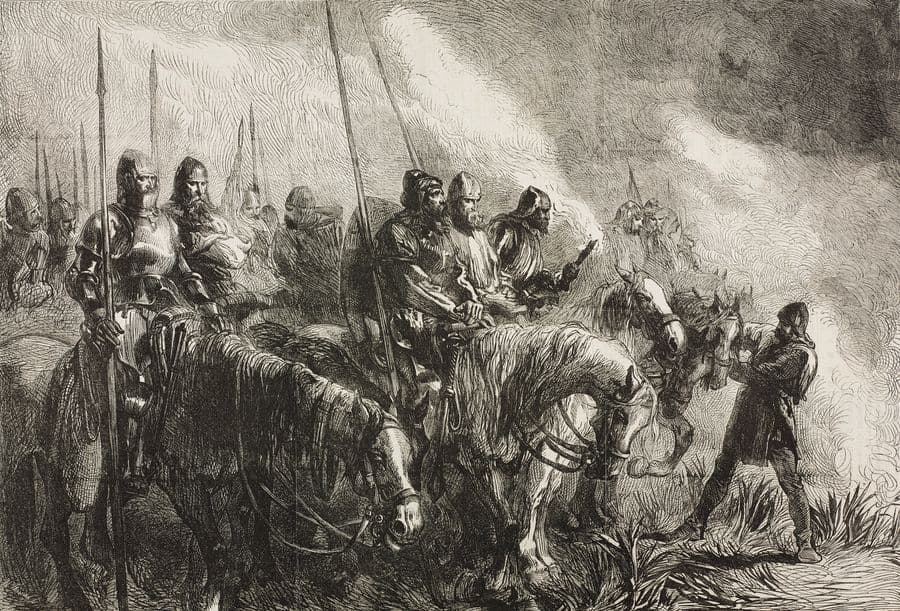
Before the first arrow flew at Agincourt on October 25, 1415, the English had prepared not just to fight, but to make the battlefield work for them.
The longbow was only part of that preparation. Stakes driven into the ground helped protect the archers from French cavalry, while mud further disadvantaged French men-at-arms. The Royal Armouries’ account explains how those elements worked together. Preparation made the weapon more effective.
Secretary of War Pete Hegseth has invoked Agincourt to argue that warfighters and innovators should work closer together. The battle also shows that adaptation depends on choices made before an urgent requirement arrives.
A decision to expand production can be announced in a day. Qualifying suppliers, training workers, and enlarging test capacity can take years. Money committed after a crisis begins cannot recover the preparation time already lost.
An adversary can change how a weapon must operate while we are still expanding its factory. More equipment may arrive without restoring the force’s effectiveness.
The Institutional Adaptation Challenge
America’s industrial buildup therefore faces two connected tests: Can we deliver enough of what works? And can we change what we deliver when battlefield experience shows it no longer works?
The Pentagon should rehearse adaptation as deliberately as it plans production. Government and industry should follow selected operational problems through requirements, engineering, testing, funding, production, and use by military units. Measure success by the time required to deliver a verified improvement to the force at useful scale.
The tank emerged in the First World War to help cross battlefields dominated by defensive fire, but its arrival did not end the stalemate. Reliability, tactics, coordination, and support had to improve before it could change battlefield outcomes.
In Fast Tanks and Heavy Bombers, David E. Johnson showed how organizational interests and doctrine shaped the development of armor and aviation, limiting what the Army learned from technologies it already possessed.
The U.S. Army’s interwar experience makes the problem concrete. The 1920 National Defense Act abolished the independent Tank Corps and placed tanks under infantry control. Cavalry called its vehicles “combat cars” to comply with the law. Organizational boundaries shaped armor’s development and use.
A military can accelerate procurement and digital engineering yet remain slow to revise the assumptions behind what it buys. A successful prototype may never reach the force if requirements, funding, training, and sustainment do not move with it.
Turn New Initiatives into a Test
The administration’s initiatives create an opportunity to connect anticipation with adaptation. Project Meridian will study future warfare. Project Agincourt is intended to chart a pathway for the announced four-star Autonomous Warfare Command while prototyping a new acquisition model.
The Army’s Project Convergence provides a venue for experimentation. Agincourt’s emphasis on operator-innovator collaboration and realistic exercises provides the starting point. The demonstration proposed here would test the full institutional and industrial response, measuring elapsed time through decisions, production, and fielding.
Emerging capabilities need a durable sponsor across requirements, acquisition, training, and sustainment. The joint Autonomous Warfare Command is still being organized; on Oct. 1, the Army directed establishment of the Futures and Autonomous Systems Command (FASCOM) and said it will designate a Portfolio Acquisition Executive for Autonomy. Project Agincourt should test how those service and joint authorities connect operational needs to trials, production, and fielding.
Meridian can identify future domains and capabilities. Agincourt and existing exercises should translate selected findings into operational problems, testing responses against mission needs, independent operational evidence, supplier limits, and production timelines. Those tests should identify preparations needed to make promising concepts achievable while preserving Meridian’s freedom to explore beyond today’s constraints.
The Deputy Secretary of War should sponsor a demonstration with Agincourt’s leaders, operational commanders, and service requirements officials. Select two or three problems, each with an accountable lead, a defined mission, a supported force, and a useful timeframe. Execution should remain with those leads under delegated authorities. Deputy Secretary sponsorship should provide a clear escalation path for cross-service requirements, funding, and policy obstacles they cannot resolve.
An initial exercise would expose constraints. Selected responses would proceed through engineering, trials, and fielding, with progress reviewed in later exercises. The clock should keep running through implementation and unresolved decisions.
Each iteration should produce a decision brief recording elapsed time, the bottleneck, mission effect, authority, or funding needed, and the next accountable decision and deadline. Senior leaders can use it to resolve cross-service obstacles before the next review.
Follow the Change to the Force
Consider a reconnaissance system that performs well in trials. An opposing team introduces a plausible change that sharply reduces its value, while the force needs more systems. Participants must adapt and continue supporting units already using it.
Start the clock with the first credible evidence of the operational problem. Starting only after a requirement has been validated would conceal the time spent deciding whether the problem deserves action.
Operators and analysts would determine whether the shortfall lies in equipment, employment, training, or the original mission assumptions. The answer could be a modification, a new tactic, or a combination of existing capabilities. A new purchase earns no credit unless it improves the mission.
Requirements leaders would identify which specifications still serve the mission and which should change, using a clear authority and evidentiary standard. Unresolved disputes across organizational boundaries would expose a readiness problem for senior leaders.
Digital models could help engineers and operators compare responses and trace effects across interfaces, manufacturing, testing, and sustainment. A modest redesign might require a new supplier or qualification process; finding that early could favor another option.
AI could reconcile supplier data, reveal shared dependencies, and flag changed assumptions. Digital engineering could assess feasibility; physical tests and operational evidence would determine whether a change is ready to field.
Participants should make bounded decisions within existing authorities and budgets. Simulated approvals and projected production should not count as demonstrated readiness. An independent opposing team should challenge favored concepts and adapt again after improvements. Sponsors must be ready to act on unwelcome results.
If the modification succeeds in a trial, can units receive the equipment, training, spares, and support to use it? Can the improvement reach the required force in time? Can it survive another plausible adversary response?
Prepare for Production and Transition
Industrial choices may prove harder than redesign. Retooling could reduce current deliveries; keeping the line open could leave equipment needing retrofit. A faster transition could consume capital, disrupt suppliers, or constrain spare parts.
Leaders must weigh those costs against operational value. They may phase the transition, retrofit selected systems, or keep producing while developing another response. The exercise should include these choices.
Suppose the modification depends on a supplier also serving two expanding programs. Their separate plans may exceed shared output. Another prime-contractor assembly line will not help if a common component remains unavailable.
Financing supplier equipment, qualifying another source, or buying a material buffer could change the result. Trace each option to complete systems usable by the force; do not count the same machine, worker, or test facility against multiple demands.
Advance investment can remove delays. The Defense Logistics Agency reported a 571-day lead time for 300M steel used in a Bradley transmission forging. Its Warstopper program prepositioned the bottleneck forging, reducing that lead time to 77 days. DLA later prepositioned raw ingots, giving suppliers flexibility across parts.
This component-level improvement did not reduce complete-vehicle delivery time by the same amount. It showed how preparation can change the options available when demand arrives. Warstopper and the Civil Reserve Manufacturing Network could link industrial readiness to operational needs.
Preparedness has a price. Credible contracts can support expansion where demand is sustained; added flexibility may require separate compensation. Companies cannot finance every contingency or absorb every requirements change. The exercise should also identify which contract vehicles need to be established in advance, with appropriate scope and qualified suppliers, to shorten the path from an urgent battlefield requirement to funded work.
Agreements should specify what is secured - suppliers, test capacity, tooling, material, or a defined production response - and set activation times and responsibilities. Continued funding should depend on military need and evidence that availability is real.
Inventory supports immediate response; production replenishes and adapts. If the critical period ends before a factory can deliver, stockpiles may be the better investment. For fast-changing designs, common inputs, and adaptable production preserve options.
Measure the Time Bought
Before the first exercise, set a baseline and target for the time from credible operational evidence to a verified improvement available to a specified force at useful scale. Track analysis, decisions, implementation, testing, and fielding; then repeat the scenario after corrective action and compare results.
Assess cycle time alongside mission performance, cost, and delivery disruption. Teams should not earn a better cycle-time score by lowering the operational standard, stopping short of the specified force, or delivering an answer that fails realistic tests. The response must meet the need.
Findings should change decisions. Expand support where it improves delivery; redirect investment toward bottlenecks; revise failed assumptions; and end commitments that no longer serve the mission, consistent with contracts.
No exercise can certify wartime performance. Repeating the process after corrective action can show whether the industrial base and its institutions are becoming more responsive, while identifying preparations useful across several futures.
This builds on the argument in Capital Must Become Capability: investment matters when it becomes useful capacity. The next test is whether that capacity can adapt when battlefield evidence changes the requirement.
Agincourt’s archers show why preparation matters, but a victory in one battle does not decide a war. England won at Agincourt; by the conventional endpoint of the Hundred Years’ War in 1453, its French possessions had been reduced to Calais, as History Today’s account of England’s French lands notes.
That is why the initiatives matter only as a connected system. Meridian can anticipate change; Agincourt and the announced command can organize adaptation. Supply-chain resilience and workforce preparation must convert lessons into fielded capability. Judge the package by whether it connects forecasting, experimentation, authority, production, and force employment.
The time bought before a crisis matters only if it gives leaders choices during the crisis and helps the force sustain an advantage through the fight.
Ryan P. McDermott is an Iraq War veteran, former Pentagon official, and author of the book, Downriver: Memoir of a Warrior Poet. His views do not reflect those of his employer or any affiliated organization.
image: Battle of Agincourt (Creative Commons)