
Why an Autonomous Combatant Command Hinders Lethality
Last updated 06:11 AM EDT • Read time: 9m
War Secretary Pete Hegseth recently announced an aggressive and necessary plan to fundamentally reshape the senior leadership of the United States military. In a forceful move to eliminate redundant force structure, initiated by a May 2025 memorandum and operationalized during his recent address at Quantico, he directed a twenty percent reduction in the number of four-star generals and a ten percent cut to all flag officers across the military branches. This mandate signaled a clear intent to flatten top-heavy military organizations, cut through bureaucratic bloat, and push decision-making power down to the warfighters who actually need it. Yet, in a glaring and inexplicable contradiction to this very mandate, the newly signed Department of War memorandum initiating Project Agincourt establishes the Autonomous Warfare Command, a brand new four-star functional combatant command slated for activation by October 1, 2027. This move represents a massive misstep. It preaches organizational efficiency while simultaneously birthing an enormous new bureaucracy that will ultimately slow down the very technological adaptation it seeks to accelerate.
Understanding why a centralized Autonomous Warfare Command is a mistake requires first examining the fundamental division of military labor. By doctrine, combatant commands exist strictly to employ military force in specific geographic theaters or defined global regimes. Conversely, the individual military branches exist under Title 10 of the United States Code to organize, train, and equip those forces. Standing up a new combatant command to solve a technological acquisition and fielding problem directly confounds operational command with developmental responsibility. While geographic combatant commands manage traditional military operations within defined regional borders, the military utilizes functional combatant commands for capabilities that genuinely transcend specific physical domains and require a unified global approach. United States Special Operations Command is the premier example. Authorized under Title 10 of the United States Code, this command does more than just organize and train forces; it is explicitly chartered to bypass geographic boundaries and directly execute highly sensitive global missions, such as countering violent extremist networks or weapons of mass destruction, when directed by the President. This centralized structure works because these unique operations demand a globally synchronized effort. Similarly, United States Cyber Command operates across the singular, universal domain of information networks. In the cyber domain, a centralized four-star headquarters makes operational sense because offensive digital capabilities carry immense strategic risk and require high-level authorization to deploy.
Autonomous warfare, however, does not fit this model in any capacity. Autonomy is not a distinct operational domain, nor is it a singular, universal skillset. Rather, artificial intelligence and autonomous capability represent a technological characteristic that must be applied to vastly different and highly specialized environments. The operational specificity required for these disparate systems is staggering, and it varies wildly from one military branch to the next. The Air Force, for instance, is currently developing Collaborative Combat Aircraft designed to fly as uncrewed wingmen alongside piloted fighter jets in highly contested airspace, requiring complex aerodynamic programming and high-speed data links. The Navy is heavily invested in unmanned underwater vehicles and robotic surface vessels that must navigate the immense water pressures, corrosive environments, and sheer vastness of the world's oceans. The Army is building Robotic Combat Vehicles engineered to breach heavily mined landscapes and maneuver through brutal ground conditions alongside infantry units. In the tactical precision strike realm, Special Operations Forces require small, highly lethal loitering munitions capable of automatic target recognition in dense, cluttered urban terrain.
A single overarching four-star headquarters cannot possibly possess the nuanced, localized expertise required to govern all of these wildly disparate programmatic efforts effectively. Attempting to place all unmanned and autonomous systems under a single command umbrella completely ignores the fundamental reality that an autonomous submarine shares almost no common engineering or tactical overlap with an autonomous fighter jet.
Furthermore, establishing this new command actively undermines the stated goal of reducing top-heavy officer ranks. A four-star headquarters is never just a single commander. It demands a sprawling staff of subordinate generals, admirals, and hundreds of field-grade officers to manage daily operations, logistics, intelligence, and personnel directorates. This directly contradicts the effort to trim the general officer ranks. Worse still, it creates a fierce new competitor for a fixed pool of defense resources. The Project Agincourt directive grants this new headquarters directed manpower, budget, and independent acquisition authorities. Because the overall defense budget is a finite pie, giving a new entity its own massive checkbook forces a greater split of existing funds among the services. It threatens to siphon vital funding directly away from the highly specialized, Service-level development efforts already underway. The directive tasks the new command with integrating Service-provided forces to support geographic combatant commanders. In practice, this means the individual military branches will be forced to pay for the initial research and development of these technologies, only to have their budgets taxed and their most successful systems hijacked by a central authority that lacks domain-specific knowledge.
This structural overhaul also creates a devastating talent drain. The military is already fighting an uphill battle to recruit and retain top-tier software engineers, artificial intelligence specialists, and agile acquisition professionals capable of navigating the modern technology sector. The directive mandates the creation of dedicated military occupational specialties, ratings, and career fields for unmanned systems. However, dragging the military's most capable technical innovators out of their respective warfighting domains and trapping them inside a centralized, administrative headquarters removes them entirely from the tactical edge. It effectively firewalls critical capability and technical expertise behind a four-star desk. Instead of writing better code or building faster procurement contracts for the warfighter, these specialists will inevitably become bogged down in the endless staff meetings, jurisdictional disputes, and PowerPoint presentations that define life at a major military headquarters.
The underlying motivation behind Project Agincourt is entirely valid. The authors of the memorandum are absolutely correct when they warn that advanced computing has suddenly and dramatically changed the nature of combat, enabling precise, low-cost weapons to be produced at a massive scale. They are right to assert that the military does not have a decade to slowly adjust its procurement and doctrine, and that immediate change is required to protect American lives. The proposed solution, however, addresses the wrong bottleneck. The obstacle preventing the rapid fielding of autonomous weapons is not a lack of generals or a missing four-star headquarters. The true barrier is the crippling regulatory environment, specifically the agonizingly vague and restrictive parameters of Department of Defense Directive 3000.09.
This directive governs the development and fielding of autonomous and semi-autonomous weapons. Under its current interpretation, any system utilizing artificial intelligence to select and engage targets without further human intervention must survive a grueling, multi-tiered review process involving the highest echelons of the Pentagon. This regulatory hurdle stifles innovation, discourages the military branches from investing heavily in advanced swarming capabilities, and ensures that critical technological updates take years to reach the battlefield. The services are continuously struggling to interpret and comply with these rules while desperately trying to push modern capabilities to their operational units.
What the defense establishment really needs is an immediate, genuine flattening of its organizational layers. Hegseth's push to reduce the general officer ranks is a step in the right direction, but simply shuffling those senior billets into a newly created Autonomous Warfare Command merely reorganizes the bureaucracy without actually flattening it. The actual fix is to empower decentralized experts. We need dedicated artificial intelligence and autonomy Subject Matter Experts embedded directly within the current Service program executive offices and acquisition branches.
These embedded teams must be granted a universal, common interpretation of Directive 3000.09. Instead of forcing every individual weapon program to seek approval from top Pentagon officials, these localized experts must be equipped with the technical knowledge and the explicit authority to rapidly approve development roadmaps. They should be the ones evaluating system fail-safes, verifying the reliability of automatic target recognition algorithms, and authorizing the integration of artificial intelligence into weapon systems directly at the Service level. By decentralizing this approval authority, the Department of Defense can instantly strip years off the fielding timeline.
The military branches do not need a four-star czar to force them to adapt. The combatant commanders and service chiefs desperately want these capabilities right now. If the regulatory barriers are removed by empowered experts, the funding will naturally flow toward the robotic vehicles, uncrewed aircraft, and autonomous surface vessels that prove their worth in realistic exercises and rugged environments. The United States must lead the world in advanced technological combat, but building a sprawling new headquarters in the name of speed is the ultimate bureaucratic paradox. We must empower the experts already working within the branches, cut the policy red tape, and let the existing operational forces build the highly specialized tools they need to win.
Stephen D. Cook is a retired U.S. Army Special Forces lieutenant colonel with 25 years of service. A combat veteran decorated for both heroism and valor, he is the author of the field manuals “When We’re Finished” and “Choose the Heavier Ruck,” and the techno-thriller precision-strike trilogy leading with “In the Shadows of the Sky.” His work explores the intersection of elite military decision-making, intuition, and disruptive leadership. He is based in St. Augustine, Florida.
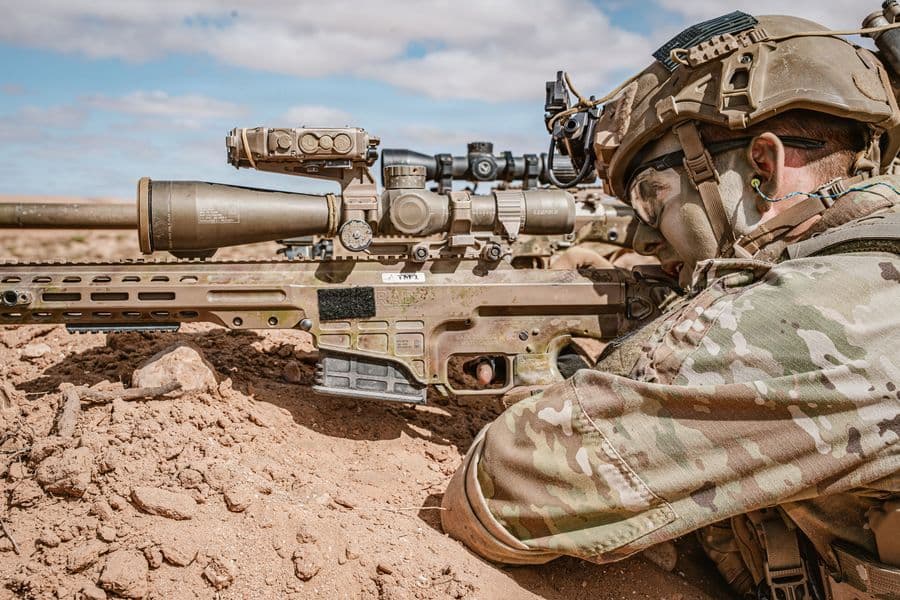
image: A U.S. Soldier assigned to Legion Company, 1st Battalion, 503rd Infantry Regiment, 173rd Mobile Brigade Combat Team (Airborne), fires down range during an African Lion 26 combined arms live-fire exercise at Cap Draa, Tan-Tan, Morocco, April 29, 2026. The exercise challenged units to synchronize maneuver forces, indirect fires, and autonomous systems under realistic combat conditions, validating the tactics, techniques, and procedures essential to modern combined arms warfare. The live-fire environment built the lethality and cohesion required to deliver combat power across the conflict spectrum.