
Towards a Multilateral Arrangement for Controlling Nuclear Weapons
Last updated 05:24 PM EDT • Read time: 6m
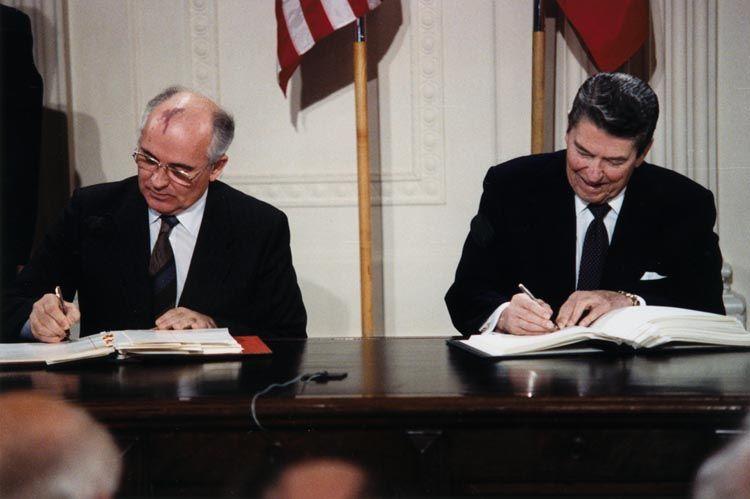
The Intermediate-Range Nuclear Forces (INF) Treaty was signed by U.S. president Ronald Reagan and Soviet general secretary Mikhail Gorbachev in December 1987 to give effect to their declaration that ‘a nuclear war cannot be won and must never be fought’. Under the first disarmament agreement of the nuclear age, within four years nearly 2,700 missiles in the prohibited 500- to 5,500-kilometre range—whether armed with nuclear or conventional bombs—were destroyed. Moscow got rid of more than twice as many as Washington.
Reflecting the dominant nuclear arms control architecture of the Cold War that has reduced global nuclear stockpiles by more than 80% since their peak in the 1980s, the INF Treaty was a bilateral accord. John Bolton, writing in the Wall Street Journal in 2011, conceded it had successfully ‘addressed a significant threat to U.S. interests’.
On 20 October, President Donald Trump said the U.S. will withdraw from the treaty because Russia has been violating it for many years. Relying on intelligence briefs, the U.S. since the Obama administration in 2014 has accused Russia of clandestinely deploying nuclear-capable medium-range (about 2,000 kilometres) ground-launched missiles in Europe that are non-compliant with INF Treaty obligations. NATO has designated this weapon as the SSC-8, while Russia calls it the Novator 9M729 missile.
In addition to Russian violations, the U.S. exit is motivated by China’s growing challenge to American dominance in the Pacific. Since the end of the Cold War, China and North Korea have been developing missile-delivery capabilities. ‘To reduce the threat from INF-range missiles’, Bolton concluded back in 2011, ‘we must either expand the INF Treaty’s membership or abrogate it entirely so that we can rebuild our own deterrent capabilities’. Now Bolton is Trump’s national security adviser. He could make Trump impervious to European pleas to reconsider.
As a non-signatory, China is unconstrained by the treaty’s limits. About 95% of its missiles are in the prohibited range, enabling it to target U.S. ships and bases from the mainland by relatively inexpensive conventional means. In testimony to the U.S. Senate Armed Services Committee on 27 April 2017, U.S. Pacific Commander Admiral Harry Harris noted that the treaty limits America’s ‘ability to counter Chinese and other countries’ cruise missiles, land-based missiles’.
Without INF restrictions, the U.S. could develop ground-launched intermediate-range cruise missiles, possibly stationed in Guam, Japan, South Korea and northern Australia, that could reach deep into China’s interior and force Beijing to divert significant military resources to defend its homeland. America’s Pacific allies would be deeply conflicted if asked to host U.S. missiles on their soil and would face substantial public opposition. This puts a premium on highlighting, perhaps even inflating, the Chinese threat to Asia–Pacific countries as a strategy for softening public resistance.
Yet China’s nuclear stockpile is below 300 compared with nearly 7,000 Russian and 6,500 American warheads. Fan Jishe of China’s Academy of Social Sciences in Beijing argued in a policy brief for the Asia–Pacific Leadership Network for Nuclear Non-Proliferation and Disarmament that China has deliberately refrained from engaging in a nuclear arms race with Russia and the U.S.. China’s stockpile has remained relatively stable over many years despite the fluctuations in the Russian and U.S. numbers.
China conducted its first nuclear test 54 years ago. Since then, the global strategic landscape has changed dramatically and China has transitioned from an economically weak country into the world’s biggest economy in purchasing power parity. It has made commensurate advances in regional and global governance institutions but steadfastly refused to make similarly dramatic changes in its nuclear policy. It may have exercised strategic restraint in nuclear development initially because of the limitations of resources and technological capability. Remarkably, China hasn’t changed its nuclear policy even after acquiring the economic and technical capability to do so.
The basic explanation is identical to the philosophy undergirding India’s nuclear policy. Both countries believe these weapons are not militarily useable. Rather, they are political weapons to deter nuclear attack and prevent nuclear blackmail. Hence the commitment by both not to be the first to use nuclear weapons—a stance not shared by the other seven with the bomb. This permits both Beijing and New Delhi to adopt asymmetric deterrence postures.
Tong Zhao, from the Carnegie-Tsinghua Center for Global Policy in Beijing and also a member of the Asia–Pacific Leadership Network, notes that, in an increasingly polycentric global order, the Cold War–era dyadic nuclear arms control structure failed to constrain the choices of other nuclear-armed states. The nuclear dyads of yesteryear have morphed into more closely interlinked nuclear chains today, as was argued in a Brookings Institution report last year. This risks a cascading effect of changes in the nuclear posture of one country leading to recalibration of nuclear force postures, doctrines and deployments in several others.
Thus, if the U.S. pulls out of the Eurocentric INF Treaty in part to counter growing Chinese military capabilities in the Asia–Pacific, China will feel compelled to institute countermeasures to protect vital security interests including nuclear assets deep in its interior. China’s response in turn will trigger readjustments to India’s doctrine of credible minimum deterrence and produce matching readjustments by Pakistan.
In a worst-case scenario, China, India and Pakistan will all engage in a sprint to parity with the U.S. with a rapid expansion of warhead numbers and missile-delivery capabilities, and perhaps even move to keeping a stock of nuclear weapons on high alert just like Russia and the U.S.. Of course, their ability to engage in an open-ended nuclear arms race will be limited by major economic constraints that could break India and Pakistan.
The sensible alternative would be to begin urgently multilateralising the Cold War bilateral structure of nuclear arms control regimes.
Either way, Zhao’s conclusion holds for the whole world, not just China: ‘the era of relying on the U.S.–Russia bilateral arms control structure is at its end’. Multilateralising the arms control negotiating process and resulting structure will avoid a free-for-all nuclear arms race and instead anchor strategic stability in arms
Ramesh Thakur, a former UN assistant secretary-general, is emeritus professor in the Crawford School of Public Policy at the Australian National University and co-convenor of the Asia–Pacific Leadership Network for Nuclear Non-Proliferation and Disarmament.
This article appeared originally at The Strategist (ASPI).

A Defense Win for Americans and Israelis in Arkansas
By Bradley Bowman • RealClearDefense
A Path to Success Against Iran
By Michael Schwartz • RealClearDefense
The World Cup Is Over. The Drone Threat Isn’t.
By Mitzi Perdue • RealClearDefense
AI Should Speed Veterans’ Benefits, Not Decide Them
By Rob Schroder • RealClearDefense
Don’t Be Swayed by Tactical Nukes
By Benjamin Giltner • RealClearDefense
Big Surface Combatants are so Hot Right Now
By CDR Salamander
USS Stout Loses Power During Port Visit Due to ‘Engineering Casualty’
By USNI News
Air Force Lessons Learned From Operation Epic Fury
By Tabitha Reeves, National Defense
Marines Need Nine More Amphibious Warships To Carry Out Its Missions
By TWZ
AFRL, ACC Fly XQ-67A Drone To Test Autonomous Teaming
By Airforce Technology