
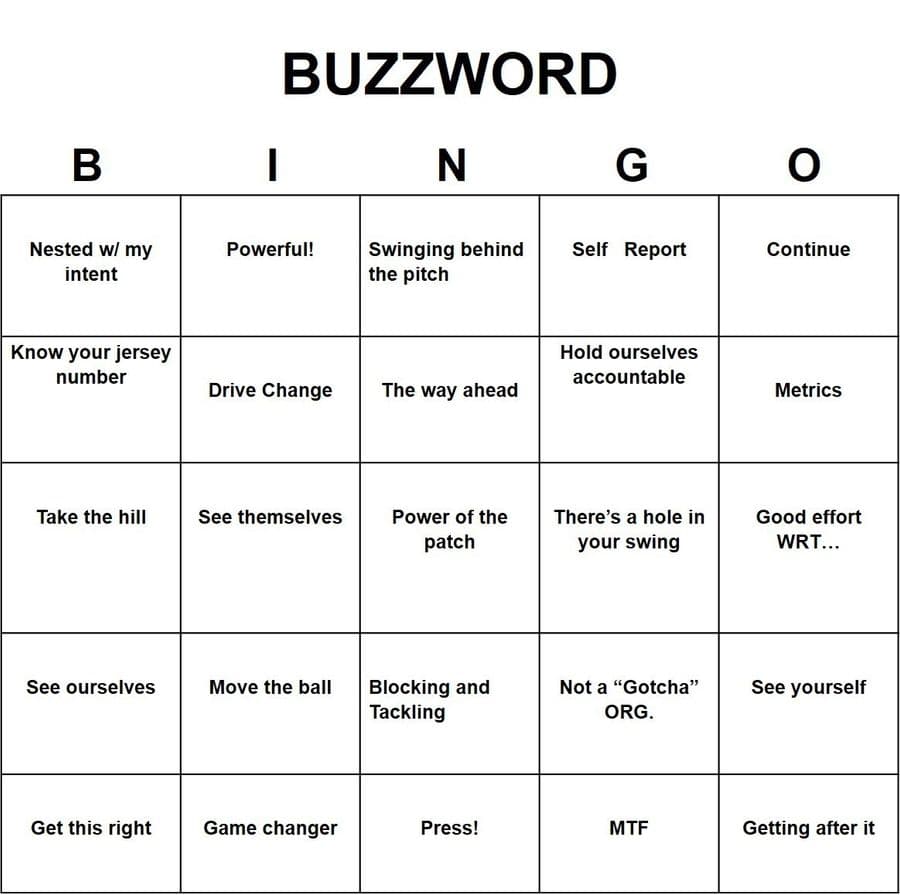
When Buzzwords Masquerade as Strategy
Last updated 12:09 PM EDT • Read time: 7m
In August 2008, Gen. James Mattis did something rare for a senior commander when he ordered a popular concept, effects-based operations, out of the vocabulary of U.S. Joint Forces Command. Mattis published guidance in the Army War College's Parameters, where he said that the ideas behind the concept did not deliver on their advertised benefits. He further said that they should be removed from the Joint Force's lexicon. Reading his memo today, it still serves as a warning about a habit the Defense Department has kept for three decades: adopt an attractive word and treat it as a plan.
Attractive words—buzzwords for this article—have been around for decades. Most recently, there has been a pattern across the military services. For example, Joint Vision 2020 promised full spectrum dominance, the 2022 National Defense Strategy centered on integrated deterrence, and the Army's 2021 Arctic strategy pledged to regain Arctic dominance. Each one of these carries hopeful ambition laced with newfound energy. Unfortunately, each also leaves readers to guess its true meaning.
Defense Department leaders should require plain terms. Further, leaders should require that these terms name the problem they are meant to solve, describe the trade-offs involved, and establish a test to measure success. These three descriptions enabled commanders to describe the goals, measure them, and apply limited budgets to achieve their effects.
Business Strategy Foundations
The world of corporate business has seen similar problems in the past. Business scholars' research applies similarly to defense. Richard Rumelt calls the problem bad strategy in a widely read McKinsey Quarterly essay. Rumelt's four warning signs included fluff—gibberish masquerading as strategic concepts—and he further described mistaking goals for strategy. He argued that good strategy begins with a clear diagnosis of the problem, then sets a guiding policy for dealing with it, and finally commits to a set of coherent actions.
Harvard Business Review (HBR) has published similar observations. In What Is Strategy?, Michael Porter wrote that the essence of strategy is choosing what not to do. Porter showed that strong companies win by making trade-offs, meaning they accept limits in some areas to excel in others. In The Big Lie of Strategic Planning, Roger Martin argued that many organizations confuse detailed planning and budgeting with strategy. Pentagon leaders should heed Martin's warning closely.
Research in HBR also shows the cost organizations pay for vague priorities. Donald Sull, Rebecca Homkes, and Charles Sull surveyed thousands of managers at hundreds of companies in Why Strategy Execution Unravels—And What to Do About It. They found a small minority of employees and leaders who could name their company's top priorities. Their work suggests that the leaders who have to carry out an organization's strategy will struggle the most when their leaders use broad terms or buzzwords.
The Military Version
Joint Vision 2020 provides a clear example of this pattern. The document used the phrase full spectrum dominance, defining it as the ability of U.S. forces to defeat any adversary and control any situation across the full range of military operations. This definition masquerades as a precise definition, yet it belies the limits of place, time, or cost. Full spectrum dominance is a goal without limits, giving planners little help when they have to choose among competing demands. Historian Maria Ryan traces how the idea shaped U.S. irregular warfare after 2001 in Full Spectrum Dominance.
Another example, integrated deterrence, follows the same pattern. The 2022 National Defense Strategy describes it as working seamlessly across warfighting domains, theaters, the spectrum of conflict, all instruments of U.S. national power, and our unmatched network of Alliances and partnerships. This definition names every tool of national power and asks all of them to work together. The definition leaves enough ambiguity to enable each military service to attach its programs to the concept.
The Joint All-Domain Command and Control (JADC2) Strategy displays the danger of ambiguity. The official summary promises information advantage at the speed of relevance, a phrase that sounds good but fails a measurement test.
The Army's 2021 Arctic strategy highlights the problem in a geographic context. In this document, titled Regaining Arctic Dominance, the service states that the Army will restore cold-weather and high-altitude dominance. Its authors deserve credit for including concrete steps toward that vision, including force structure, training, equipment, and infrastructure. However, the strategy repeatedly uses the term dominance without defining the conditions that would demonstrate its success. Without a clear definition, baseline, and measures of progress, the Army cannot show whether its investments have produced dominance.
The Lasting Habit
Organizational research helps explain why capable leaders keep reaching for buzzwords. A study of management fashion in the Academy of Management Review shows that organizations adopt popular techniques and vocabulary partly to signal progress and win approval from outside audiences. For the Pentagon, those audiences can include Congress, allies, and the defense industry. A fresh term provides organizations with an appealing story to follow.
Goal-setting research shows the price of the habit. A summary of 35 years of studies in the American Psychologist found that specific and challenging goals lead to higher performance. Simply urging people to do their best falls short because of the lack of specificity and measurement. Dominance falls into this trap. Describing the Army as dominating the Arctic sounds like encouragement to do its best but falls short of measurable goals. Poorly designed goals can narrow attention and push people toward shortcuts.
The Case for Broad Language
Some critics might argue that broad language is necessary in strategy. Leaders use open-ended language to bind diverse groups, leaving room for adaptation. Big, hairy, audacious goals can rally an organization around a bold aim, allowing employees to draw pride from a confident mission.
Although broad language leaves room for broad adaptation, it falls short when organizations need to spend limited resources and accept risk. Broad language pushes hard choices down the ladder, landing on subordinate staffs and budget offices. At lower levels, people make those hard choices quietly and often inconsistently. Ambiguity is a tool that leaders should balance with clarity, lest the organization as a whole lose sight of its strategy.
A Three-Part Test
Defense leaders can break this habit with a three-question test drawn from business research. Before allowing a buzzword to appear in a strategy, leaders must test it. First, they must determine the problem that the term diagnoses. Without a problem to solve, strategy is aimless. Diagnosis is the core of a good strategy. Next, they must determine the trade-offs. The organization needs to determine what it will stop doing or where it will accept risk. This is the core of risk acceptance. Last, leaders need to know whether they succeeded. Establishing measurable goals allows leaders to see whether they crossed the finish line.
Senior defense leaders should require this test for department-level strategies. The services should apply it to their various strategies and concepts. Congress can reinforce this practice when reviewing a new strategy. A term needs to be able to pass the test to earn its place. A term unable to pass it belongs in a speech. The danger of buzzwords begins when writing the strategy and will not end unless it passes the test.
Conclusion
Mattis showed the problem with popular terms and buzzwords when he retracted their use. Admitting that his 2008 guidance was supposed to smooth and simplify joint operations, but instead generated confusion serves as a guiding light. A strategy will earn trust when it names the problem, makes a choice, and determines the finish line. The Defense Department would benefit from this test in the creation of new strategies that rest on buzzwords. If it continues apace, buzzwords will continue to masquerade as strategy.
Matt Russell is a retired Army infantry officer and strategist. Currently, he is the co-founder and managing partner of Attain Leadership Solutions, LLC, a consulting firm focused on strategy, leadership, and team performance.
Michael Carvelli is an Army officer who writes on strategy, operational planning, protection, and engineering. He has written on large-scale combat operations for Real Clear Defense, War on the Rocks, Parameters, Modern War Institute, and Small Wars Journal.
The views expressed are their own and do not represent those of the U.S. Army, the Department of Defense, or any part of the U.S. government

In Pursuit of Nuclear Abolition
By Peter Huessy • RealClearDefense
Innovation Alone Won’t Prepare the U.S. for the Future Battlefield
By Joshua Segal • RealClearDefense
The sUAS Tactical Trifecta
By Bryan T. Woody • RealClearDefense
The Revolutionary War: When Strategic Options Share the Same Weakness
By Henry Yep • RealClearDefense
The Houthis Are Testing the Limits of Collective Defense
By Saima Afzal • RealClearDefense

Who Shoots Down the Drone Over the Shipyard?
By John Ferrari & Dillon Prochnicki • RealClearDefense
Northrop Grumman Breaks Out the Big Guns at AUSA
By Daniel Terrill, Defense News
Army Pursuing Diverse Array of New Anti-Air Interceptors
By Trevithick, The WarZoneWho Shoots Down the Drone Over the Shipyard?
By John Ferrari & Dillon Prochnicki, RCD
F-35C Lands for the First Time on a Ford-Class Aircraft Carrier
By The Aviationist