
Finland Must Prepare To Defend NATO's Longest Border With Russia
Last updated 09:24 PM EDT • Read time: 5m
Finland’s entry into NATO significantly alters the security environment in Europe. Now that it and Sweden (provisionally) are members of the alliance, the Baltic Sea has been turned into a NATO lake. In addition, NATO proximity to Russia’s Kola Peninsula and Artic naval bases is much improved. But that also means the alliance has suddenly acquired a 1,300 km border with Russia.
Recognizing that it has become a frontline state and seeing the importance of military preparedness underscored by the war in Ukraine, Finland is seeking to rapidly enhance its military capabilities. Its already capable military is adding U.S.-produced fighter aircraft, air and missile defenses, and long-range fires.
The Finnish military has focused for more than eighty years on a single threat: Russian (formerly Soviet) aggression. The lessons of the Russo-Finnish War are likely never far from the minds of Finnish defense leaders. Even after the collapse of the Soviet Union, the country maintained its conscription-based military. Finland’s response to this threat is serving it well in the current era of great power competition. The country has a comprehensive civil defense program with stockpiles of critical military goods, medical supplies, and industrial equipment.
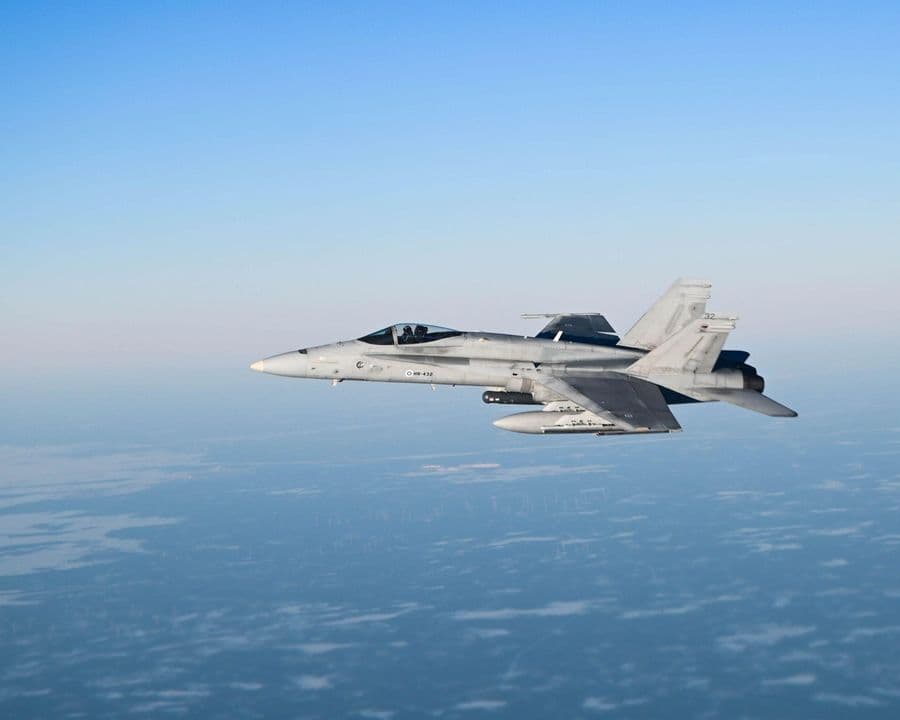
Even before becoming a NATO member, Finland had been slowly modifying its neutral stance. Despite pressure and tacit warnings from Moscow, it acquired Western military equipment, notably F/A-18 fighter jets from the United States. Finland also participated in NATO-led coalition missions in Afghanistan and with the European Union’s Nordic Battlegroup.
Likewise, Finland has been a staunch supporter of Ukraine since the beginning of the war. It provided Kyiv with a range of military hardware from rifles to Leopard mine-clearing tanks and has been involved in NATO efforts to train Ukrainian forces.
Finland’s accession to NATO catapulted it to the alliance’s third spot in terms of total military manpower, behind only the U.S. and Turkey, and just ahead of Poland. In the event of a conflict Finland could mobilize some 900,000 reservists. The Finnish military is said to have the biggest artillery park in Europe, with some 1,500 artillery tubes, rocket launchers and heavy mortars. Although Finland adds the mission of defending a 1,300 km border with Russia to the alliance’s responsibilities, the strength and capability of the Finnish military make it a net exporter of security to the alliance.
Like all NATO countries, Finland is looking to garner lessons from the war in Ukraine for future military requirements. One clear lesson is the need for robust war stocks, particularly of munitions, as well as the ability to resupply forces under conditions of contested logistics. A second lesson is the importance of long-range fires and the means to acquire targets accurately and rapidly. The value of air and missile defenses has become another major theme emerging from this conflict. Finally, given its land border with Russia, Finland must see the value of capable armored platforms being proven in the war in Ukraine.
Finland recognizes the need to modernize its military and ensure interoperability with other key NATO players. That is one reason Helsinki signed a contract to acquire 64 F-35A stealth fighters. According to the Department of State, the United States has $13.6 billion in active government-to-government sales cases with Finland. Recent sales include the Extended-Range Guided Multiple Launch Rocket System; the MK 41 Vertical Launching System; AIM-120 Advanced Medium-Range Air-to-Air Missiles; AGM-158 Joint Air-To-Surface Standoff Missiles; RGM-84Q-4 Harpoon Block II and Extended-Range anti-ship missiles; FIM-92 Stinger anti-aircraft missiles; and RIM-162 Evolved SeaSparrow Missiles. The country is also buying the Israeli David’s Sling for enhanced air and cruise missile defense.
Having experienced an invasion by the Soviet Union that seized significant territory from Finland, Helsinki recognizes the need for strong modern ground forces. The last time the Finns faced the Russians, they were outgunned by the massive Russian artillery force. Since then, the Finns have continuously maintained a large inventory of howitzers, rocket launchers, and heavy mortars. They are increasingly modernizing this capability, with Finland acquiring the U.S.-produced Guided Multiple Launch Rocket System and a number of South Korean K9 Thunder self-propelled howitzers.
As the war in Ukraine has shown, the Finnish Army needs additional armored fighting vehicles. It is already buying new CAVS armored personnel carriers and will likely seek better infantry fighting vehicles as well.
Many NATO members in Eastern Europe have decided that they need new Western-built MBTs. Likewise, the Finnish Army needs better main battle tanks (MBTs). At present, it is relying on around 250 aging German Leopard 2 tanks, some of which it has transferred to Ukraine.
The best MBT that Finland could acquire is the M1A2 Abrams from the U.S. In terms of lethality, survivability, sustainability, and connectivity, the Abrams currently beats all other MBTs currently in production in the West. Moreover, there are plans to develop an advanced variant of the Abrams with an unmanned turret, a hybrid electric drive, the ability to operate drones, and state-of-the-art sensors and communications systems.
The Abrams is currently deployed in Poland with U.S. Armored Brigade Combat Teams. Poland and Romania are both acquiring this platform. Poland is setting up an overhaul depot that can service Abrams tanks for its own army and those of NATO allies. The U.S. is also providing some 31 Abrams tanks to Ukraine. In the case of Finland, operating the M1 would enhance its military’s interoperability with other alliance members.
Acquiring the M1 Abrams for the Finnish Army is the equivalent to buying the F-35 for the Finnish Air Force. Both are platforms around which the Finnish military can build operating concepts to counter potential Russian aggression.
Dan Gouré, Ph.D., is a vice president at the public-policy research think tank Lexington Institute. Gouré has a background in the public sector and U.S. federal government, most recently serving as a member of the 2001 Department of Defense Transition Team. You can follow him on Twitter at @dgoure and the Lexington Institute @LexNextDC. Read his full bio here.

In Pursuit of Nuclear Abolition
By Peter Huessy • RealClearDefense
Innovation Alone Won’t Prepare the U.S. for the Future Battlefield
By Joshua Segal • RealClearDefense
The sUAS Tactical Trifecta
By Bryan T. Woody • RealClearDefense
The Revolutionary War: When Strategic Options Share the Same Weakness
By Henry Yep • RealClearDefense
The Houthis Are Testing the Limits of Collective Defense
By Saima Afzal • RealClearDefense

Who Shoots Down the Drone Over the Shipyard?
By John Ferrari & Dillon Prochnicki • RealClearDefense
Northrop Grumman Breaks Out the Big Guns at AUSA
By Daniel Terrill, Defense News
Army Pursuing Diverse Array of New Anti-Air Interceptors
By Trevithick, The WarZoneWho Shoots Down the Drone Over the Shipyard?
By John Ferrari & Dillon Prochnicki, RCD
F-35C Lands for the First Time on a Ford-Class Aircraft Carrier
By The Aviationist