
New NATO Strategy will Usher in a Renaissance in Allied Operations
Last updated 08:31 PM EDT • Read time: 8m
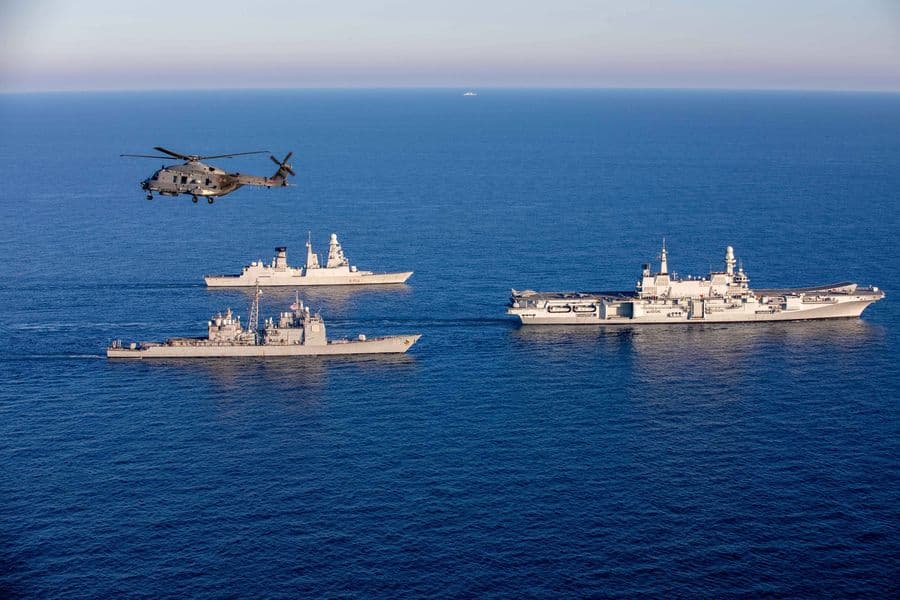
(Feb. 21, 2023) The Ticonderoga-class guided-missile cruiser USS Leyte Gulf (CG 55), bottom left, sails in formation with the Italian aircraft carrier ITS Cavour (C 550) and Orizzonte-class destroyer ITS Caio Duilio (D 554), right, Feb. 21, 2023. The George H.W. Bush Carrier Strike Group is on a scheduled deployment in the U.S. Naval Forces Europe area of operations, employed by U.S. Sixth Fleet to defend U.S., allied, and partner interests. (U.S. Navy photo by MC2 Christine Montgomery)
In the annals of history, moments arise that beckon a reawakening, a revitalization that breathes new life into established institutions. In the realm of international security, NATO stands as an exemplar of collective defense, borne out of the ashes of a fractured world. For decades, this transatlantic alliance has safeguarded peace, forged bonds between nations, and defended the ideals of freedom and democracy. NATO remains the world’s strongest and most powerful alliance.
There is an irony that the catalyst for new and bolder changes stem from Vladimir Putin’s attempt to fracture and weaken the alliance. The illegal invasion of Ukraine has pushed NATO to become stronger, not weaker.
Today, as the world grapples with ever-evolving threats and geopolitical challenges, NATO finds itself on the precipice of a new renaissance—a transformative chapter that holds the promise of a revitalized purpose and enhanced relevance in an increasingly complex global landscape. Like a phoenix ascending from the ashes, NATO's resurgent spirit is poised to shape the destiny of nations and usher in a new era of collective security. As we embark upon this exploration of NATO's evolving trajectory, we delve into the profound factors underpinning this renaissance: (1) new strategy and defense plans, (2) force posture changes, (3) modernized readiness and response mechanisms.
The Concept for Deterrence and Defence of the Euro-Atlantic, commonly referred to as the “DDA,” has proven its worth before and after the Russian invasion of Ukraine. The North Atlantic Council’s (NAC) efforts to review and approve the DDA over the past few years has enabled a coherent and purpose driven response when it mattered most.
This DDA concept and updated framework is linking a family of plans together across regions in a more comprehensible and nested manner. For the first time since the Cold War, Allied Command Operations (ACO) has re-engineered its planning and strategy processes to meet the demands of the rapidly changing environment. General Cavoli, the Supreme Allied Commander Europe (SACEUR), best describes this new approach as “living documents that can be updated as the situation and operating environment requires.” In other words, this is a new level of dynamism that requires changes to force structure, posture, and readiness.
Posturing to Prevail
NATO force posture is undergoing massive change. To understand the nature of this change it is useful to compare the Russian incursions of 2014 and 2022. In the initial illegal invasion of Ukraine and the annexation of Crimea, it took NATO sixteen months to emplace four battle groups into Poland and the Baltic states. Many argued this was more of a political gesture to a military problem, lacking any real readiness and capability to create meaningful effects. No one knows if these forces contributed significantly to deterrence, but NATO is doubling down on integrated capabilities in the East.
Today, Supreme Headquarters Allied Powers Europe (SHAPE) is taking a more holistic approach by implementing the DDA concept across all domains. The 2022 invasion of Ukraine triggered a more rapid and calibrated response. In a matter of weeks four additional battlegroups deployed to Slovakia, Hungary, Romania, and Bulgaria. The NATO Response Force (NRF) and other forces were put under the control of ACO.
With an increase of response options and capabilities, SACEUR now has more than 40K ground forces, 100 plus aircraft, and 25 ships under permanent control. NATO has also seen numerous carrier strike groups going under NATO control for periods of time. Recently this included the George H.W. Bush carrier strike group with an Italian aircraft carrier, ITS Cavour, and a Spanish amphibious assault ship, ESPS Juan Carlos.
During Neptune Strike in February of this year, NATO received an additional 8k sailors, dozens of ships, and numerous maritime air platforms to conduct enhanced deterrence activities with high end military capabilities. This ability to control and exercise forces under ACO at this level, and across domains, is unprecedented and has not been applied since the end of the Cold War. However, the key difference today is the ability to scale up and ramp down forces as needed across multiple countries. This is the result of new readiness and response mechanisms.
Tiered Readiness
The NATO Response Force (NRF) is also undergoing significant change and being replaced by a tiered readiness system. The decades old NRF framework was not fit for purpose in a time compressed operating environment. As announced at the Madrid Summit in June 2022 by the NATO Secretary General, Jens Stoltenberg, the Alliance will adapt its force structure to operate at a higher state of readiness. A new force generation model with dynamic force employment from multiple nations will provide up to 300K forces under the control of SACEUR. This increased force posture and readiness gives the alliance the required mass to defend “every inch of NATO territory.” This new force model integrates units of all types in place to be reinforced by a tiered readiness structure that is informed by a new alert system which anticipates and helps coordinate transitions from peacetime to crisis and conflict. Cutting-edge technology improves the command and decision-making apparatus at all levels of NATO.
NATO command elements are gaining new capabilities to command and control (C2) in multiple domains. Lessons from the last 20 years for out of area operations in Afghanistan, Iraq, and Libya inspired many changes. In the past, the Joint Force Commands (JFCs) became sourcing HQs for operations and the theatre component commands like maritime command (MARCOM) and air command (AIRCOM) ran day to day operations for the alliance in Europe. There is now a complete reversal where the JFCs will manage deterrence for the alliance and the components will source operations and activities with high end capabilities.
As an example, the land headquarters in Izmir, Turkey was aligned more closely with United States Army Europe - Africa (USAREUAR-AF). NATO land forces now have a 4-star commander focused on the underinvestment in the land domain. European armies have been atrophying since 1989.
This new C2 structure will reset HQs with muti domain capabilities that operate under stress for 24 hours a day in continuous and contested environments. Other changes are underway with NATO special operations forces, cyber and space. Overall, these changes help shift the focus on crisis management to resetting the alliance to focus on collective defence. SHAPE will optimize its capacity to operate as a strategic warfighting headquarters.
Conclusion
A new security era in NATO has come by storm and will challenge the alliance for years to come. It will take an adapted approach driving the return of collective defense. Sadly, it will be much more complicated than the Cold War. The key area of control for NATO will extend from the North Tip of Finland to the Turkish and Syrian border. This complex security environment will need to address the Russian Federation across the competition continuum as well as terrorist groups. NATO needs to hone its alert system of indicators and warnings to dynamically employ muti domain effects.
SHAPE is on the rise to become a strategic warfighting headquarters that will use all the tools of the alliance to deter, and if needed, defeat any adversaries that threaten over a billion citizens. This will be done with the DDA and new strategic framework of integrated plans, force posture changes and a new readiness model.
Tough days lay ahead for the alliance but it is poised to meet any demands, just as it did in the challenging Cold War era. The world needs its greatest alliance to remain strong, uphold its treaty obligations, and serve as a beacon of stability and security.
This coming NATO Summit in Vilnius will be decisive to solidify change and maintain positive momentum. A renaissance has begun.
Matthew Van Wagenen is a major general in the U.S. Army currently serving as the Deputy Chief of Staff for Operations (DCOS OPS) in the NATO Supreme Headquarters Allied Powers Europe (SHAPE).
Arnel P. David is a colonel in the U.S. Army completing a PhD at King’s College London. A recent distinguished graduate from the Joint Advanced Warfighting School and National Defense University Scholar, Arnel is the cofounder of Fight Club International and his books include Military Strategy in the 21st Century and Warrior Diplomats.
The views and opinions expressed are those of the authors and do not reflect any entity or organization of the U.S. Government or NATO.

Putin, Plague, and the America’s Biodefense Gap
By Ryan Kane • RealClearDefense
From Hormuz to the South China Sea: Defending Freedom of Navigation in Contested Waters
By David F. Lasseter • RealClearDefense
Checklist for Modern Conflict Readiness
By Sergey E. Ivashchenko • RealClearDefense
AUTOWARCOM Is Heading for a Command-and-Control Collision
By Michael Carvelli • RealClearDefense
The Unfinished Reform
By Mark W. Castillon • RealClearDefense
From Hormuz to the South China Sea: Defending Freedom of Navigation in Contested Waters
By David F. Lasseter • RealClearDefense
Winning the Data Advantage
By Turin Pollard • RealClearDefense
The F/A-XX and the AIM-260 Reclaim the Perimeter
By Bruce Allen Lubbering • RealClearDefenseWinning the Data Advantage
By Turin Pollard, RealClearDefenseThe F/A-XX and the AIM-260 Reclaim the Perimeter
By Bruce Allen Lubbering, RCD