
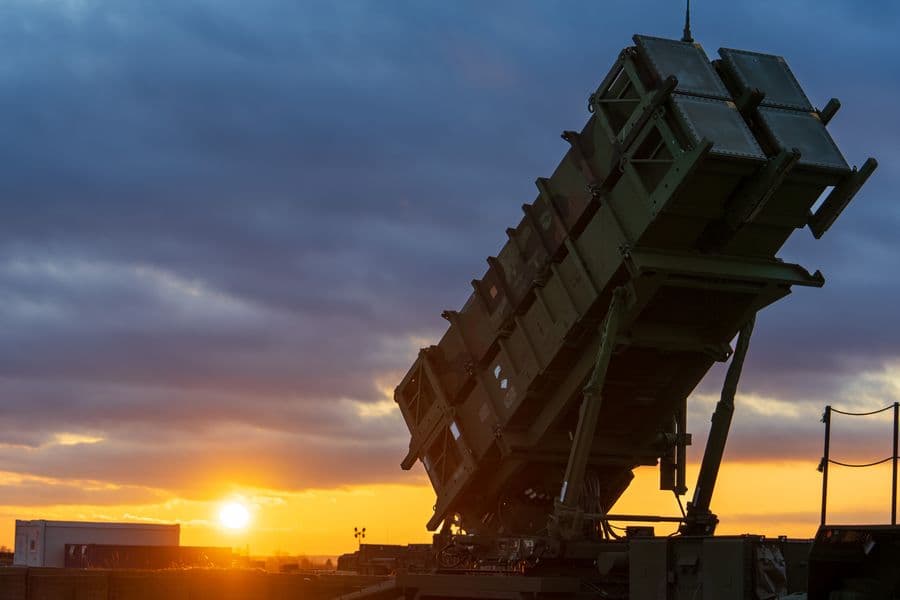
For the past nine months, the 5th Battalion, 7th Air Defense Artillery Regiment (5-7 ADA) has provided Patriot missile defense in Poland, supporting ongoing missions in Europe to assure NATO allies and deter Russian aggression. On Jan. 31, 2025, German Patriot missile launchers will replace those from 5-7 ADA, allowing the battalion to return to Baumholder, Germany, where they will train, equip, and modernize in preparation for future missions. (U.S. Army photo by Capt. Alec Watkins)
Patriot Delays Force a New Air Defense Doctrine on NATO’s Eastern Flank
Last updated 05:43 AM EST • Read time: 5m
Expected delays in U.S. Patriot deliveries to Poland have exposed a critical vulnerability in NATO’s reliance on traditional Foreign Military Sales for high-end air defense. Coupled with the unsustainable cost-exchange ratio of firing multi-million-dollar interceptors at cheap Russian drones, frontline states are pivoting from off-the-shelf procurement to localized industrial co-production of low-cost counter-UAS networks. If Washington wants to maintain its defense market dominance in Central Europe, U.S. primes must urgently establish joint manufacturing and maintenance hubs on allied soil.
At this week’s Warsaw Security Forum, two seemingly separate announcements revealed a structural shift in how NATO’s frontline states plan to defend their skies. On Tuesday, just as a senior Polish military commander warned that scheduled deliveries of U.S.-made Patriot air defense systems to Poland are expected to face delays, Polish Defense Minister Władysław Kosiniak-Kamysz issued a blunt ultimatum to international defense primes: future contracts depend on establishing manufacturing and maintenance facilities inside Europe. Hours later, Norwegian defense group Kongsberg answered that call, unveiling a $51 million investment to build a new counter-drone production plant in northern Poland.
Taken together, these developments signal the end of NATO’s post-2022 emergency procurement phase. For the past four years, Eastern Flank capitals treated Washington’s Foreign Military Sales (FMS) pipeline as an insurance policy, buying American hardware off the shelf to plug immediate capability gaps. Today, backlogged U.S. production lines and the brutal economics of modern aerial attrition are forcing Warsaw and its Baltic neighbors to rewrite both their air defense doctrines and their industrial strategies.
The Tyranny of Backlogs and Cost-Exchange Ratios
Poland currently allocates roughly 4.8 percent of its GDP to defense—the highest proportion in NATO—and serves as the primary European customer for flagship American platforms, including Abrams tanks, F-35 fighters, Apache helicopters, and Patriot batteries under its mid-range Wisła air defense program. Yet financial commitment cannot buy industrial capacity that does not exist. With U.S. assembly lines strained by global commitments in Ukraine and the Middle East, waiting years for backlogged PAC-3 MSE interceptors leaves dangerous operational windows along NATO’s eastern border.
To mitigate this gap in the short term, allies are resorting to ad-hoc rotational patches. Last week, Stockholm confirmed it will deploy a Swedish Patriot unit and approximately 100 troops to Poland starting December 1 to help shield the critical logistics hub in Rzeszów. While Sweden’s deployment demonstrates admirable Nordic-Baltic solidarity, shuffling scarce high-end batteries from one frontline sector to another does not solve the Alliance’s underlying deficit.
More importantly, even if Patriot deliveries were arriving ahead of schedule, high-tier surface-to-air missiles cannot address the primary aerial threat facing the Eastern Flank. As defense industry leaders warned during recent European resilience panels, NATO cannot protect thousands of dispersed critical infrastructure nodes using conventional air defense systems alone. Firing a $4 million interceptor at a $30,000 Russian one-way attack drone or decoy is a path to rapid magazine depletion and fiscal exhaustion.
Warsaw’s response is the SAN counter-unmanned aerial system (C-UAS) program, a bilateral industrial effort pairing Poland’s state-owned PGZ consortium with Kongsberg. By building a permanent manufacturing facility in Poland’s Pomeranian region—backed by over 200 million zlotys in initial capital and aligned with the European Union’s $51 billion SAFE defense loan mechanism—Poland is securing sovereign supply chain depth for the bottom tier of its air shield. Integrating programmable 30mm cannon ammunition, low-cost guided rockets, and dedicated drone interceptors, the SAN architecture is designed to absorb massed saturation attacks while preserving precious Patriot and CAMM missiles for high-speed ballistic and cruise missile threats.
Why Off-the-Shelf Buying No Longer Works
Skeptics in Washington and Brussels often argue that establishing new factories across Eastern Europe fragments the defense industrial base and delays immediate fielding. From a purely peacetime efficiency standpoint, expanding a single existing assembly line in the United States or Western Europe appears faster than building a greenfield facility on the Baltic coast that will not reach serial production until the first half of 2028.
However, that argument ignores the operational realities of modern high-intensity warfare. First, Ukraine’s experience proves that counter-drone warfare evolves on a six-week software and hardware cycle. Relying on a trans-Atlantic supply chain—or awaiting export licenses for minor sensor modifications—renders C-UAS systems obsolete before they reach the field. Forward-deployed factories allow engineers to adapt radar algorithms, electronic warfare frequencies, and kinetic effectors directly alongside frontline units.
Second, logistics depots and repair hubs located thousands of miles from the theater cannot sustain a military once hostilities begin. When Polish officials urge Europe to switch to "war-mode" defense production, they are referring to battle-damage repair and ammunition replenishment within kilometers of the operational zone. Without local maintenance centers and domestic component manufacturing, Poland’s massive fleet of imported hardware risks becoming a hollow deterrent after the first month of high-intensity combat.
Strategic Implications for Washington and NATO
The message emerging from Warsaw this week carries clear lessons for Pentagon planners and American defense executives. The era in which Eastern European allies unconditionally signed multi-billion-dollar FMS checks for turnkey American systems without demanding deep industrial reciprocity is closing.
European competitors and agile Nordic firms are moving aggressively to fill the void, leveraging EU financing instruments like EDIRPA and SAFE to lock in long-term co-production partnerships. If U.S. defense primes wish to retain their strategic foothold on NATO’s Eastern Flank, Washington must streamline technology transfer bottlenecks and fast-track joint ventures that place final assembly, interceptor energetics, and depot-level maintenance directly on Polish and Baltic soil.
For NATO’s military command, the priority must shift toward inverting the air defense pyramid. High-end systems like Patriot remain indispensable against Russian ballistic missiles, but they must be treated as a silver-bullet reserve rather than a default shield. By pairing localized production of affordable counter-drone networks with distributed European maintenance hubs, the Eastern Flank can build an air defense architecture capable of surviving a protracted war of attrition—without waiting on backlogged trans-Atlantic supply lines.
Jan K. Varga (pen name) is an independent defense and geopolitical analyst based in Warsaw, Poland. His research focuses on NATO’s Eastern Flank security architecture, modern military doctrines, and great power competition in Central and Eastern Europe.

Beyond Hormuz: What Washington Should Expect from a Frontline Ally
By Daewon Cho • RealClearDefense
Putin, Plague, and the America’s Biodefense Gap
By Ryan Kane • RealClearDefense
Patriot Delays Force a New Air Defense Doctrine on NATO’s Eastern Flank
By Jan K. Varga • RealClearDefense
How the Army Can Turn Plans into Combat Power
By Matt Russell • RealClearDefense
Is It Déjà vu All Over Again: The 2012 Report on Global Zero
By Peter Huessy • RealClearDefense

U.S. Marine Corps Attack Helicopters Set for Major Upgrade
By C. Jones, Defence Blog
How the Iran War Compounded the U.S. Navy’s Maintenance Crisis
By Hartung, NatInt
Fielding Forces for Full Mobilization
By Jon Hoffman, Proceedings
BAE’s New Launcher Lets Warships Deploy and Replenish Missiles at Sea
By NextGenD
Why Is the Navy Spending $19 Billion on ‘Flying Gas Stations’?
By Mark Thompson, RS