
Weekly Recon – NATO Resolve, Arming Ospreys, Future Frigates
Last updated 05:47 PM EDT • Read time: 6m
Good Saturday morning and welcome to Weekly Recon. On this day in 1942, a Japanese floatplane drops incendiary bombs on an Oregon state forest – the first and only attack on the U.S. mainland in the war. Launching from the Japanese sub I-25, Nobuo Fujita piloted his light aircraft over the state of Oregon and firebombed Mount Emily, alighting a state forest–and ensuring his place in the history books as the only man to ever bomb the continental United States.
Ground Truth
Russia will kick off its 100,000 troop strong Zapad exercise next week, with many wondering if NATO could pull off a similar feat. The short answer: No. Although NATO was united against a common threat during the Cold War, NATO forces were never a match for their Soviet adversaries, nor current Russian forces in the post-Cold War era. Zapad serves to highlight NATO’s lack of resolve and quantitative deficiencies. NATO has not conducted a large-scale exercise like Zapad in decades. In contrast, Zapad is a Soviet-era carry over that Russia never ceased, maintaining operational experience while updating with tactics used in Crimea, Ukraine, and Georgia. Will NATO have a qualitative and quantitative response, not to mention - resolve?
The Marines could soon have their first female infantry officer. A female lieutenant is now in the Marine’s infantry officer course (IOC) pipeline and has advanced further than any female to date. Potentially succeeding where 30 others had failed, her final major barrier will be PALMFEX, which is a “multi-objective live-fire exercise conducted at Twentynine Palms in California…” If the lieutenant completes IOC, she will graduate with her class on September 25.
Air Superiority
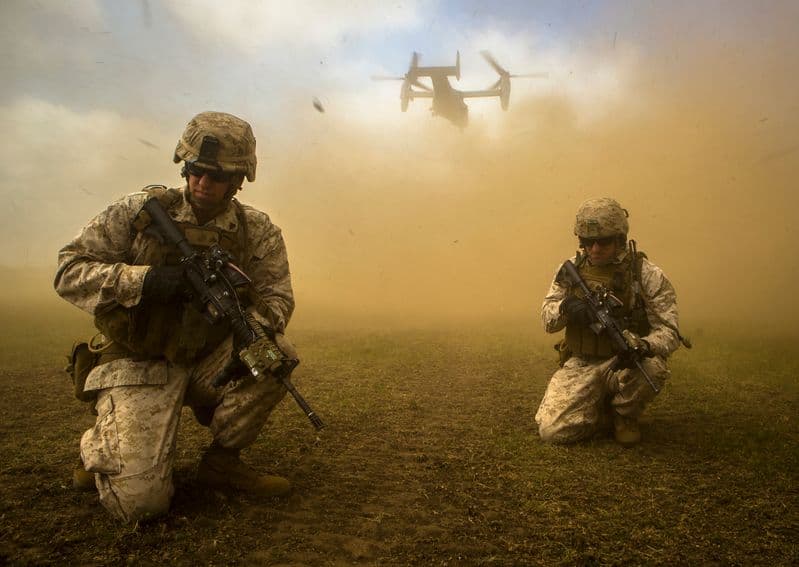
What could make the MV-22 Osprey better? Adding laser guided weapons, rockets, and heavy machine guns, and that is just what the Marine Corps is planning to do. The Marines are looking to put heavy guns and 2.75inch laser-guided rockets on its Ospreys in the near-term. This will make the aircraft more capable of future amphibious operations and enhance its ability to defend itself, something that has plagued the aircraft since inception.
Regarding Marine Corps Aviation, two officers recently contend that less would be more. Lt. Col. John Arsenault, Ret. USMC, contends that the Corps should: leave support and most aviation roles to the Navy, downsize to 100,000 troops, and pivot back to its roots as a maritime raiding force. Adding fuel to the argument, Lt. Brian Hayes, USNR, argues that the Marines are “throwing good money into bad Hornets,” and that the Corps should ditch its fleet of F/A-18s out right, given that only 31% of the planes are reported to be presently airworthy.
The Air Force’s OA-X competition completed its first round this week but provided no insight into the future of light attack. Secretary of the Air Force Heather Wilson told Defense News and the Air Force Times in a joint interview that it could be December or January before the Air Force even decides if OA-X will continue as planned. If the program does move forward, selected planes will take part in real-world combat demonstrations in active war zones.
Blue Waters
The British Royal Navy’s frigate fleet is facing a critical capability gap until “around 2030.” Following the withdrawal of the Harpoon missile in 2018, the Royal Navy does not expect its Type 26 frigates (and eventually Type 31 frigates) to field an anti-ship missile for over a decade. The fleet will instead rely on helicopter-borne and submarine based anti-ship weapons in the interim, but the helicopters will not get anti-ship capabilities until 2020.
The House Armed Services Committee grilled Navy officials Thursday regarding the spate of collisions involving ships from the Navy’s 7th Fleet. Vice Chief of Naval Operations Adm. William Moran told the committee that a lack of training and budget constraints were at the root of the collisions, but was quick to add that these were not excuses. A recent GAO report found the Navy to be in a serious state of disrepair, finding sailors to be overworked and undertrained, also questioning the service’s ability to operate the planned 355-ship fleet. John Pendelton of the GAO, who testified before the HASC on Thursday, wrote in his prepared statement: “Looking to the future, the Navy has plans to grow its fleet by as much as 30 percent, but it has not yet shown the ability to adequately man, maintain, and operate the current fleet.”
China’s People’s Liberation Army Navy (PLAN) has advanced its capabilities as a naval power with the commissioning of its first Type 901 Aircraft Carrier Replenishment Ship. This follows the declaration of the Liaoning aircraft carrier’s combat readiness and the commissioning of the country’s first domestically built Type 001A aircraft carrier. The Type-901 will allow Chinese carriers to refuel and restock at sea, expanding its operational range – a step closer to a truly “blue water navy.”
Space Wars
SpaceX, racing against the fast approaching Hurricane Irma, successfully launched the U.S. Air Force’s secretive X-37B spacecraft into orbit on Thursday. This marks the highest profile military launch for SpaceX, coming just one year after its future as a military contractor was in serious doubt.
The Fifth Domain
The world is in a perpetual state of cyberwar, and chances are that it is taking place in your own back yard. A recent report found that Russian-linked hacking groups hacked over 100 conventional and nuclear power plants in the last year, fifty of which were in the U.S. The group called “Dragonfly” – which was able to cause blackouts across Ukraine in 2015 and 2016 – was also found to have been the culprit in breaches of U.S. power plants. The group was also found to have hacked operational networks that control plant function, although they have not perpetrated any nefarious actions using that access – yet.
Private military contractor, TigerSwan, is in hot water after resumes submitted to the company, many from applicants with top-secret clearances working at DoD and in the Intelligence Community, as well as Afghan and Iraqi nationals that cooperated with U.S. forces in their home country, were left unsecured without a password on an Amazon server. TigerSwan blames a subcontractor, TalentPen, contending that its servers were never breached. Many of the details in the exposed resumes were of an extremely sensitive nature and included identifying information on many of the applicants, including home addresses, phone numbers, and more. The files have now been secured, but the extent of the damage done is unclear at this point.
SEND RCD YOUR INPUT: Please send your tips, suggestions, and feedback to editors@realcleardefense.com. Make sure to follow us on Twitter at @RCDefenseand follow Blake Baiers @BlakeBaiers.

In Pursuit of Nuclear Abolition
By Peter Huessy • RealClearDefense
Innovation Alone Won’t Prepare the U.S. for the Future Battlefield
By Joshua Segal • RealClearDefense
The sUAS Tactical Trifecta
By Bryan T. Woody • RealClearDefense
The Revolutionary War: When Strategic Options Share the Same Weakness
By Henry Yep • RealClearDefense
The Houthis Are Testing the Limits of Collective Defense
By Saima Afzal • RealClearDefense

Who Shoots Down the Drone Over the Shipyard?
By John Ferrari & Dillon Prochnicki • RealClearDefense
Northrop Grumman Breaks Out the Big Guns at AUSA
By Daniel Terrill, Defense News
Army Pursuing Diverse Array of New Anti-Air Interceptors
By Trevithick, The WarZoneWho Shoots Down the Drone Over the Shipyard?
By John Ferrari & Dillon Prochnicki, RCD
F-35C Lands for the First Time on a Ford-Class Aircraft Carrier
By The Aviationist