
Withdrawing From Germany – Consolidating EUCOM's Combat Power
Last updated 04:47 PM EDT • Read time: 4m
The Pentagon’s decision to withdraw several thousand troops from Germany, moving some back to the U.S. and others elsewhere in Europe, has engendered much controversy. There is, for example, good reason to argue that it does nothing to strengthen NATO’s forward presence. Yet parts of the plan certainly do make good sense. The redeployment of air assets, for example, would make U.S. presence in Europe more survivable, cost-effective, sustainable and versatile.
For the last seven years, the vast majority of the nearly 5,000 airmen at Spangdahlem AB, Germany, have supported a flying wing whose operational mission is pretty much limited to supporting just one U.S. fighter squadron. If you’re prone to complain about waste within the Defense Department, the inefficiencies of that tooth-to-tail ratio are more than worth writing home about. But the debilitating operational impact of locating that single squadron in Germany is even more concerning.
The U.S. fighter force has shifted to fighting at night, which means its pilots need to spend most of their time training in that environment. Unfortunately, the German government prohibits military aircraft from flying after 10:00 PM and, with late summer sunsets, U.S. fighter pilots have no ability to train for night operations from mid-May through the end of August. Germany’s night flight restrictions, as well as its limitations on low altitude and weekend operations, make sustaining any real form of combat readiness a real challenge.
There are other limitations as well. The size and location of bombing and electronic countermeasure ranges are already inadequate for the needs of the F-16, and the Air Force is in the process of replacing that fleet with F-35s, which need four times the air and range space made available by Merkel’s government. And that’s with just one U.S. fighter squadron based there; any viable fighter wing needs three.
The Air Force now has the fewest fighter squadrons in its history, which means those assets need to be ready to deploy to fight anywhere in the world, while somehow training replacement pilots to feed those operations. Because of limitations of manning and low fighter mission-capable rates, a wing with a single squadron could deploy just 18 of its 24 fighters. And, the aircraft and personnel left behind couldn’t train replacements because the equipment needed to support flight operations deploys with the 18 fighters. By moving Spangdahlem’s single squadron to join the two squadrons at Aviano, Italy, the Air Force will actually increase its fighting and training capacity without any additional funding or aircraft.
The move to Italy won’t be cheap, but the Air Force may save even more by not executing a plan it had on the books to move the 100th Refueling Wing and the 352nd Special Operations Wing from Mildenhall, England, to Spangdahlem. Unlike other countries, the U.K. has never constrained the USAF’s ability to deploy, operate or support combat operations from that island nation (think Libya Raid in 1986). By its very nature, the 352nd Special Operations Wing flies almost exclusively at night and, proximity to the threat aside, moving them to Germany with its night restrictions never made sense. The Air Force will actually be better for this move, as will European Command (EUCOM).
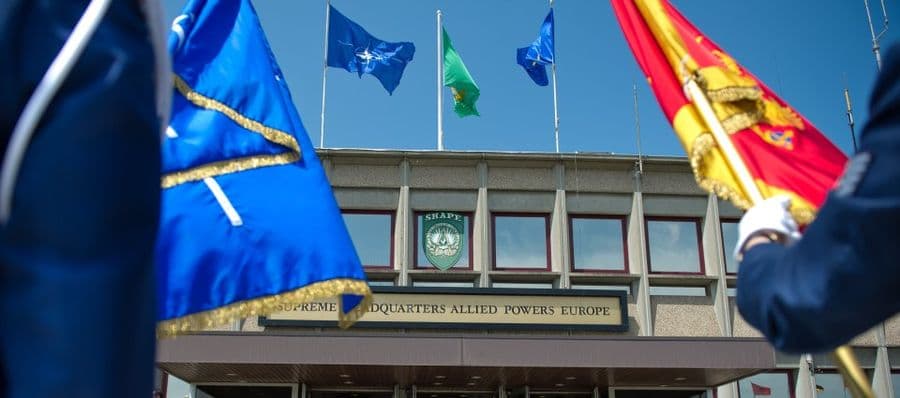
Since 1967, EUCOM headquarters has been located at Stuttgart, Germany—some 330 miles away, but EUCOM’s commander and his immediate staff at Supreme Headquarters Allied Powers Europe (SHAPE) in Mons, Belgium. Secretary Esper’s direction to reduce troops based in Germany will also consolidate EUCOM into a single location, which will markedly streamline that combatant command’s efforts.
EUCOM’s consolidation and the increased combat capacity and capability of U.S. fighter assets based in Europe are two moves that should have been made years ago. They are the right moves to make now.
A 25-year veteran of the U.S. Air Force, John “JV” Venable is a senior research fellow in The Heritage Foundation’s Center for National Defense. James Jay Carafano is a Heritage vice president, directing the think tank’s research in matters of national security and foreign relations.

In Pursuit of Nuclear Abolition
By Peter Huessy • RealClearDefense
Innovation Alone Won’t Prepare the U.S. for the Future Battlefield
By Joshua Segal • RealClearDefense
The sUAS Tactical Trifecta
By Bryan T. Woody • RealClearDefense
The Revolutionary War: When Strategic Options Share the Same Weakness
By Henry Yep • RealClearDefense
The Houthis Are Testing the Limits of Collective Defense
By Saima Afzal • RealClearDefense

Who Shoots Down the Drone Over the Shipyard?
By John Ferrari & Dillon Prochnicki • RealClearDefense
Northrop Grumman Breaks Out the Big Guns at AUSA
By Daniel Terrill, Defense News
Army Pursuing Diverse Array of New Anti-Air Interceptors
By Trevithick, The WarZoneWho Shoots Down the Drone Over the Shipyard?
By John Ferrari & Dillon Prochnicki, RCD
F-35C Lands for the First Time on a Ford-Class Aircraft Carrier
By The Aviationist