
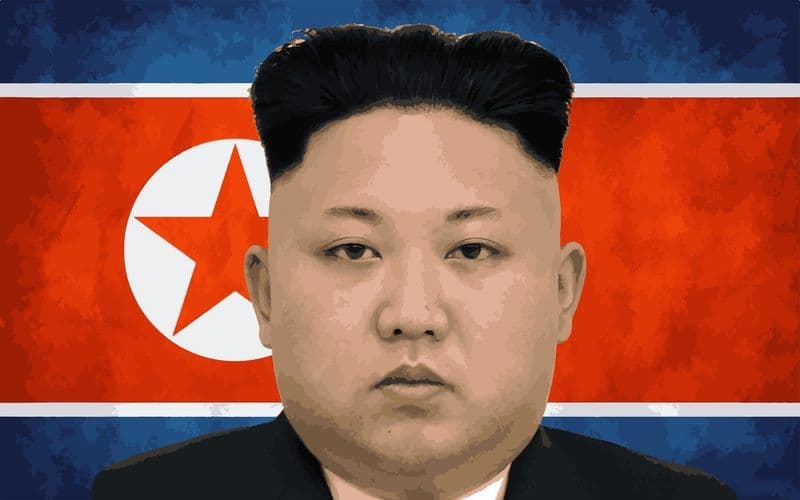
Confident Kim
Last updated 05:29 PM EDT • Read time: 5m
As international concern mounts about North Korea’s nuclear and missile programs, recent events suggest a Pyongyang strongly interested in a new round of talks—or at least in talks with South Korea and the U.S., if not with Japan.
Skeptics say we’ve been here before, and that previous negotiations—and agreements—have proven to be mere speed bumps on a long road to actual North Korean nuclear capabilities. Even joint North–South declarations in favour of denuclearisation of the peninsula have proven no more effective. But in his latest post, Ron Huisken argues that Kim Jongâ??un might now actually want to cut a deal. That’s an intriguing possibility. So should we be more hopeful this time around?
Let’s start with Kim Jongâ??un himself. He’s riding high at the moment. He has solidified the Kim Jongâ??il—Ko Yongâ??hui line within the ruling family. He’s killed off his half-brother, Kim Jongâ??nam, and promoted his sister, Kim Yoâ??jong, to the country’s politburo. He’s seen his sister fêted as the belle of the ball at the Winter Olympics.
And during the last year, the results of his nuclear and ballistic-missile tests have probably exceeded his wildest expectations. He’s successfully tested two new intercontinental-range ballistic missiles (ICBMs) and a thermonuclear device. The result must surely be a young leader in Pyongyang who feels more secure and confident than he did a year or so ago.
How does that observation help us in our thinking about the broader problem? Let’s apply the Theory of the Confident Kim and see where it takes us. First, it’s not unreasonable to assume that a Kim Jongâ??un more at ease with his immediate security and the acceptability of his regime to the wider world is also a Kim Jongâ??un more willing to look towards his longer-term ambitions.
After all, he’s still young. He can probably expect his period of rule to resemble more closely that of his grandfather (46 years) than that of his father (17 years). At the moment, Kim Jongâ??un has been in the saddle for a little over six years. So, in round numbers, he might—confidently–anticipate another 40.
Secondly, he’s probably not just thinking about the long game, but also about the appropriate breadth of his own ambitions. Within a relatively short space of time, he has managed to reverse North Korea’s strategic fortunes and to reset the agenda in Northeast Asia. An American president has agreed to meet with him. Over the coming decades, he probably hopes to achieve much more.
Those ambitions almost certainly include pushing the U.S. off the Korean peninsula and encouraging the emergence of a South Korea more accommodating to Pyongyang’s wishes. They might also include eventual reunification with South Korea—as long as that can be achieved on terms Pyongyang would find advantageous. And on that point, it’s important to remember the status the first family already enjoys in North Korea. Kim’s currently treated as a deity—would he settle for being a bog-standard politician?
Thirdly, we should expect a more confident Kim to find ways of signalling that he is his own master. In this regard, it’s worth recalling that Kim is—apparently—willing to accept a freeze on further nuclear and missile testing while negotiations are underway without requiring a similar freeze on U.S.–South Korean military exercises. Given that the freeze-for-a-freeze proposal is China’s public position, it’s hard to imagine a clearer signal that Kim Jongâ??un doesn’t see himself as China’s puppet.
Moreover, both his prominence in the talks with the visiting South Korean delegation and his offer of direct talks with President Donald Trump are signs of the more confident Kim reaching out and interacting with the world.
Fourthly, though—and this is the crunch point—we shouldn’t delude ourselves that a more confident and secure Kim Jongâ??un would be in any hurry to give up his nuclear arsenal. His confidence derives, in large part, from those very capabilities. He believes that thermonuclear-tipped ICBMs deter U.S. intervention on behalf of its allies and give him greater freedom of manoeuvre in Northeast Asia.
Certainly he understands that possible future denuclearisation is an important carrot to keep the U.S., South Korea and Japan diplomatically engaged. And diplomatic engagement is essential to getting the security assurances and economic assistance that Kim wants.
But he’s likely to see his nuclear capabilities as something to be given up only slowly, sparingly and selectively, if at all. Full denuclearisation probably won’t happen faster than it has taken for North Korea to nuclearise, and that’s been a project spanning decades. Indeed, getting to zero via a negotiated settlement might be achievable only in the context of broader nuclear disarmament.
So, is Kim looking to cut a deal? Yes, probably. Isn’t that good news? Not necessarily: the problem concerns the nature of the deal he’s willing to cut. To put it bluntly, a more confident Kim is probably more willing to bargain but less willing to compromise. And that means the international community still faces a daunting set of challenges on the Korean peninsula. We aren’t out of the woods on this one, regardless of how the upcoming summits unfold.
Rod Lyon is a senior fellow at ASPI.

In Pursuit of Nuclear Abolition
By Peter Huessy • RealClearDefense
Innovation Alone Won’t Prepare the U.S. for the Future Battlefield
By Joshua Segal • RealClearDefense
The sUAS Tactical Trifecta
By Bryan T. Woody • RealClearDefense
The Revolutionary War: When Strategic Options Share the Same Weakness
By Henry Yep • RealClearDefense
The Houthis Are Testing the Limits of Collective Defense
By Saima Afzal • RealClearDefense

Who Shoots Down the Drone Over the Shipyard?
By John Ferrari & Dillon Prochnicki • RealClearDefense
Northrop Grumman Breaks Out the Big Guns at AUSA
By Daniel Terrill, Defense News
Army Pursuing Diverse Array of New Anti-Air Interceptors
By Trevithick, The WarZoneWho Shoots Down the Drone Over the Shipyard?
By John Ferrari & Dillon Prochnicki, RCD
F-35C Lands for the First Time on a Ford-Class Aircraft Carrier
By The Aviationist