
Poll: Most Americans, South Koreans Back Summit
Last updated 05:27 PM EDT • Read time: 3m
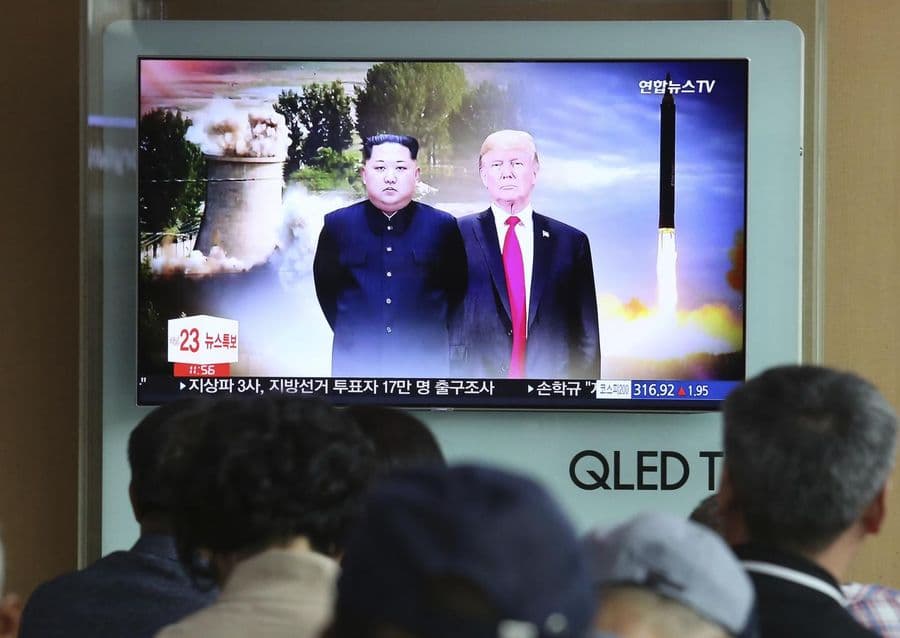
On the eve of President Trump’s historic meeting with North Korean leader Kim Jong Un, world leaders are uneasy about what may transpire in Singapore, and U.S. foreign policy experts are openly divided.
But what about the people who have the most to gain—or to lose—regarding tensions between the United States and North Korea? In a poll of South Koreans and Americans commissioned by the Charles Koch Institute and RealClearPolitics, the two groups dovetailed in a number of key areas:
- A vast majority of Americans (70 percent) say that Trump should meet with North Korea’s leader. In South Korea, this optimism is even higher, at 81 percent.
- Regarding Trump’s ultimate objective -- denuclearization of the peninsula – 46 percent of South Koreans believe that it will be achieved, compared to 31 percent of Americans.
- About one-fourth of respondents in South Korea and the U.S. believe relations are already improving between their country and North Korea.
Although there were differences regarding the strategy to deal with North Korea, both Americans and South Koreans believe that engagement is key. Attitudes diverge regarding sanctions to garner positive outcomes: Americans are more likely to favor this approach than are South Koreans, who are less likely to believe such leverage will produce positive results.
If North Korea fails to denuclearize, both Americans and South Koreans believe that a combination of sanctions and nuclear deterrence are key going forward, but South Koreans favor the latter over the former. In either case, only a small minority of either Americans or South Koreans say that war or preemptive strikes should be part of any strategy toward North Korea.
The two allies also diverge over North Korea’s motives for pursuing nuclear arms. Perhaps surprisingly, more Americans feel threatened, believing that the Kim regime has the intent to use the weapons to attack. Three-fourths of South Korean respondents believe that North Korea is using its nuclear capability as a tactic to relieve the current sanctions regime.
As a former member of the military and a student of strategy and international relations, I was struck by another key area of divergence -- the prospect of withdrawing U.S. troops from the peninsula. Forty-five percent of South Koreans want U.S. troops to remain in their country indefinitely -- more than twice the percentage of Americans who feel this way.
South Koreans also believe that an end to the 65-year-old armistice is more important than denuclearization as a condition for a withdrawal of U.S. forces.
As a reminder that even geopolitics is local, the pollsters asked residents in each country, “Which country do you think is the greatest threat to your country’s safety?”
Among Americans, the “winners” in this dubious category were North Korea and Russia in a dead heat – with both at 24 percent. China was third at 12 percent, with Iran next at 8 percent.
In South Korea, the answers were North Korea (46 percent); China (30 percent); Japan (18 percent); the United States (14 percent). Russia came in a distant fifth at 2 percent. Iran barely registered.
The poll of 1,000 respondents in the United States and 700 in South Korean was conducted June 4-6 by Survey Sampling International. The margin of error for the larger group is plus or minus 3.1 percentage points and plus or minus 3.7 for the smaller group.
David Craig is the editor for RealClearDefense.

In Pursuit of Nuclear Abolition
By Peter Huessy • RealClearDefense
Innovation Alone Won’t Prepare the U.S. for the Future Battlefield
By Joshua Segal • RealClearDefense
The sUAS Tactical Trifecta
By Bryan T. Woody • RealClearDefense
The Revolutionary War: When Strategic Options Share the Same Weakness
By Henry Yep • RealClearDefense
The Houthis Are Testing the Limits of Collective Defense
By Saima Afzal • RealClearDefense

Who Shoots Down the Drone Over the Shipyard?
By John Ferrari & Dillon Prochnicki • RealClearDefense
Northrop Grumman Breaks Out the Big Guns at AUSA
By Daniel Terrill, Defense News
Army Pursuing Diverse Array of New Anti-Air Interceptors
By Trevithick, The WarZoneWho Shoots Down the Drone Over the Shipyard?
By John Ferrari & Dillon Prochnicki, RCD
F-35C Lands for the First Time on a Ford-Class Aircraft Carrier
By The Aviationist