
Trump's Opportunity To Re-Engage Kim Jong Un
Last updated 07:10 AM EDT • Read time: 5m
As if the world needed more drama, the appearance of Chinese President Xi Jinping alongside Russia’s Vladimir Putin and North Korea’s Kim Jong-un at a recent military parade in Beijing has energized the doomsayers in the West.
Much has been made of the supposed dangers of warming Russian-Chinese relations but the presence of North Korea at the parade also has some alarmed, especially in South Korea. By welcoming Kim Jong-un, it appears China is trying to normalize its smaller neighbor.
There are reasons to be concerned about this but it’s far too early to hit the panic button.
Even as the Japanese prime minister steps down, no major Asian partner of the U.S. has seen more political tumult in the last year than South Korea. Former president Yoon Suk Yeol was impeached after suddenly declaring martial law last December. Now, the new leadership of Lee Jae Myung has been damaged by the pressures of tariff negotiations with the Trump administration.
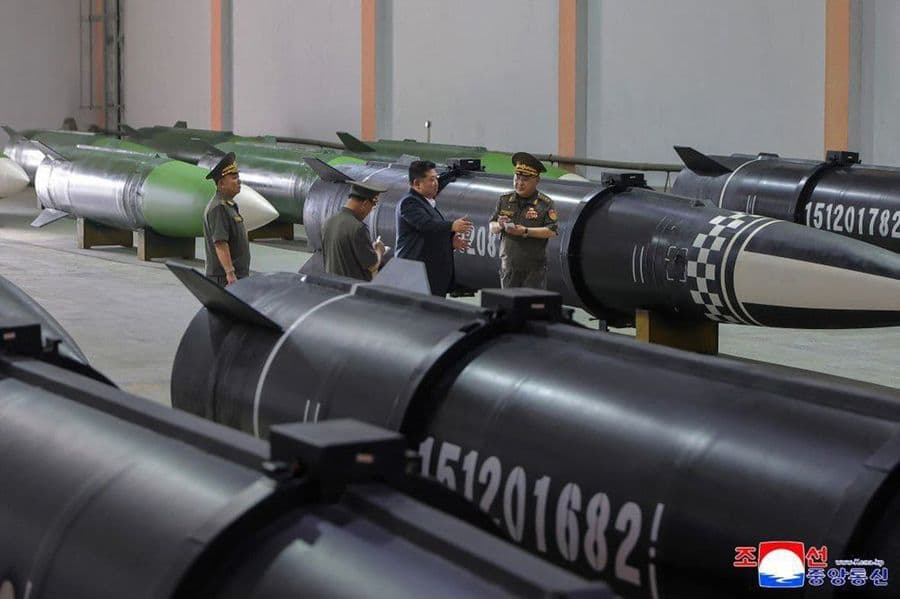
Another major reason South Koreans are so unnerved is that North Korean leader Kim Jong-un seems to be the only big winner from the Ukraine war, at least to date. By extending a lifeline on munitions to the Kremlin, he has secured numerous benefits for his own country, including access to food and fuel, as well as high-tech military upgrades ranging from satellites to submarines.
Earlier this year, Pyongyang went a step further and committed its own troops to the Ukraine fight, helping Russia push Ukraine’s forces out of Kursk. These gains for Russia on the ground came at a heavy price, but North Korean forces apparently distinguished themselves on the battlefield.
In short, there is little doubt that Russia’s relationship with North Korea has significantly solidified in the last two years. This was only made all the more obvious at the Beijing parade.
But what of China’s motives? Does the elevated appearance of both Putin and Kim portend a kind of nascent Warsaw Pact for Asia? At the very least, it’s far too early to accept such a worst-case assessment.
The summitry in Beijing did not even feature a trilateral meeting of these three leaders or any known diplomatic cooperation agreements, let alone concrete manifestations such as joint military exercises.
Beijing has complex relationships with both countries. China’s role in North Korea is not small, especially compared to other states, but its influence over Pyongyang has long been exaggerated. It’s quite clear that North Korea is far from a vassal state and that significant problems exist in this bilateral relationship. In fact, China has maintained stringent economic sanctions against North Korea over the last two decades due to the sensitive issue of Pyongyang’s nuclear weapons development.
Likewise, China-Russia relations are not entirely smooth. Anyone watching the parade of Chinese weaponry on display in Beijing could be forgiven for wondering why these weapons have not appeared on the battlefields of Ukraine. The reason is there is no tight China-Russia military alliance and Beijing has exercised restraint in the context of the Russia-Ukraine War.
Recent high-level meetings in China generally focused on economic and diplomatic rather than military cooperation. Attending leaders included those from a diverse group of important developing countries including Congo, Indonesia, and Pakistan, as well as from reasonably successful democracies such as Malaysia and Slovakia.
It’s worth pointing out, moreover, that the Kim family’s credentials for fighting Japanese imperialism during World War II are quite strong, which may help explain why Beijing found it appropriate to invite the North Korean leader to a commemoration of the defeat of Imperial Japan. Such historical appreciation is a far cry from a basis for an enduring and threatening alliance.
Nevertheless, it would be a mistake to think these meetings have no importance for the national security landscape. By according Kim and Putin elevated status, Beijing sought not only to register a clear dissent from the Western order but to achieve a kind of normalization for North Korea. It’s noteworthy that the phrase “denuclearization” did not feature on the agenda of the summitry in Beijing.
South Korea is understandably anxious. On the other hand, few can doubt, even in Beijing and Moscow, that Seoul’s economic, diplomatic, cultural, and military heft still far exceeds anything Kim can muster. Rather than a crisis of confidence, South Korea should lead a new, more relaxed reincarnation of the Six Party Talks, a multilateral effort that previously attempted to reign in North Korea’s nuclear program. This diplomatic revival would embrace a multipolar approach to regional stability rather than grasping for the chimera of denuclearization.
For both Beijing and Washington, current diplomacy should focus on informal acknowledgement of the twin facts that the North Korean regime is staying put and will also most certainly retain its nuclear weapons status. For the U.S., that more flexible approach will open up new opportunities to engage – following through on President Donald Trump’s brazen overtures to North Korea during his first term. A few days ago on 21 Sept, Kim announced his readiness to talk directly with Trump as long as “denuclearization” was off the table. In a set of compromise overtures, Trump could reasonably now ask for limits on Pyongyang’s missile force and a cessation of all nuclear tests in return for U.S. diplomatic recognition, as an example of how the overall deal could shape up.
The last set of U.S.-North Korea direct negotiations were unfortunately beset by unrealistic expectations, political grandstanding, internal disagreement, and poor preparation. Hopefully, a future effort could integrate the requisite attention to detail and simultaneously adapt to new circumstances.
Lyle Goldstein is Director of Asia Engagement at Defense Priorities.

In Pursuit of Nuclear Abolition
By Peter Huessy • RealClearDefense
Innovation Alone Won’t Prepare the U.S. for the Future Battlefield
By Joshua Segal • RealClearDefense
The sUAS Tactical Trifecta
By Bryan T. Woody • RealClearDefense
The Revolutionary War: When Strategic Options Share the Same Weakness
By Henry Yep • RealClearDefense
The Houthis Are Testing the Limits of Collective Defense
By Saima Afzal • RealClearDefense

Who Shoots Down the Drone Over the Shipyard?
By John Ferrari & Dillon Prochnicki • RealClearDefense
Northrop Grumman Breaks Out the Big Guns at AUSA
By Daniel Terrill, Defense News
Army Pursuing Diverse Array of New Anti-Air Interceptors
By Trevithick, The WarZoneWho Shoots Down the Drone Over the Shipyard?
By John Ferrari & Dillon Prochnicki, RCD
F-35C Lands for the First Time on a Ford-Class Aircraft Carrier
By The Aviationist