
Why the U.S. Failed To Contain North Korea's Nuclear Threat
Last updated 05:29 PM EST • Read time: 4m
When Barack Obama took over the U.S. presidency in 2009, North Korea could barely muster one nuclear weapon and had just a handful of missiles that could reach Japan. Yet despite tight international sanctions, tough external pressure and on-again-off-again negotiations, barely a decade later Pyongyang had managed to develop advanced nuclear weapons capable of striking cities in the continental United States.
Joel Wit’s latest book, Fallout, explains how the world’s strongest superpower allowed North Korea, which still considers itself at war with the U.S., to develop a nuclear arsenal that threatens global stability. Wit does so by chronicling the policies and negotiating strategies of six U.S. administrations to contain North Korea.
A well-known expert on Northeast Asia, Wit worked for the U.S. State Department and several think tanks for two decades and participated in key negotiations with Pyongyang. He is currently a distinguished fellow at the Henry L Stimson Center.
As Wit sees it, the administrations of Bill Clinton and George W Bush missed several opportunities to curtail North Korea’s nuclear program. However, he points to Obama and Donald Trump as being most responsible for the U.S.’s failed efforts. The Obama administration neglected to contain North Korea’s rapidly growing nuclear threat, and once it was there, the Trump administration failed to roll it back.
Based on more than 300 interviews with his contacts in Pyongyang and decision-makers in Washington, Beijing and Seoul, Wit provides a vivid account of the international discussions, internal debates and behind-the-scenes wrangling that shaped the U.S.’s North Korea policy.
For eight years, the Obama administration adopted a policy of strategic patience, unrealistically assuming that international sanctions would suffice to contain North Korea’s weapons development. When Pyongyang in 2013 tested a miniaturised nuclear device and completed construction of a new uranium enrichment plant, Washington responded by tightening sanctions.
But North Korea was not a priority, and enforcement of sanctions was patchy.
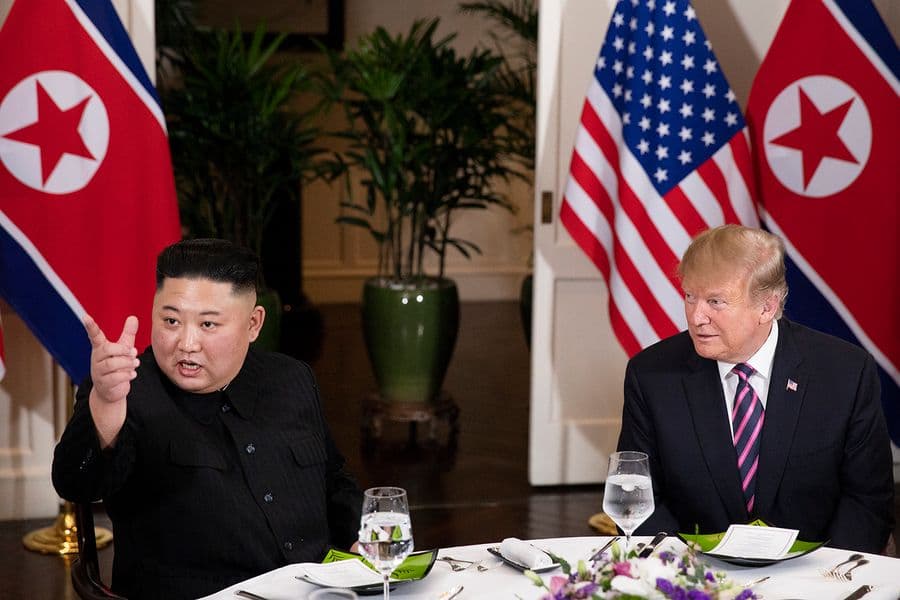
The advent of the Trump administration marked a major shift. Trump wanted to step up pressure on Pyongyang but was also open to negotiations. The initial result was a heated public exchange of insults, with Trump famously referring to Kim Jong Un as the ‘little rocket man’ and Kim calling Trump a dotard.
However, behind the scenes a U.S. advisor to UN Secretary General Antonio Guterres sounded out whether Pyongyang was open to a meeting with Trump. This triggered a quick thaw in relations, with North Korea joining the 2018 Winter Olympics in South Korea, and Trump and Kim meeting in Singapore the same year. But the summit in Hanoi that followed was a failure, and the parties walked away without even a joint communique.
Wit’s detailed post-mortem of the Hanoi summit provides valuable guidance for how future negotiations should—and should not—be conducted. He details the hurried pre-summit discussions and reminds us that even as Trump and Kim were travelling to Hanoi, the two key issues—denuclearisation and the lifting of sanctions—had not been resolved. The collapse of the talks should not have been a surprise.
In-fighting within Trump’s team, particularly between secretary of state Mike Pompeo and national security advisor John Bolton, played a role. So too did Kim’s excessive confidence that Trump wanted a deal. Wit credits Trump’s unorthodox approach for setting the stage for the summit, but blames his short attention span for its breakdown. ‘The president couldn’t sit still long enough to close the deal.’ Most importantly, preparatory negotiations were woefully inadequate.
Since then, Pyongyang has strengthened its cooperation with Moscow, supporting Russia’s war on Ukraine and introducing a major new obstacle to the resumption of talks.
Looking ahead, Wit suggests that the U.S. may need to recognise that North Korea is a nuclear state and shift from a policy focused on denuclearisation to one with two objectives: denuclearising North Korea in the long term; and reducing the threat of nuclear war in the short term. According to Wit, there are indications that Secretary of State Marco Rubio might support such an approach.
However, the U.S. administration’s national security strategy is firmly focused on the western hemisphere, with new geopolitical hotspots emerging in Latin America, the Middle East and even Greenland. With less than three years to the next U.S. presidential elections, the question is not when Trump and Rubio will shift their focus to Asia, but whether they will have the time and patience needed to address the security challenges of the Korean peninsula.
Robert Wihtol is an adjunct faculty member at the Asian Institute of Management and former Asian Development Bank country director for China and director general for East Asia.
AI contributed no ideas to this article—Robert Wihtol.
This article appeared originally at The Strategist (ASPI).

In Pursuit of Nuclear Abolition
By Peter Huessy • RealClearDefense
Innovation Alone Won’t Prepare the U.S. for the Future Battlefield
By Joshua Segal • RealClearDefense
The sUAS Tactical Trifecta
By Bryan T. Woody • RealClearDefense
The Revolutionary War: When Strategic Options Share the Same Weakness
By Henry Yep • RealClearDefense
The Houthis Are Testing the Limits of Collective Defense
By Saima Afzal • RealClearDefense

Who Shoots Down the Drone Over the Shipyard?
By John Ferrari & Dillon Prochnicki • RealClearDefense
Northrop Grumman Breaks Out the Big Guns at AUSA
By Daniel Terrill, Defense News
Army Pursuing Diverse Array of New Anti-Air Interceptors
By Trevithick, The WarZoneWho Shoots Down the Drone Over the Shipyard?
By John Ferrari & Dillon Prochnicki, RCD
F-35C Lands for the First Time on a Ford-Class Aircraft Carrier
By The Aviationist