
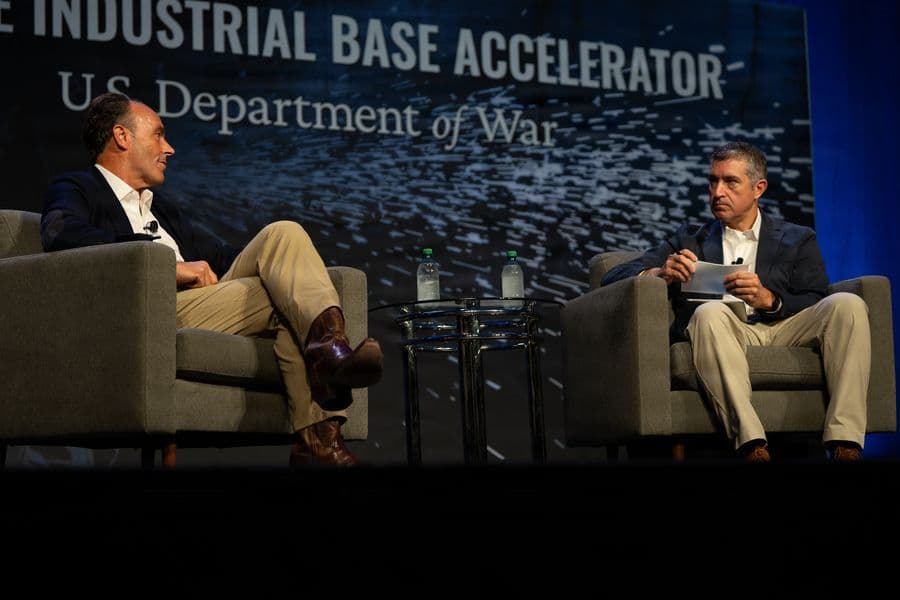
In the fireside chat, “Mobilizing Private Markets as a Strategic Defense Asset,” Assistant Secretary of War for Industrial Base Policy Hon. Michael Cadenazzi and Kyle Bass, Co-Chief Executive Officer and Founder, Rochefort Asset Management, discussed the critical role of private capital in strengthening the defense industrial base, accelerating investment in defense technology, and addressing emerging strategic threats. (DVIDS)
As Private Investment Pours Into Defense, the Clock Is Ticking
Last updated 05:19 AM EDT • Read time: 6m
We are in uncharted territory in terms of private capital’s influence on the defense economy. At the same time, federal lawmakers struggle to advance 2027 legislation most likely to support autonomy, AI, c-UAS, industrial base expansion, critical minerals, and other sectors that are key markets for those same companies competing for private financing. The nation requires vision, clarity of opportunity and risk, problem definition, and deliberately investigated solutions – in that order – followed by on-time budgets.
As the interests of warfighters, taxpayers, industry, and investors converge on the same goal - a dominant, cost-effective, adaptable, resilient American military – there is understandable widespread enthusiasm to leverage private capital interest in defense to accelerate the delivery of innovative technologies at lower cost, shift the financial risk for the development of such technologies from taxpayers to investors, and increase overall competition in the defense market. Now is also the time to anticipate potential fracture points and mitigate them through intelligent design.
One such friction point is the unpredictability of the federal budget. Another is differing time horizons and structures for financial risk.
The numbers underscore that we have entered a new epoch in the defense economy. Venture investment in defense is up tenfold over the past ten years, from a few hundred million annually to tens of billions. Active defense unicorns carry a combined valued of around $500 billion – more than double their levels from just a few years ago.
The trends in private capital in defense are a microcosm of the broader economy. Private market assets have more than doubled from 2012 to 2024, from $10 trillion to more than $22 trillion. Moreover, low interest rates during the pandemic era accelerated institutional investor reallocation to private markets – creating more than $1 trillion in buyout “dry powder” of capital that is under pressure to deploy and generate returns. While the availability of private capital increased, the defense sector opened opportunities through a combination of acquisition reform and operational urgency, particularly in the AI, drone, cyber, and space domains. But we do not yet know whether those reforms will result in contracts that appreciate commercial profit margins resulting from private innovation investments.
Private capital’s position in the defense economy is unique by historical standards. The Packard Commission in the 1980s made its recommendations based on an industrial ecosystem dominated by public companies that had both commercial and defense businesses. The industry consolidation following the end of the Cold War and the “Last Supper” occurred with public sector transparency, directed by defense leadership and with restructuring costs paid for by the government.
We are well into the “First Breakfast” epoch today; new entrants are flooding into the defense arena bringing the entrepreneurial ethos to tackle technological challenges that threaten America’s military edge. This new wave is bringing consequential change to the ownership and financing structure of the defense economy and its own unique pathologies.
The financing for this tsunami of new entrants comes primarily from venture capital and private equity. Private capital asset classes have lifespans, which are the timeframes where investors expect a return. Liquidity rounds are the inflection points that motivate early stage capital investors and therefore loom over every founder, no matter how committed they are to the defense mission. The progression of liquidity events produces increasing pressure on the internal cost structure of companies as the need for positive and predictable earnings starts to overshadow the need for disruptive research and development, something defense contracts do not yet fully appreciate.
The vast majority of private capital investments in the past 12 months has gone to late-stage growth companies with shorter hold horizons, which means there is a drive for liquidity events in the next five years. A resulting wave of liquidity demand arrives around 2029 to 2032 – exactly when the Administration's own projection shows national defense funding down 14 percent from the 2027 request.
For defense-focused companies, this creates a shot clock that only newly structured production-level contracts can satisfy; meaning these companies must get Pentagon budget commitments in the current planning cycle. If successful exits do not happen, pressure builds on the balance sheets of new entrants and can manifest in terms of greater debt leverage, deferred capital expenditures for capacity expansion, or increased costs that are passed to the warfighter.
In addition, greater complexity in the supply chain can create new risk in the industrial base in the form of financial fragility in the supplier ecosystem, delayed deliveries as demand scales, and cost inflation – risks that need to be prudently instrumented and mitigated through intentional policy design. The power law that underwrites venture logic becomes a national security problem when key suppliers fail – investors write off the loss while the government inherits the risk.
Congress has taken note of the new landscape and is pursuing a basket of targeted provisions on government/commercial partnerships and well-meaning but narrowly scoped ways to counter organic deficiencies in contracting expertise and mitigate perceived vulnerabilities. Instead of such piecemeal approaches to complex terrain, Congress should first lay out the vision, define the potential problems, and do the necessary due diligence to produce a clear, consistent legislative strategy for next year’s bill.
Guiding this moment into its next chapter means establishing several overarching principles. First, organize the market and incentives around program risk and technical maturity rather than a company’s origin story, funding, and diversification. Second, make the capability demand explicit and politically durable to provide potential relief from the shot clock conundrum. Third, as government expands its financial role through credit and equity instruments, base such interventions on transparent criteria, with independent review, and at the portfolio-level instead of the deal-level. Fourth, recognize the connection between annual budget dysfunction, the health of the industrial base and the price of goods and fix this self-inflicted damage.
Taking these steps could ensure the epoch following a “First Breakfast” is a “balanced lunch” that can sustain the public-private innovation and momentum beyond the next few years.
Elaine McCusker is a senior fellow at the American Enterprise Institute (AEI), where she focuses on defense strategy, budget, and innovation; the US military; and national security. Before joining AEI, Ms. McCusker served as deputy and then acting undersecretary of defense (comptroller) from August 2017 until June 2020.
Dan Folliard is a former career Department of Defense (DoD) civil servant, where he served for two decades. His most recent assignment was as the Chief Digital and Artificial Intelligence Officer at U.S. Special Operations Command. As a direct report to the Commanding General, he was responsible for accelerating the Command’s transition to a data-driven enterprise and creating decision advantage from the headquarters to the tactical edge.

Is It Déjà vu All Over Again: The 2012 Report on Global Zero
By Peter Huessy • RealClearDefense
As Private Investment Pours Into Defense, the Clock Is Ticking
By Elaine McCusker • RealClearDefense
The First Test of Peace Lies in Ukraine's Borderlands
By Dennis T. Cosgrove • RealClearDefense
The VFW’s Gambling Addiction Victimizes Veterans
By Jack Yoest • RealClearDefense
Superintelligence Exposes a Gap in the Law of Delegated Authority
By Sue Ghosh Stricklett • RealClearDefense

When Your Navy is too Small, the Bill Comes Due Bigly
By CDR Salamander
Quo Vadis MCU?
By Marine Corps Compass Points
When the Network Goes Dark, Who Controls the Battlefield?
By Jonathan K. Corrado • RealClearDefense
Air Force Should Buy 250 Blended-Wing Tankers, as 2027 Demo Looms
By A&SF Mag.
Long Deployments to Be Navy Standard For Next Couple Years
By Mongilio, USNI News