
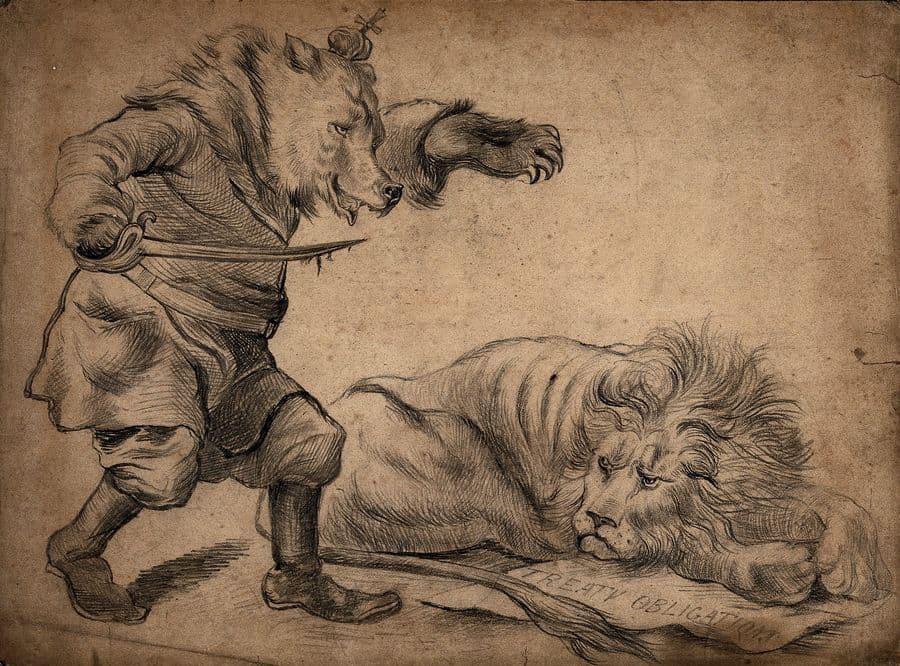
Bloody Damned Poetry – The Russian Bear
Last updated 07:32 AM EST • Read time: 20m
Thucydides: The strong do what they can, and the weak suffer what they must.
Mark Twain is often quoted, apparently incorrectly as it often the case, as saying that “History does not repeat itself, but it rhymes.” Whatever. If it’s happening now, it’s happened before, and it will happen again. Or as Solomon put it about 3,000 years ago, “There is nothing new under the sun.”
Immediately after VJ Day, President Harry S Truman unleashed a chaotic demobilization of millions of Americans in uniform. It would prove to be catastrophic. By 1948, Army Chief of Staff General Omar Bradley worried that the Army “could not fight its way out of a paper bag."
In January 1950, the Army was a decaying skeleton, but the president assured the American people that their military was in great shape and ready for anything, Truman and the Joint Chiefs believed that as the only country in the world to have The Bomb, the United States had nothing to fear from any wannabe bully. The belief in Assured Destruction (AD) of any enemy meant that the U.S. only needed the bombers necessary to deliver The Bomb and the necessary people for the care and feeding of the bomber fleet, thus no need to waste money on obsolete military forces. HST’s intent was to reduce the U.S. Army to a few reserve cadres.
(Forty-some years later, President Bill Clinton would trumpet a great “peace dividend” because the end of the Cold War meant that we could drastically reduce if not do away with our defense posture. The Berlin Wall had fallen down, flowers bloomed in artillery emplacements, unicorns danced, and military bases were turned over to civic groups. Peace and love would reign.)
When Truman’s Secretary of State Dean Acheson gave a speech at the Press Club in Washington, DC on 12 January 1950 to announce America's new security zone in the Pacific, Korea was excluded. Joseph Stalin took note. Mao Tse-Tung also took note. Kim Il-Sung took note with keen interest. Syngman Rhee took note with great alarm. Harry Truman placidly sailed on, floatin' down the River of Denial (compliments to songwriter/singer Pam Tillis.)
Six and a half months after Acheson’s speech, on 25 June 1950, Joseph Stalin said, “GO!” North Korean forces, supported by Soviet artillery and air, smashed through the 38thth parallel and the fragile defensive ROK (Republic of Korea, i.e., South Korea) line. American advisors had poorly armed and trained the ROK army only for constabulary duty, not for combat.
The rest is another bloody damned poem, which will rhyme with the Soviet invasion of Afghanistan on Christmas Eve, 1979.
Twenty-nine years after the Chinese People's Volunteer Army chased American soldiers and Marines from the Yalu River all the way back to South Korea’s far southern port of Pusan, the Soviet army was staged at the northern gates into Afghanistan. Not believing his lying eyes, President Jimmy Carter believed Leonid Brezhnev’s promise that the Soviet Union would not invade Afghanistan. (That would rhyme with the Russian invasion of Ukraine some 43 years later.)
The U.S. State Department Historian dryly observed that “Although the Carter administration had closely watched this buildup from the outset, its reaction following the invasion revealed that, until the end, it clung to the hopeful belief that the Soviets would not invade, based on the unjustified assumption that Moscow would conclude that the costs of invasion were too high.”
That would rhyme with President Joe Biden’s warning to Russian ruler Putin not to even think about invading Ukraine in 2022.
When the Russians did invade Afghanistan on Christmas Eve, 1979 (and incidentally, murdered their own puppet president,) Jimmy Carter stamped his foot and cried, “They lied to me!” The American president wrote a sharply worded letter to Brezhnev, and punished the Russians, American athletes, and American farmers by keeping the U.S. team home from the Moscow Olympics and embargoing U.S. grain sales to the USSR.
History is a long. messy, brutal, and bloody story. And it rhymes.
The embers of freedom smoldering in Captive Nations rekindled in 1987 in the Baltics with the Singing Revolution. They watched and were inspired, as Poland’s Lech Wałęsa said, as the Afghan freedom fighters sapped the juices of their all-powerful Soviet masters. Estonia, Latvia, and Lithuania declared their independence in 1990. After threats failed to intimidate the uppity Balts, the Russian army, tanks and all, celebrated New year’s 1991 by cracking down. They killed people and broke things, but in the end gave up and retreated. That was embarrassing and would not be repeated. Would it?
The Soviet Union collapsed 51 weeks later, on Christmas day 1991. Such a gift—the Captive Nations were liberated at last without another shot being fired!
One would think that the Russians would have had enough on their plate with the blocks of the collapsing USSR falling all around them, but it was the collapsing bloc that they were dead set on holding. Oblasts and autonomous republics became independent countries, divided, split, merged, shook and stirred. Russian troops invaded to recover runaway nations, and refugees fled first in one direction, then back, then sideways, and leaders were assassinated or flipped. And always, always, the Russians were in the middle, stirring the pot and pouring gas on the flames. Double, double toil and trouble; fire burn and cauldron bubble. It still hasn’t sorted itself out and might never—this is Eastern Europe and the Caucasus, after all. Borders, populations, and rulers in that part of the world have been fluid ever since the first armed horsemen rode out of the mist.
Mineral-rich Georgia with her excellent Black Sea ports is a case study. When it first declared its independence from the decomposing Soviet Union, President Gorbachev said, “No, ain’t gonna happen.” Soviet soldiers crushed an independence demonstration in Georgia’s capital, Tbilisi, on 9 April 1989. Georgia’s ambassador to the U.S. 2016 to 2022, David Bakradze, was a schoolboy then and described in a Washington Post article what he watched in the streets that day:
Russian soldiers bludgeoned unarmed citizens with military trenching tools. They gave no quarter, attacking even some of those who were fleeing. They fired tear gas and CS gas — a chemical weapon — at the crowds of peaceful protesters, paralyzing some, killing others. In the end, 21 Georgians lay dead, including 17 women and three that were no more than 16 years old, battered with trenching tools and suffocated by gas from the Soviet army.
Over the next few days, Soviet media claimed that these young men and women were guilty of stirring ethnic unrest and endangering public safety, and that they were trying to overthrow the government.
Trenching tools? Why not? Garden hoes worked for Pol Pot in the Killing Fields of Cambodia.
Georgia remained a captive of the Soviet Union until the USSR’s inglorious swan song in December 1991. What happened after that is one of the messiest messes on our very messy globe.
You need a chalkboard to chart events involving just Georgia and Russia since 1989. It also helps to wrap your head with duct tape while doing it. Let’s take a quick tour along the ridgeline of Russian perfidy,
The ground under the Kremlin was already shaking in 1990, but the thugs monitoring the seismometers anticipated Georgia’s intent to break free. It had already tried once, after all. Immediately upon Georgia’s Independence Declaration Round 2, Russia plunged in, fomenting a civil war for control of the future government. It only lasted two weeks—22 December 1991-6 January 1992--but it gave rise to the Black Pantyhose Battalion, and it was a harbinger of what was to come...and it would rhyme. Russia roiled the waters, instigating revolutions and counter-revolutions, riots and uprisings, bloodbaths and ethnic cleansing, assassinations, conspiracies and betrayals, mass deportations, battalions of Little Green Men, civilian airliners shot down, separatists trying to separate geographic body parts, bloodthirsty “peacekeepers” killing, raping and pillaging, Hundreds of thousands of men, women and children were massacred or driven from their homes. Corpus Georgia was torn asunder as Russia bit off and devoured large chunks of the country, and stationed “peacekeeping” forces to aid in digestion.
The Bear picked her teeth and eyed the next course.
It was not the first time Russia had laid her claws on Georgia, one of those unfortunate nations to occupy strategic geography and/or be blessed (or cursed) with rich natural resources that bigger and stronger countries want. From the dawn of history, Georgia—indeed all of Central and Eastern Europe--has been part of one empire or another—Persian, Ottoman, Austro-Hungarian, Prussian, Mongol, Polish-Lithuanian, German, etc., and warred over time and again. Various czars tried unsuccessfully to seize Georgia, or pieces of it, in the 18h Century from whatever other empire.
Catherine the Great, she who said “I have no way to defend my borders but to extend them,” added New Russia, Crimea, Northern Caucasus, Right-bank Ukraine, Belarus, Lithuania, and Courland at the expense, mainly, of two powers: the Ottoman Empire and the Polish–Lithuanian Commonwealth. Under her rule, some 200,000 square miles were added to the Russian empire. She went to war with the Ottoman sultan for Georgia, and ever after to this day under the Holy Doctrine of Irredentism, Russia claims Georgia...and Ukraine, et at. is the Bear’s unto eternity. Amen.
Next the empress annexed Ottoman Crimea, and took Ukraine from Poland, Lithuania, and Austria. Now she could have a Black Sea fleet with a straight shot through the Dardanelles and Bosporus Straits to the Mediterranean.
The Ukrainians lost their relative autonomy and personal freedoms when Catherine turned them into serfs. Not until the late 1980s would they again taste freedom, only to be crushed again. Only when the USSR was no more would Ukraine drink from the cup of liberty.
Three years later, President Bill Clinton strongarmed free Ukraine into turning its nuclear weapons over to a kindly Russia for safekeeping and sealed the deal with the Budapest Memorandum of 1994. Oddly, Clinton included the UK as protectors of now-nuclear weapon-free Ukraine, along with Russia. Russia could be trusted, Clinton promised, to take good care of Ukraine’s nukes and ensure disarmed Ukraine’s sovereignty and security. (wink, wink!) The future American president knew a thing or two about the Russians--he played hooky from Oxford and went to Moscow to nurse at the breast of the Russian Bear.
Items 1, 2, and 6 of the Budapest Memorandum [boldface mine]:
1. The Russian Federation, the United Kingdom of Great Britain and Northern Ireland and the United States of America reaffirm their commitment to Ukraine, in accordance with the principles of the Final Act of the Conference on Security and Cooperation in Europe, to respect the independence and sovereignty and the existing borders of Ukraine;
2. The Russian Federation, the United Kingdom of Great Britain and Northern Ireland and the United States of America reaffirm their obligation to refrain from the threat or use of force against the territorial integrity or political independence of Ukraine, and that none of their weapons will ever be used against Ukraine except in self-defense or otherwise in accordance with the Charter of the United Nations…
6. Ukraine, the Russian Federation, the United Kingdom of Great Britain, and Northern Ireland. And the United States of America will consult in the event a situation arises which raises a question concerning these commitments.
Consult? Vladimir Putin put the Budapest Memorandum in a shredder. No more problem.
Kipling in his 1919 poem “Gods of the Copybook Headings:”
When the Cambrian masses were forming, They promised perpetual peace
They swore, if we gave them our weapons, that the wars of the tribes would cease.
But when we disarmed They sold us and delivered us bound to our foe,
And the Gods of the Copybook Headings said: “Stick to the Devil you know.”
Tiny oil- & gas-rich Chechnya was another of the Captive Nations that broke from the Soviet bear hug along with its neighbor, even teenier, weenier, mineral-rich Ingushetia (population around half a million) to declare sovereignty. How dare these primitive savages reject the embrace of Mother Russia! Russia invaded Chechnya in 1994 to drag the wannabe-free nation back into the fold, killing 100,000 civilians in the process.
In the old USSR, Chechnya and Ingushetia were joined at the hip as the Checheno-Ingush Autonomous Soviet Socialist Republic. It was a very unhappy forced marriage. Upon liberation, Ingushetia filed for divorce and voted to be a Russian Federation republic, but many Ingush violently disagree with that decision. Ingush independence from its liberated neighbors is reinforced by the Russian army with a few thousand dead and wounded on all sides. Ingush Islamists are stirring the cauldron, too. It’s complicated, and bloody.
Meanwhile, back at the ranch: Russian President Boris Yeltsin expected an easy, quick victory in Chechnya. He was disappointed. Having managed only to rubbelize the capital city, Grozny, and a few villages in 20 months, Russia declared victory by granting Chechnya autonomy as a Russian oblast, set a puppet president in the ruins, and signed a peace treaty “To reject forever the use of force or threat of force in resolving all matters of dispute.” When Putin assumed the presidency of the Russian Federation in 1999, he immediately set out to rectify Yeltsin's Chechnya mistake. Russian forces brutally and quickly crushed any hope of Chechen independence. Another 100,000 civilians died. Between the two Chechnya wars, around 40,000 Russian soldiers died. Now, Putin sends Chechen soldiers to die trying to drag Ukraine back to Mother Bear’s loving arms.
That’s real poetry.
To look at national borders and state entities in Eastern Europe is to gaze through a kaleidoscope with all the shifting bits of colored glass. The Color Revolutions, a misnomer because they were not all colors: the “Orange,” the “Rose,“ the “Tulip,” the “Bulldozer,” the “Velvet,” the “Singing” animated Communist Europe. The chaos: Georgia. North Ossetia...South Ossetia… Abkhazia… Azerbaijan…Gagauzia ... Lithuania, Estonia, Latvia, Ukraine, Moldova, Transnistria, Belarus, Daghestan, Kabardino-Balkaria, Ingushetia, Kyrgyzstan, Romania...the beat goes on. Wherever there is chaos and bloodshed, Russia is there, twisting that kaleidoscope, wielding it like a battleaxe. Shattered societies, shattered lives, the promise of freedom and stability through revolution. Transnistria, (aka the Pridnestrovian Moldavian Republic,) Abkhazia and South Ossetia are three potsherds that chipped off the old Soviet bloc with Russian help aren’t even recognized as real countries by anybody.
Truth be told, border mutability goes back to when Man first conceived the notions of “I want that!” and “Gimme!” and “Mine!” But since 1914, that’s been the Russians twisting, twisting that kaleidoscope’s cell, bloodily rearranging the shards of colored glass in Europe and Asia, in Africa and the Western Hemisphere. The common denominator is that these countries or would-be countries are all rich in precious natural resources, ports, and/or geostrategic location.
By 2008, Russia had developed a severe case of indigestion over Georgia. Vladimir Putin had a remedy. Russia invaded the country by sea, land, air, and cyberspace to cure it with Russian troops and “separatist” forces ethnically cleansing the parts of Georgia abutting Russia on the Black Sea. The European Court of Human Rights charged Russia with war crimes and human rights abuses in Georgia and ordered Putin to pay damages to tens of thousands of survivors. Putin, his peacekeepers firmly in control, smirked.
Sympathizers are quick to justify Russian annexation of sovereign nations’ territories on the grounds that there are so many Russian speakers there—the same rationalization Hitler used to seize Sudetenland on the grounds that there were so many German speakers there. Russian speakers? Two reasons for that. 1) Stalin repopulated captive nations with ethnic Russians after exterminating or deporting the native populations. 2) The indigenous languages of Captive Nations were suppressed and the people forbidden on pain of death or the Gulag to speak or teach it. Russian was the official and sole language permitted.
With 100,000 Russian soldiers lined up on the Ukrainian border in 2022, President Joseph R. Biden had one word for Vladimir Putin in a two-hour video call that if the Russian president had any ideas about invading, “Don’t.” Putin would be really, really sorry if he did it, Biden warned.
But Putin heard Biden tell reporters that a “minor incursion” by the Russians would be no big deal. After all, they had already invaded and seized the Donbas, Ukraine’s industrial heartland, and Crimea. Another little piece of Ukraine wouldn’t hurt. (Flashback to Truman’s Pacific security zone and Secretary of State Acheson’s excluding South Korea from American interests.)
Putin did do it. He did invade Ukraine, and it’s not a “minor incursion.” Putin, Biden, and the pundits expected Russia to take Kiev in days. Biden offered Ukrainian president Volodymyr Zelensky a ride out to someplace safe. Zelensky and his nation chose to fight.
Poetry written in blood. As the refrain went in Pete Seeger’s Vietnam-era antiwar song “Where have all the flowers gone?”: Oh, When will you ever learn? Bad guys don’t learn. Often, good guys don’t, either. Santayana: Those who don’t remember history are doomed to repeat it.
It’s useful to reread Rudyard Kipling’s Kim. Yeah, it’s a delightful children’s story with exotic people in exotic places doing exotic things. It’s also a geostrategic primer of the Great Game with international intrigue, espionage, and Russian treachery in South Asia.
Stalin did not break the Molotov-Ribbentrop treaty with Nazi Germany only because Hitler beat him to it. One other treaty the Soviets kept was with Japan (over Manchuria), until the U.S. dropped the Bombs on Hiroshima and Nagasaki. As soon as it was clear that America had defeated Japan, Stalin took up Harry Truman’s invitation to join the rest of the war, thus adding North Korea to the Bear’s empire. That’s another bloody damned poem.
Do we see a pattern here? Yeah. History is stained by centuries of Russian treachery. This blood-drenched planet of ours is littered with the rubble of treaties broken, lives and cultures shattered, governments sabotaged on every continent.
To prove what good neighbors they were, Russian president Yeltsin signed a Treaty on Friendship, Cooperation and Partnership with Ukraine in 1997. It was very nice, but it conveniently expired in ten years.
Consider the Minsk Agreements—Minsk I and Minsk II. The Russians immediately broke first Minsk Protocol that they signed with Ukraine and the Organization for Security and Co-operation in Europe (OSCE) in September 2014. It was a ceasefire that required the Russians to withdraw its forces from Ukrainian territory. But Russia denied having any forces in Ukraine, so... Remove Russian patches from uniforms and they become civilian “separatists.” Little Green Men. Piece of cake.
Lucy’s holding the football again. “I promise, Charlie Brown, that this time…” Ukraine lost more territory to Russia after signing Minsk I. So, five months later, Ukraine and Russia sign Minsk II—ceasefire, round 2. The Russians call themselves “mediators” there in Ukraine just to help the OSCE oversee elections in the “disputed” territories that they, the Ruskies, have invaded. Then they’ll talk about withdrawing the Russian military forces that aren’t there. By 2019, the Russians had bestowed citizenship on three-quarters of a million people in the Donetsk and Luhansk regions (aka the Donbas) of Ukraine that Russia unilaterally declared to be independent republics.
American isolationists, long dormant outside of the Libertarian movement and Cato, are in full cry. Paraphrasing Neville Chamberlain, Ukraine, they say, is a country far away and its people are of no account to the United States. Anyway, they say, Putin will make no further territorial claims once the Russian Bear has consumed eastern Ukraine. Adolf Hitler said the same thing about Czechoslovakia.
Western Europe, though, is waking up and realizing that, hey, this is serious. For the first time since the Berlin Wall came down and the lessons of the Cold War were tossed into the dustbin of history, European countries are preparing to defend themselves. They realize what’s on Putin’s menu.
Meanwhile, back at the American ranch. During the Cold War, hippies chanted “Better red than dead!” There is a danger that today an American president might might cave to American pacifists and isolationists, might channel the appeaser Neville Chamberlain with his black umbrella in a desperate grasp for world peace at any price. As Winston Churchill said, feeding the crocodile in hopes that it will eat you last. Chamberlain ordered Czechoslovakia to give up its Sudetenland province for the sake of lasting peace, certain in his mind that Herr Hitler was telling the truth that he wanted no more land from anybody. “No more territorial claims!” U.S. politicians and pundits insist that Ukraine must give up territory, in this case its industrial heartland and ports, for the sake of lasting peace with Russia. What amazingly contorted logic it is to demand that the victims of aggression concede body parts for the sake of peace. Blaming the rape victim and demanding she submit to her assailant...for her own good, of course.
Putin is acting strategically regardless of cost. Those in the U.S. who just want the war to end at any cost are acting emotionally.
If Russia keeps its Ukrainian conquests, it will own the Sea of Azov and dominate the Black Sea—Russia’s strategic objective since long before Catherine the Great. Ukraine will have lost all of its ports and become a landlocked nation...if it retains its sovereignty.
It’s funny when year after year when Charlie Brown takes Lucy’s word for it that this time she’ll really hold the football for him. Should we blame the Ukrainian for not trusting the United States when our president says “Trust me—I’ll protect you this time,” and the Russian president says “Trust me. I’ll keep my word this time.”? Ask the Montagnards, the Vietnamese, the Afghans we left twisting slowly, slowly in the wind about American promises. Ask the victims of Russian imperialism about Russian trustworthiness.
Speaking of bloody damned poetry, Rudyard Kipling had something to say about trusting Russians in his 1898 poem “The Truce of the Bear:”
..."Horrible, hairy, human, with paws like hands in prayer,
Making his supplication rose Adam-zad the Bear!
I looked at the swaying shoulders, at the paunch's swag and swing,
And my heart was touched with pity for the monstrous, pleading thing.
"Touched with pity and wonder, I did not fire then...
Nearer he tottered and nearer, with paws like hands that pray --
From brow to jaw that steel-shod paw, it ripped my face away!
"Sudden, silent, and savage, searing as flame the blow --
Faceless I fell before his feet, fifty summers ago.
I heard him grunt and chuckle -- I heard him pass to his den.
He left me blind to the darkened years and the little mercy of men…
"...this is the time to fear,
When he stands up like a tired man, tottering near and near;
When he stands up as pleading, in wavering, man-brute guise,
When he veils the hate and cunning of his little, swinish eyes;
"When he shows as seeking quarter, with paws like hands in prayer
That is the time of peril -- the time of the Truce of the Bear!"...
Karen McKay is a retired U.S. Army lieutenant colonel. She is a Foreign Area Operations Officer (Middle East/SW Asia), and Airborne, Civil Affairs, and Psyops qualified. Her PhD dissertation at Hebrew University in Jerusalem was on the failure of Allied air forces to bomb Auschwitz and the rail lines transporting Jews to death camps. She was the Executive Director of the Committee for Free Afghanistan, and president of Americans for Freedom, an NGO supporting the Contras, especially on the Atlantic coast of Nicaragua.

In Pursuit of Nuclear Abolition
By Peter Huessy • RealClearDefense
Innovation Alone Won’t Prepare the U.S. for the Future Battlefield
By Joshua Segal • RealClearDefense
The sUAS Tactical Trifecta
By Bryan T. Woody • RealClearDefense
The Revolutionary War: When Strategic Options Share the Same Weakness
By Henry Yep • RealClearDefense
The Houthis Are Testing the Limits of Collective Defense
By Saima Afzal • RealClearDefense

Who Shoots Down the Drone Over the Shipyard?
By John Ferrari & Dillon Prochnicki • RealClearDefense
Northrop Grumman Breaks Out the Big Guns at AUSA
By Daniel Terrill, Defense News
Army Pursuing Diverse Array of New Anti-Air Interceptors
By Trevithick, The WarZoneWho Shoots Down the Drone Over the Shipyard?
By John Ferrari & Dillon Prochnicki, RCD
F-35C Lands for the First Time on a Ford-Class Aircraft Carrier
By The Aviationist