
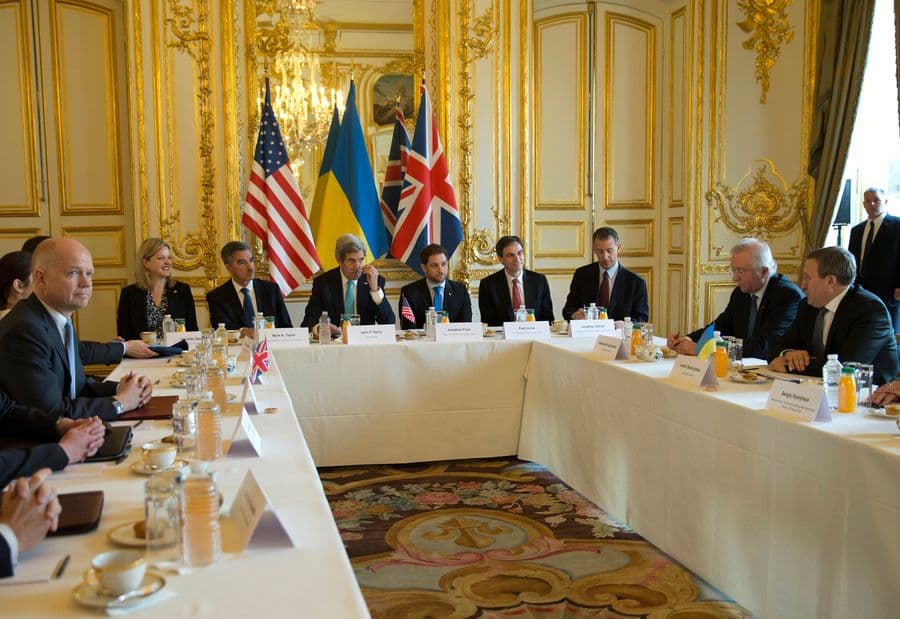
Nuclear Weapons and the War in Ukraine
Last updated 06:51 AM EST • Read time: 6m
Russia’s invasion of Ukraine on February 24, 2022, not only put an end to a long period of relative peace and security in Europe, but it also raised fears of a wider and more destructive war—fought under the shadow of nuclear weapons. How nuclear weapons figure into this crisis must be appreciated if the United States and NATO are to manage it, and its aftermath, successfully.
Nuclear Implications for the United States
Russia’s invasion of Ukraine poses three challenges for the United States as it seeks to prevent nuclear proliferation and deter nuclear conflict.
First, Russia’s invasion of Ukraine offers an example of “history bites back.” If readers will recall, the Budapest Memorandum (1994) required Ukraine to surrender its large number of nuclear weapons to Russia. In return, the United States, Russia, and the United Kingdom agreed to maintain the sovereignty of Ukraine based on its existing borders. Russia violated this agreement in 2014 when it annexed Crimea and destabilized eastern Ukraine in the Donbas. Russia is now seeking to erase Ukrainian sovereignty, a blatant violation of the Budapest Memorandum.
Russia’s violations of its prior commitments to Ukrainian sovereignty send an appalling message about nuclear proliferation. Ukraine gave up its nuclear weapons and is now suffering a potentially fatal dismemberment. Had Ukraine kept its nuclear arsenal, even if only in a minimally viable operationally ready state, Russia may have never invaded and seized Crimea nor invaded the Donbas region of Eastern Ukraine. If history is any example, the very existence of a nuclear-armed Ukraine could have deterred Russian aggression.
Ukraine’s current predicament only underscores the lesson learned during the United States’ Global War on Terror—nuclear-armed enemies of the United States (North Korea) do not get invaded, while those without nuclear arms do (Iraq). If human psychology holds, this decreases the likelihood that any current or future nuclear weapons state will give up its nuclear arsenal or even agree to significant reductions in its nuclear weapons inventory. In fact, it should come as no surprise if the number of nuclear weapons states grows in the near future (Iran and Taiwan).
Second, the Russian invasion of Ukraine creates a challenge for escalation control. If fighting between Russian and Ukrainian forces spills over into a NATO member-state, a response by either NATO or Russia could escalate the conflict beyond its original scope. Russian strikes against NATO forces could provoke a chain reaction of cumulating escalation and a decision for nuclear first use. A Russian loss that is attributed to Western military assistance—putting Putin, and potentially the regime, at risk—could also have a similar effect.
It is important to keep in mind that Putin knows he is very unlikely to survive—quite literally—a loss in Ukraine. Thus, the stakes could not be higher for Russia’s President and his regime. As Prospect Theory—the basis of behavioral economics—suggests, when an individual is guaranteed a loss, they are more likely to double-down and take even greater risk to recover what is lost.
This view of human behavior indicates that Vladimir Putin may double-down to avoid losing in Ukraine and use nuclear weapons to regain the advantage. Further escalation is worth the risk in such a case because the other option leads to his own demise. It is possible, however, that Russian military leaders may refuse such an order because they operate under a very different risk calculation than Putin.
President Putin recently placed Russia’s nuclear forces on a higher readiness. This action was both an effort to deter the West from aiding Ukraine and a real threat to use nuclear weapons in the event his regime is threatened.
What makes it so difficult to anticipate and understand Putin’s behavior is that during the Cold War, experts tried to tackle the problem of limiting or terminating a nuclear war but repeatedly found war termination efforts unsatisfactory and undependable. One reason for this was the different views of nuclear deterrence and conflict resolution held by NATO and Russian strategists. NATO studies often “mirror imaged” Soviet planners and commanders as if they were just like their Western counterparts. We are no better today at predicting Russian behavior than we were during the Cold War.
Third, Russia’s advantage in low-yield tactical nuclear weapons means Russia can use one or a small number of nuclear weapons in Ukraine and achieve a level of escalation that causes NATO and the United States to back away from support for Ukraine—to avoid further nuclear escalation. With NATO maintaining a small number of fighter-delivered B-61 gravity bombs at low levels of operational readiness, Vladimir Putin sees a seam in the use of low-yield tactical nuclear weapons that he can exploit.
Recommendations
As we have written elsewhere, weakness is provocative and particularly dangerous when your adversary is authoritarian in a culture that values demonstrations of strength. This truth is now more evident than ever.
First, it is time for NATO to declare Russia an adversary of the alliance. It is impossible to effectively plan to deter or defeat Russia absent such a clear policy. Make it clear to President Putin that the alliance takes the Russian threat seriously.
Second, immediately place Dual-Capable Aircraft (DCA) on twenty-four hour alert and invest the time and money required to ensure the alliance’s B61-armed fighter jets maintain readiness rates that allow them to perform the tactical nuclear mission at a moment’s notice. This will also require the United States and NATO to provide the needed Conventional Support to Nuclear Operations (CSNO) and Reconnaissance Support for Nuclear Operations (RSNO) to fly these missions.
Third, it is time the United States redeploy not only nuclear-capable bombers to Europe but bombers armed with variable-yield nuclear air-launched cruise missiles. It is imperative that the United States close the gap in its nuclear capability in Europe. Forward deploying nuclear weapons to Europe sets the conditions to keep the conflict limited to Europe. Ensuring Putin understands that the United States and NATO will match his capabilities is the first step to deterring his use of low-yield nuclear weapons on a Ukrainian battlefield.
Finally, in keeping with Prospect Theory, the United States must create an opportunity for President Putin to leave Ukraine with the perception of a victory, which is important for his domestic audience and his own survival. Acceding to Russian sovereignty over Crimea, supporting the session of the Donbass, removal of all sanctions and security guarantees are all options that may when coupled in the right package, work to persuade Putin that he can claim victory.
This is no easy task but maybe our only option to avoid the use of nuclear weapons. It is also worth noting that the United States cannot achieve such a situation from a position of weakness.
Admittedly, the United States has no easy parallels for the current war in Ukraine. What is certain is that leading with fear is by no means a recipe for success.
Stephen J. Cimbala is Professor of Political Science at Penn State University – Brandywine.
Adam Lowther is the former Director of the US Air Force’s School of Advanced Nuclear Deterrence Studies. They have written more than thirty books and hundreds of articles on nuclear issues.

The First Test of Peace Lies in Ukraine's Borderlands
By Dennis T. Cosgrove • RealClearDefense
The VFW’s Gambling Addiction Victimizes Veterans
By Jack Yoest • RealClearDefense
Superintelligence Exposes a Gap in the Law of Delegated Authority
By Sue Ghosh Stricklett • RealClearDefense
When the Network Goes Dark, Who Controls the Battlefield?
By Jonathan K. Corrado • RealClearDefense
We Cannot Build Tomorrow's Weapons With Yesterday's Alloys
By Joseph F. Krause • RealClearDefense
When the Network Goes Dark, Who Controls the Battlefield?
By Jonathan K. Corrado • RealClearDefense
Air Force Should Buy 250 Blended-Wing Tankers, as 2027 Demo Looms
By A&SF Mag.
Long Deployments to Be Navy Standard For Next Couple Years
By Mongilio, USNI NewsWhen the Network Goes Dark, Who Controls the Battlefield?
By Jonathan Corrado, RCD
Marines Deploy Neros Archer Drone in Live Fire Exercise for First Time
By USNI News