
Reconstruct Ukraine Now
Last updated 09:29 PM EDT • Read time: 5m
The time to start reconstruction in Ukraine is now. Timid voices (some would say prudent voices) will argue that reconstruction efforts must wait for a ceasefire, or until “the dust settles.” However, if the West waits for a ceasefire, let alone for the dust to settle, it will lose critical strategic opportunities to see that the Ukraine that emerges from this struggle will be a better Ukraine; one that meets the aspirations of the Orange revolutionaries and of the Maidan vision of joining the European world.
There is still a war raging in Ukraine to be sure; Russian troops and artillery continue to pound Ukraine’s eastern provinces and seek control over a large bite of the country. The White House, the Pentagon, and NATO are laser-focused on helping to avoid a Ukrainian defeat on the battlefield, and rightly so. But the war is not affecting all parts of Ukraine equally. While some parts of Ukraine are under relentless bombardment, other parts—particularly the west—have resumed as close to normal life as is possible in the circumstances, and other regions lie somewhere in between.
It seems increasingly likely that Ukraine will be a divided country for the foreseeable future, as the Russian invasion settles into a frozen conflict. This is unfortunate, but the situation on the ground speaks for itself. Beginning reconstruction now will give hope to those in free Ukraine, while offering a vision of what life could be like to those in Russian-occupied east Ukraine. There is much talk of a Marshall Plan for Ukraine, most recently by German Chancellor Olaf Scholz, but till now little actual reconstruction work is taking place on the ground.
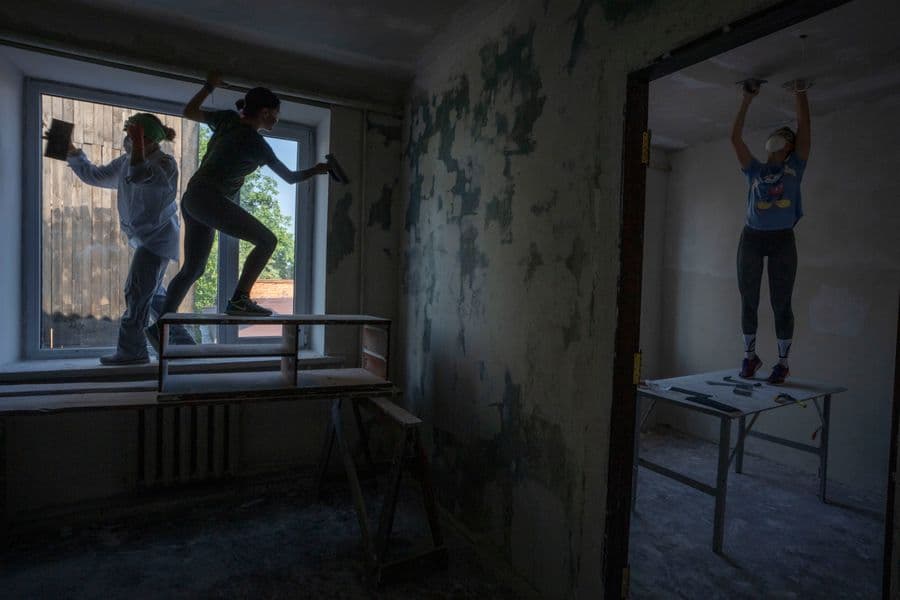
At a recent reconstruction conference in Switzerland Ukraine’s President Volodymyr Zelenskyy presented a reconstruction plan with a $750 billion price tag. Prime Minister Denys Shmyhal, who attended in person explained the plan in terms of immediate needs — even as the war continues —a “fast recovery” when it’s over—and the long-term vision. While the war continues in the east, or during an indefinite period of Russian occupation, there is opportunity to begin the reconstruction of destroyed and damaged infrastructure and public service systems in places like Odessa, Lviv, Kharkiv, and Bucha. This process should begin immediately, not wait for some elusive “best time.”
Initial reconstruction efforts should focus on the full restoration of public safety and security institutions to ensure that lawlessness and criminal elements do not seize the opportunities offered by the fog of post-combat conditions to become an embedded illicit ecosystem. Police stations and border control posts and security forces must be restored to full operationality. Security, public safety, and the rule of law are the linchpins of successful reconstruction. A parallel effort must be dedicated to reconstruction of production and logistical functions to sustain the war effort.
The reconstruction effort should be calibrated carefully to Ukraine’s absorptive capacity. Ukraine is not Afghanistan; it has a highly educated and skilled population, but it also has a legacy of toxic corruption. Initial efforts should provide finance, materials, and limited technical assistance under accountable and responsible Ukrainian leadership. Heavy lifting should be “insourced,” leveraging Ukrainian labor and expertise. But donor nations and organizations should use every opportunity and technique available to excise the corruption that has beleaguered Ukraine since its independence from the Soviet Union. Channeling reconstruction support through locally accountable governance structures can reduce the influence of corrupt oligarchs. Close scrutiny and monitoring of the reconstruction funds that will pour into Ukraine will be critical to this effort.
There are risks inherent in such an approach. Putin could decide to resume attacks on those areas in the north and around Kyiv where the initial Russian advance was stalled. Reconstruction work could be sabotaged or destroyed by missiles or artillery. Reconstruction workers might be injured or even killed. Infusions of cash intended for reconstruction might be pilfered by oligarchs or criminal elements. But there are always risks involved in reconstruction efforts. That does not mean reconstruction efforts should be delayed—only that they should be more strategically planned and carefully executed.
It is also possible that reconstruction limited to Ukraine’s sovereign part will reinforce the impending division of the country, creating a dynamic resembling the division of Germany after World War II. As regrettable as that might be, both those who choose Russian suzerainty and those involuntarily trapped in the Russian-occupied zone will be able to see up close the costs of aligning with Russia and the possibilities offered by a realignment with Europe. It took the people of the German Democratic Republic—East Germany—forty years to see the benefits of reunification within a European Germany, but they did realize it and left the Soviet orbit when the opportunity arose. Such opportunities will inevitably arise in occupied Ukraine in the future, and certainly in less time as information cannot be contained today as it was during the 20th century.
Ukraine’s reconstruction must be led by Ukrainians, not outsourced to the international donor community. With Ukrainians in the lead, the European Union should provide the principal donor muscle, but there is certainly a significant role for the United States. Its Agency for International Development (USAID) and State Department Bureau of International Narcotics and Law Enforcement Affairs (INL) are world leaders in their respective areas. They have much to offer to Ukraine’s future and unparalleled experience in reconstruction assistance. Ukrainian leaders should request support to develop their strategic framework for coordination and implementation. The aspiration should be to make Ukraine reconstruction less like Iraq or Afghanistan and more like post-World War II Germany.
Europe has already begun the process of integrating Ukraine into the European ecosphere; cautious strategic reconstruction efforts begun today will increase the likelihood of the success of that project.
Michael Miklaucic is a Senior Fellow at National Defense University and the Editor-in-Chief of PRISM, NDU’s journal of national and international security affairs.
The views expressed in this article are those of the author and do not reflect the official policy or position of the National Defense University, the Department of Defense or the U. S. Government.

Iranian Cyber Operations
By Michael Groen • RealClearDefense
Reflecting on an Epic Horse Campaign in the Mountains of Afghanistan
By Brian Glyn Williams • RealClearDefense
The Godfather of American Foreign Policy Realism Speaks to Today’s World
By Francis P. Sempa • RealClearDefense
In Pursuit of Nuclear Abolition
By Peter Huessy • RealClearDefense
Innovation Alone Won’t Prepare the U.S. for the Future Battlefield
By Joshua Segal • RealClearDefense

Navy Civilianizes Six Former Flag Billets, Reduces Six to Captains
By Mongilio, USNI N.
Raytheon's $8B Contract for Strategic Comms Terminal Modernization
By M+A El
America’s Maritime Moment Will Not Wait
By CDR Salamander
Armor Up?
By Marine Corps Compass Points
Who Shoots Down the Drone Over the Shipyard?
By John Ferrari & Dillon Prochnicki • RealClearDefense