
The Ukraine and Iran Wars Are a Wake Up Call
Last updated 06:31 AM EDT • Read time: 6m
The two wars have both demonstrated the importance of unmanned systems in war and demolished the myths that have driven U.S. National Security polices for the last 25 years.
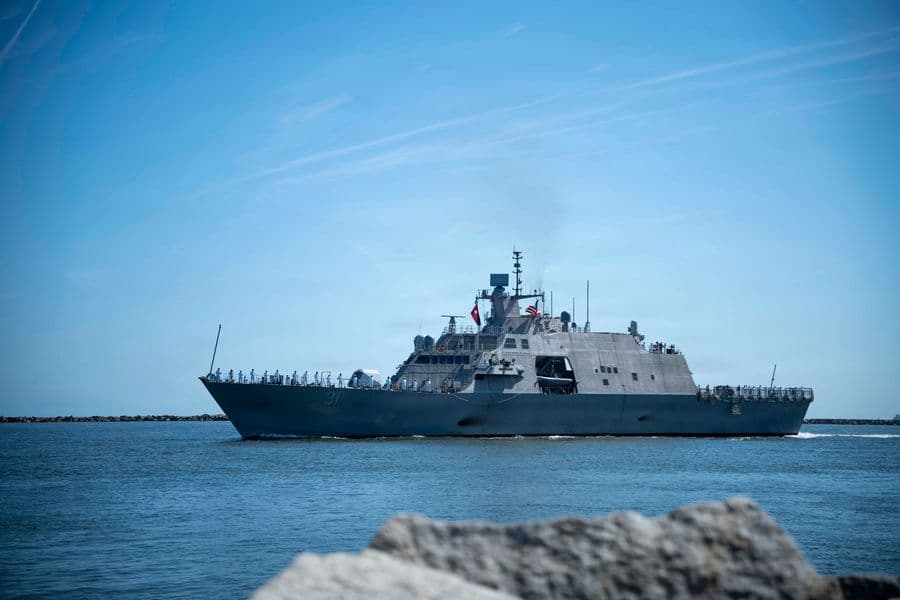
The late former Defense Secretary Donald Rumsfeld created the most damaging myth by replacing traditional military threat planning with the delusion that pirates and terrorists would be America’s primary future threats. He rejected any concerns about a near peer opponent. That and Rumsfeld’s faith in promised new technologies, led to acquisition decisions that saddled the U.S. Navy with trouble-plagued warships that cannot be deployed safely into a combat zone. That is, the Littoral Combat Ships (LCS’s) and Zumwalt-class stealth “guided missile” destroyers (DDGs). Reportedly designed for “Littoral Warfare” like the U.S. Navy is currently fighting in the Strait of Hormuz, they are in fact not suitable for either “littoral” or broad ocean area warfare.
Ostensibly built for a variety of missions by carrying mission-tailored weapons modules, LCSs are completely helpless in anything but a pirates-in-small boats environment. The LCS is limited to its mine countermeasures role in the Iran conflict but it must be escorted by Arleigh Burke-class DDGs whose less innovative design dates back to the 80s. Yet the constantly upgraded Burkes are combat capable while this century’s vaunted “innovative” designs are not. LCS advocates promised it was flexible and cost-effective. It would accommodate rapidly installed threat modules tailored to meet any emerging mission requirement from Anti-Submarine, Air Defense, Anti-Surface, Amphibious and Mine Warfare.
The problem is that construction started before any of the modules had even been prototyped and there was no effective coordination between the ship and module builders. The Mine Countermeasures (MCM) and Anti-Submarine Warfare (ASW) Modules were not operationally certified for installation until after 2020. The first MCM modules were installed last year. The Air Defense module has never been built, leaving the LCS possessing little capability against any level of air or drone attack. Its 57mm gun lacks the range and fire power to engage anything larger than the smallest surface fast attack craft, manned or unmanned.
Having gotten rid of all but one of its mission-specific mine countermeasures ships, the LCS Mine Warfare module’s capabilities provide a critical capability. In fact, the fast response MCM mission is the LCS’s only effective and very essential combat role. Strapping anti-ship cruise missiles on them may make them a threat against an enemy who can’t shoot back. But otherwise, anti-submarine operations far from a battle area will be the only other mission the LCS can conduct in any future conflict against a near-peer maritime opponent. For that mission, an unmanned ship might be a more cost-effective choice.
The Zumwalt-class is another warship reportedly designed for Littoral Warfare. All but invisible to enemy radars, it was designed to move in and strike terrorist targets in coastal areas Of course, the envisioned terrorists were not expected to have artillery or long-range multiple rocket launchers nor be capable of visually spotting a ship offshore. Moreover, Zumwalt’s construction, like that of the LCS, started before its primary weapons system, a 90nm range 155mm gun, was approved. Its cancellation resulted in the U.S. Navy spending $27 billion to commission three ships armed with only a single close-in-defense missile system. Helpless and harmless-to-the-enemy until hypersonic missiles are installed, they also cannot be deployed to a war zone. The USN is struggling with what to do with them in the meantime. Talk of using them as flagships ignores the fact that flagships have extensive electronics signatures that can be detected and localized by aerial and space-based sensors. Costing more than a nuclear submarine and unable to dive, they may still serve as long-range missile platforms if stationed outside the tactical danger zone.
Those two platforms highlight a problem with Navy Sea Systems Command (NAVSEA). USN efforts to replace the Oliver Hazard Perry-class guided-missile frigates (FFGs), the Burke-class DDGs, and Ticonderoga-class guided missile cruisers essentially have died in NAVSEA. The U.S. Navy awarded a contract to construct a proven FFG design over a decade ago, but NAVSEA’s design review, which inexplicably began after the contract was awarded, spent years and millions of dollars debating and reviewing modifications to the design. The result is the Constellation-class’s cancellation with only two to be built.
Yet, NAVSEA has been tasked to develop the specifications for the Constellation-class’s replacement and so far, it has only proposed a design less well-armed than the Perry -class FFGs of 40 years ago. It is unwise to believe an organization that could not design a successor to the highly regarded Perry, Burke and Ticonderoga-classes will do better than it did with the combat incapable warships of the last 26 years. Someone needs to be held accountable for those disasters and NAVSEA’s process’s need a penetrating review to ensure it replaces its focus on process with one centered on mission and costs. Given the need for speed, accepting NAVSEA’s proposed frigate design for Flight I construction might be necessary but subsequent units should have VLS, a 76mm cannon and directed energy weapon.
Congressional oversight needs to improve as well. Instead of just asking which warship components will be built in their distract and states, they should ask why is it Japan and South Korea can construct newly designed mission-capable warships and the USN cannot?
The Ukraine and Iran wars have also discredited two other long-standing myths; 1) that military logistics can be based on the “just in time” delivery model, and 2) that precision weapons had ended the need for weapons stockpiles. The conflict with Iran has destroyed both myths.
The timing of the lessons from those aforementioned wars may prove critical. While America looked elsewhere for twenty years, China expanded its military reach and bullied America’s Asian allies. It is well past time to wake up and prepare the deterrent capabilities to prevent a potential future war of aggression. Removing the now-discredited myths from our security thinking is a necessary first step.
Captain Schuster is a retired naval officer with 25 years of service who served on a variety of U.S. and allied warships and staffs. He entered the USN as a surface warfare officer before transferring to Intelligence, finishing his career as Director of Operations at U.S. Pacific Command’s Joint Intelligence Center. He is also a freelance writer, retired Hawaii Pacific University lecturer and security analyst and consultant.

In Pursuit of Nuclear Abolition
By Peter Huessy • RealClearDefense
Innovation Alone Won’t Prepare the U.S. for the Future Battlefield
By Joshua Segal • RealClearDefense
The sUAS Tactical Trifecta
By Bryan T. Woody • RealClearDefense
The Revolutionary War: When Strategic Options Share the Same Weakness
By Henry Yep • RealClearDefense
The Houthis Are Testing the Limits of Collective Defense
By Saima Afzal • RealClearDefense

Who Shoots Down the Drone Over the Shipyard?
By John Ferrari & Dillon Prochnicki • RealClearDefense
Northrop Grumman Breaks Out the Big Guns at AUSA
By Daniel Terrill, Defense News
Army Pursuing Diverse Array of New Anti-Air Interceptors
By Trevithick, The WarZoneWho Shoots Down the Drone Over the Shipyard?
By John Ferrari & Dillon Prochnicki, RCD
F-35C Lands for the First Time on a Ford-Class Aircraft Carrier
By The Aviationist