
War Criminals Must Be Held Accountable
Last updated 01:00 AM EDT • Read time: 7m
War is as inevitable as death and taxes. But war crimes, genocide, and crimes against humanity are not. This distinction draws the redline between the rules-based world order and the blood-soaked realism of force checked only by counterforce. In the 21st century it is the line between civilization and barbarism. Russia has crossed that line and Vladimir Putin and his henchmen (and henchwomen) must be held accountable for their crimes.
Defining what is acceptable and what is not acceptable in warfare has a long and painful history. Much was codified in the Geneva Conventions culminating in ratification by 196 nations in 1949, and a phalanx of primarily 20th century laws, declarations, and international conventions that defined some of the most egregious crimes of war. Yet human history is punctuated with mass atrocities. Even the most heinous crime against humanity—genocide—was only criminalized formally in 1951.
Because it is only recently that the international community has both resolved and been able to prosecute such crimes, the jurisprudence is thin; however, some things are clear. The eradication or the intent to eradicate, in whole or in part, a national, ethnical, racial, or religious group is genocide and illegal. War crimes include intentionally killing civilians or prisoners of war, torture, taking hostages, unnecessary destruction of civilian property, deception by perfidy, wartime sexual violence, pillaging, ordering mass killings or ethnic cleansing, the granting of no quarter despite surrender, the conscription of children in the military, or flouting the legal distinctions of proportionality and military necessity. These acts are illegal. Crimes against humanity are large-scale attacks against civilians including mass murder, torture, sexual violence, enslavement, persecution, enforced disappearance, etc. That these acts are now universally understood to be crimes reflects how humanity has evolved and parallels, though with a regrettable time-lag, our political and technological evolution.
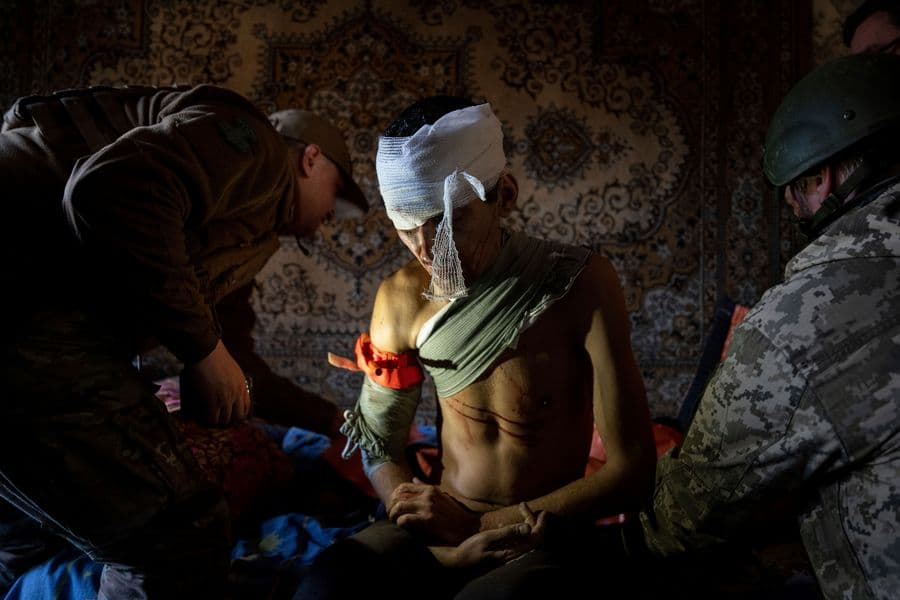
According to Ukraine’s Prosecutor General Andriy Kostin, over 67,000 war crimes have been committed by Russian combatants since the war began just over a year ago. Many of these allegations have been corroborated by independent sources such as Human Rights Watch, the Organization for Security and Cooperation in Europe, and UN-appointed human rights investigators. These incidents have not yet been adjudicated, and many certainly never will be. Such a massive caseload would burn out even the best-resourced and most efficient judicial institutions. However, the meticulous collection, archiving, and preservation of forensic evidence is taking place and is necessary to ensure the ability to prosecute war crimes, and that no future effort to erase or distort the historical record succeeds.
Some must be prosecuted; certainly, Putin and his top co-conspirators must be indicted and tried even if they may never actually face justice. As the mastermind behind this war Putin has made clear his intention to eradicate Ukrainian nationality, going so far as to say Ukraine “is an inalienable part of our own (Russian) history, culture, and spiritual space…” and that “Ukraine actually never had stable traditions of real statehood.” This war is Putin’s effort to convert that denial into reality.
The wanton killing of as many as 8,000 civilians by Russian soldiers and missile attacks is a clear violation of the laws of war. The intentional destruction of Ukraine’s economic infrastructure and 70 percent of its electrical grid, as well as reportedly over 140,000 residential buildings and 320 bridges violates any measure of proportionality or discrimination. And that is not to mention the numerous allegations of rape, abduction of children, forced deportation, pillage, and plunder. Then there is the crime of aggression defined as invasion, military occupation, annexation by the use of force, and bombardment.
It is regrettable that there is no existing judicial institution in which to try these crimes. Neither Ukraine nor Russia are signatories to the Rome Statute. Even though Ukraine has accepted the ad hoc jurisdiction of the International Criminal Court, Russia will never submit to its authority. United Nations bodies are compromised by Russia’s veto in the Security Council and Putin’s sympathizers in the General Assembly. There have been discussions in Europe of prosecution under the European Convention on Human Rights to which Russia was subject until September 2014. The Ukrainians have proposed an ad hoc tribunal to try Russia’s crime of aggression.
The lack of an existing venue is an obstacle, but it is not insurmountable. There was no existing institution to try Nazi war crimes before the Nuremburg tribunal which was established by the four major Allied powers—France, the Soviet Union, the United Kingdom, and the United States. A similar tribunal could be established today by the United States, Germany, France, and the United Kingdom. To increase the global legitimacy of such an ad hoc tribunal it could also include such countries as Poland, Japan, Philippines, or Indonesia. It might include any state willing and committed to the liberal, rules-based global order.
According to Prosecutor General Kostin “The victims want justice,” but justice in the sense of righting past wrongs is beyond reach. Some wounds are too deep; Ukrainians will never forget or forgive Stalin’s Holodomor terror famine of 1932-1933. They are resilient, but nor will they forgive or forget Putin’s stain which is inked indelibly in the historical record. The victims cannot be made whole again.
What is attainable is holding accountable those most responsible for the war crimes and crimes against humanity in Ukraine—the architects, planners, and commanders. While the Ukrainian judicial system may try the lower-echelon field criminals in Ukrainian courts, they will never have custody of those most responsible for the atrocities of the last year; those in the Kremlin. Those should be named, shamed, and ostracized.
Every country with statutory provisions for universal criminal jurisdiction or trials in absentia could try those most responsible for these crimes. Some, including Germany, Lithuania, Spain, and Sweden are already taking such actions. Ukraine should request INTERPOL red notices on all those it considers most responsible. These measures might never result in the criminals being imprisoned, but it would permanently label them as what they are and limit their access to much of the world. It was an INTERPOL notice that resulted in the London arrest of Chilean dictator Augusto Pinochet; Putin and his cronies would forever have to watch over their backs.
And even if they remain in power, and even if we must deal with them on such issues as climate change, arms control, or pandemics, the stench of their criminality should not be diluted.
Justice for Ukraine is beyond the reach of Ukraine alone. This burden falls on those self-professed guardians of the liberal, rules-based global order, meaning primarily the transatlantic allies and partners, and other aligned nations. Last March 141 nations voted in favor of a United Nations resolution deploring Russia’s invasion of Ukraine; last September 143 countries condemned Russia’s illegal annexations in Ukraine, and just last month 141 voted for a resolution calling for a “comprehensive, just and lasting peace” in Ukraine. They should step up.
Although prosecuting national leaders is a daunting challenge sovereign immunity is no longer absolute. Charles Taylor was tried, convicted, and remains in prison. Slobodan Milosevic and Biljana Plavsic were charged with war crimes during the Balkan wars, and though Milosevic died before conviction Plavsic was convicted and spent six years in prison. Putin belongs on this list—he is no better than they.
U.S. Vice President Kamala Harris and Secretary of State Antony Blinken have declared Russian forces guilty of war crimes in Ukraine. Such declaratory statements are important but not enough. If Russian forces are guilty of war crimes their leaders are even more guilty. If we are to live in a world governed by law—which is what we mean when we speak of the rules-based global order—then the perpetrators of the atrocities in Ukraine, their leaders including Vladimir Putin, and their commanders must be held accountable by law, their crimes adjudicated, and the decisions written for the record.
Michael Miklaucic is a Senior Fellow at National Defense University and the Editor-in-Chief of PRISM, NDU’s journal of national and international security affairs.
The views expressed in this article are those of the author and do not reflect the official policy or position of the National Defense University, the Department of Defense or the U. S. Government.

Iranian Cyber Operations
By Michael Groen • RealClearDefense
Reflecting on an Epic Horse Campaign in the Mountains of Afghanistan
By Brian Glyn Williams • RealClearDefense
The Godfather of American Foreign Policy Realism Speaks to Today’s World
By Francis P. Sempa • RealClearDefense
In Pursuit of Nuclear Abolition
By Peter Huessy • RealClearDefense
Innovation Alone Won’t Prepare the U.S. for the Future Battlefield
By Joshua Segal • RealClearDefense

Navy Civilianizes Six Former Flag Billets, Reduces Six to Captains
By Mongilio, USNI N.
Raytheon's $8B Contract for Strategic Comms Terminal Modernization
By M+A El
America’s Maritime Moment Will Not Wait
By CDR Salamander
Armor Up?
By Marine Corps Compass Points
Who Shoots Down the Drone Over the Shipyard?
By John Ferrari & Dillon Prochnicki • RealClearDefense