
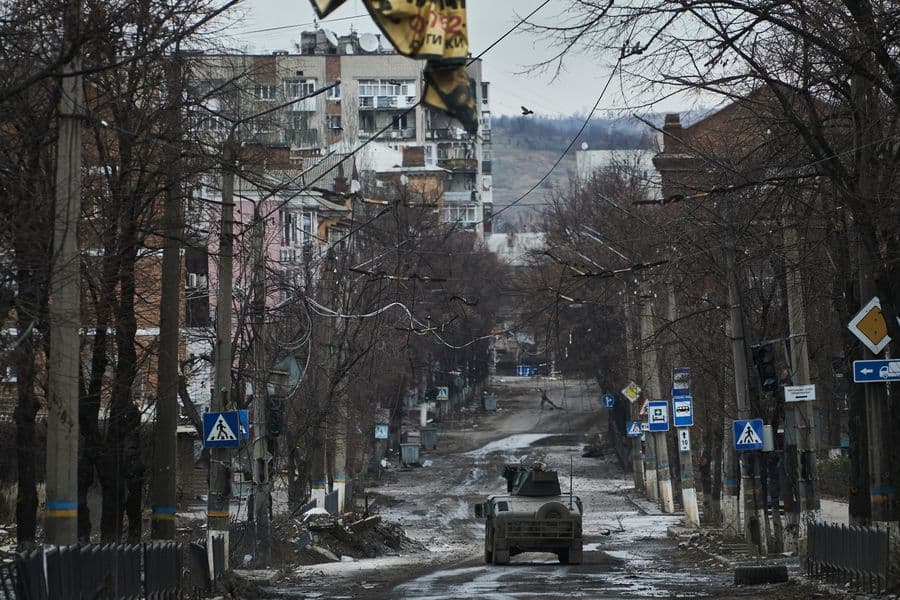
Winter Cold: Where the War is Today
Last updated 04:33 PM EST • Read time: 10m
The West’s Interest in Fighting This War to the Finish
The Ukraine War nears its year-mark, a bloody anniversary for a vicious war of conquest. Yet there will be far more violence before it ends. Russia has committed to an indefinite war of conquest and seeks to rebuild its arsenal and assault Ukraine between January and May in the new year. Most critical, the West’s strategic incentives have not changed – it may still lose this war.
The Ukraine War will continue because none of the participants’ strategic incentives have changed. This is true despite Russia’s apparent calls for negotiation – albeit only if its current gains are recognized – and the Ukrainian request for a UN-brokered peace summit that also includes discussion of war crimes and an indemnity against Russia.
Russian Objectives
Russia persists in its long-term strategic objective. It remains identical to that of February 24th. Vladimir Putin still seeks the conquest of Ukraine, at least up to Zhytomyr and Vinnytsia Oblasts, with the remainder of the country’s reduction to a satellite rump-state. Captured Russian operational documents and an extensive investigation of still-classified Ukrainian sources indicate that Russia had a comprehensive post-conquest plan for Ukraine. This included the liquidation and reeducation of Ukrainians deemed hostile to Russian conquest – namely political and business figures, but also leaders of NGOs and charities alongside military personnel – a political framework for the installation of pro-Russian authorities throughout the country, and a scheme to capture Ukraine’s power grid and water system. This final point reveals the full scope of Russian ambition. Russian troops were meant to withdraw by June 2022. A light post-conquest force would then punish recalcitrant regions by cutting their power, water, and food supplies, conducting a targeted a Stalin-like Great Famine to break Ukrainian will.
Subjugating Ukraine in 2023 or 2024 still provides numerous benefits to the Kremlin. It expands Russian territory significantly, gives Russia a dominant position in the Black Sea, facilitates Belarus’ integration into the Russian Federation, provides Moscow with another 40 million or so subjects, and ensures substantial Russian control over global food supplies given the combined productivity of Russia and Ukraine.
Russia with Ukraine becomes not a gas station with a country, but a legitimate global power. If Belarus, Transnistria, and perhaps Moldova and Georgia are included, the new Russian Empire, from the Black and Baltic Seas to the Pacific, becomes a country of around 200 million with a GDP well over $2 trillion. This is a strategic actor capable of holding its own against Europe and exerting power in Central Asia and the Middle East. Moreover, the Russian conquest of Ukraine in the next two years would demonstrate Russian strength to the same degree—albeit in a different manner—as a rapid six-week conquest would have. Yes, Russia made mistakes. But the great Russian bear, slow as it may be, is a formidable adversary, far more willing to accept punishment than the wobbling West.
At minimum, then, Russia retains a decided interest in continued conflict. It continues as if its objectives are static. Russia’s reorientation towards the Donbas was initially meant to inaugurate a series of grand encirclements, culminating with a drive towards Dnipro that would effectively cut Ukraine in half, and allow Russia to conquer Ukraine up to the Dnieper River. Only when this failed, and when Russia’s more ambitious encirclements also stalled, did it finally settle for a grinding offensive in the Donbas. Despite Ukraine’s successes in September and November, Russia has intensified its commitment to the conflict. It has mobilized some 300,000 new soldiers, rationalized its production systems to deploy more missiles, and bombarded Ukrainian critical infrastructure. None of these actions imply a desire to negotiate, indeed, to settle for anything less than the conquest of Ukraine.
The Ukrainian Condition for Peace
Ukraine, meanwhile, has no interest in negotiations today. The central question for the Ukrainian state was and remains survival. This has a territorial, and military-technical, and diplomatic component. Territorially, Ukraine’s borders must provide it with economic access to the broader world and defensive depth to repel another Russian invasion. Current borders provide Ukraine neither. Russia’s control of the south, including Crimea, allows it to regulate Ukrainian trade, reduce Ukrainian strategic depth, and continue to present a potential invasion path for renewed Russian conquest.
Russia’s control of the east is less problematic strategically, although politically, the unsurpassed savagery of the Russian invasion weighs heavily on Ukrainian minds – it is emotionally difficult to leave Ukrainians beyond a ceasefire line, subjected to horrors of the same kind as in Kherson’s torture chambers, or simply murdered as in Bucha or Izyum. Yet the south will be the war’s key, and the fact is that Ukraine must at minimum hold Kherson and Zaporizhzhia Oblasts to be economically sustainable and strategically secure.
In military-technical terms, Ukraine also requires the capabilities to take the war to the enemy, to strike Russian territory, thereby countering the strategic bombardment campaign that Russia began this past autumn. Ukraine’s Western supporters who cannot stomach the thought fail to grasp that Putin respects only force. Would the Wehrmacht have ceased fighting and gone home if it were stopped at the Rhine or prevented from opening the Eastern front?
Russia pounds Ukrainian power stations with a combination of high-tech missiles and low-tech loitering munitions, slowly eroding the Ukrainian electric grid. Ukraine must develop its own long-range weapons, not to destroy Russia’s power system, but to hit the air bases and staging sites for a similar campaign, along with other crucial command-and-control and logistics nodes for another invasion.
This hinges on the third set of diplomatic considerations. NATO membership is no panacea. Ukraine will require its own military capabilities after the war and may seek a more flexible structure that allows it to respond to Russian aggression, and construct its forces, without submitting itself to NATO bureaucracy. Yet Ukraine must be affiliated with NATO simply because NATO has been an active participant, albeit not a combatant, in the Ukraine War through its arms transfers and intelligence support. Moreover, Ukraine may build up a defense industrial base by the 2030s. But for the coming years, Ukraine will rely on NATO weapons, including long-range weapons like ATACMS, or sign co-production agreements with NATO countries to create Ukrainian-designed missiles. Nevertheless, Ukrainian NATO affiliation will formalize an increasingly robust informal relationship, thereby assuaging well-founded Ukrainian concerns of strategic abandonment.
Some combination of these three considerations – enough territory to remain defensible and economically viable, the ability to strike into Russia, and a diplomatic affiliation with NATO – will satisfy Ukraine.
The West’s Endgame
The West’s position in this is the least clear. Despite feckless handwringing over Putin’s irrationality, caricatured depictions of a supposedly hyper-nationalist Ukraine, or a divided and incompetent Russian state, the West is the most volatile actor in the war. Nearly a year into the war, it lacks a clear strategy.
New Europe is the clearest. There is no desire in the post-Soviet space to allow Russia to remain in Ukrainian territory. The U.S., meanwhile, seeks to humble Russia, and does not see Putin as a reasonable interlocutor, but nevertheless remains keenly aware of the long-term strain the Ukraine War has caused, and the realities of an assertive China in the Indo-Pacific. Old Europe is the opaquest of the three Western camps. Scholz’s Global Zeitenwende signals a desire to shift away from American dependence, but retains significant anti-Russian rhetoric, while Macron’s France, despite its coy public actions, has remained a consistent arms supplier for Ukraine since the early summer.
A peace settlement in Ukraine will occur only once the battlefield situation allows it. But both Russia and Ukraine undoubtedly have the incentive to launch future offensives and thereby bring their territorial control in line with their political objectives. Hence the West’s key consideration is the degree to which Ukraine can be allowed to push.
This, in turn, rests upon the potential for military action to bring Russia to legitimate negotiations.
The question should not be framed as what might satisfy Russia: nothing beyond the current situation will meet Russian minimum requirements. Certainly, a reversion to the February 24th situation would be deeply unsatisfactory. Putin found that odious enough to unleash a war of conquest. And while the east may be Putin’s rhetorical prize, the south is his strategic one, and when Crimea is considered, his true political reward.
The paradoxical answer is that Putin’s core interests must be pressured to identify whatever maneuver space actually exists. Crimea must be threatened if Ukraine and the West are to strike a bargain with the Kremlin that is worth making. Peace emerges not necessarily because both parties are satisfied territorially – in this case Russian and Ukrainian territorial, military, and diplomatic objectives are in direct contradiction – but because the alternative to fighting for one of the combatants is far worse than the cost of surrender. Barring an active attempt to overthrow Putin, an attempt that the United States and its allies are almost certain not to make, the only way to pressure the Russian regime is to hammer its political center of gravity, Crimea, the physical embodiment of the return of Russian greatness that Putin has leveraged to maintain power since 2014.
The United States has done the arduous work of alliance management to a degree. As it stands, Germany and France have yet to break with Ukraine publicly, despite their intimations of a post-Ukraine European security system that excludes the U.S.. Washington’s new task, however, is more specific. It must convince Western Europe that the only path to peace runs through Crimea, and that the West must provide Ukraine with the support to put the peninsula at severe risk and retake it.
Equally, however, the American public has been denied a clear message. The right conflates the Ukraine War with U.S. southern border issues, while the left lacks even a pale imitation of foreign policy understanding. America should hold the line in Ukraine because it cares for the fate of Eurasia: a Eurasian continent dominated by a single or shared hegemony will create a world inimical to American values and interests. America’s founders grasped this as it applied to Europe. Today the geopolitical arena of America’s security and economic interest stretches from the English Channel to the Taiwan Strait. Leadership is needed to convince Western publics on both sides of the Atlantic that Eurasia’s fate lies here. It has been absent.
Despite all geopolitical signals to the contrary, the West has a shot at stopping authoritarian conquest before it spirals beyond control. The most dangerous of illiberal formations is the entente, the informal alliance of predatory international actors. Humbling or breaking Russian power would demonstrate the West’s resolve. But pressure against Crimea would indicate its understanding of the political incentives at play, and the ability to manipulate those incentives to produce a favorable outcome. A coalition willing to break Putin’s conquest has the strategic ability to stare down Xi Jinping – and win. Indeed, a West that can finish this fight faster—providing more to Ukraine in a shorter time span—would benefit even more. If the West can keep Ukraine’s fate from becoming Eurasia’s future, it can avoid a confrontation that will surely engulf its own people in the foreseeable future.
Seth Cropsey is the founder and president of Yorktown Institute. He served as a naval officer and as deputy Undersecretary of the Navy and is the author of Mayday and Seablindness.

Iranian Cyber Operations
By Michael Groen • RealClearDefense
Reflecting on an Epic Horse Campaign in the Mountains of Afghanistan
By Brian Glyn Williams • RealClearDefense
The Godfather of American Foreign Policy Realism Speaks to Today’s World
By Francis P. Sempa • RealClearDefense
In Pursuit of Nuclear Abolition
By Peter Huessy • RealClearDefense
Innovation Alone Won’t Prepare the U.S. for the Future Battlefield
By Joshua Segal • RealClearDefense
26th MEU – U.S. Needs Crisis Response MAGTF
By Marine Corps Compass Points
The Influence of History on a Sea Power
By CDR Salamander
Navy Civilianizes Six Former Flag Billets, Reduces Six to Captains
By Mongilio, USNI N.
Raytheon's $8B Contract for Strategic Comms Terminal Modernization
By M+A El
America’s Maritime Moment Will Not Wait
By CDR Salamander