
Logistics: One Byte at a Time
Last updated 12:18 AM EDT • Read time: 5m
An old adage holds: bullets don’t fly without supply. Today, bullets don’t fly without bytes.
The Department of War’s fortification and digitization of its supply chains is a long overdue investment. Yet one critical element continues to lag: logistics command and control (C2).
Fires and intelligence, sharpened by the Global War on Terror (GWOT) and industry partnerships that embedded advanced data platforms into the force, now operate with Jetsons-level speed. Logisticians still struggle like the Flintstones. Recent offerings from defense technology firms give joint force logisticians powerful tools to move planning from the stone age to the AI age. Yet that promise has yet to translate into uniform results. Each service pursues its own Logistics Command and Control (C2) efforts, leaving the joint force without a coherent logistics picture.
Recent events in the Middle East, including the difficulty of resupplying aircraft carriers and gaps in the movement of wounded service members, bring this shortfall to the forefront. As operations continue in the Middle East and a larger fight looms in the Pacific, the joint force must accelerate logistics command and control efforts.
Every U.S. military unit will fight and sustain itself within a contested environment. Legacy systems and once-assured networks are now a vulnerability. Units need logistics C2 systems that can communicate and plan when bandwidth and time are limited. The system must be service-agnostic, capable of integrating across Joint and Combined forces, and delivered to the tactical edge. Today that demand signal resides on spreadsheets, PowerPoints, and siloed databases. These methods prevent cross-enterprise visibility, and slow resupply and decision making when speed proves decisive.
From the tactical edge to industrial depots, the joint force would be much more efficient if it ran on a single line of sight from the point of need on the front lines to commercial industry on the home front. Today the lines remain blurred by materiel shortfalls, and suppliers in hostile nations leave warfighters exposed. Oversight of Data management and sound governance from the top down could provide many of the answers, yet the fragmentation of logistics data plagues U.S. military operations around the world. During Operation Epic Fury, following attacks on the logistics hubs in Bahrain, CENTCOM repositioned distribution nodes across the Middle East — an already difficult task further complicated by a fragmented logistics C2 picture.
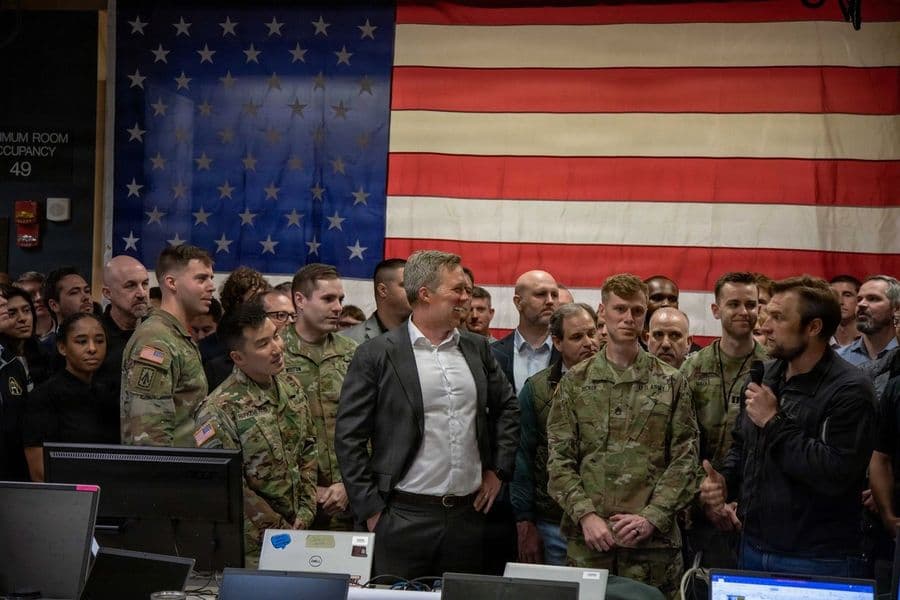
The Department of War can provide coherence to the fragmented logistics C2 efforts across the department by first mapping what systems are being employed where and cross-leveling efforts. Also required is a tiered map, showing which systems are feeding other systems. Logisticians must define the problem, and software engineers must write the code. Building on the model of the U.S. Army’s Operation Jailbreak, every logistical data system should be required to prove its ability to integrate with the joint force, not just at the service level. The services must implement cross-domain solutions to bring data into protected environments. In addition, the department should open the process to potential vendors to present solutions, but do so from a holistic level. At any point, a senior leader and decision maker should be able to see the number of drones, aircraft, missiles, resources, and personnel available to deploy at a moment’s notice; and use high end analysis tools, such as large language models to blend all that information together and answer questions, with confidence that the data is accurate and reliable enough to stake human lives on.
If those assets or the warfighters who wield them are not ready and equipped, the joint force must see the constraints and bypass them in real time. Software engineers will not provide all the answers, but can show senior leaders the extent of the Logistics C2 problem. Then senior leaders can align incentives, direct funding, and grant authorities.
During the Global War on Terror (GWOT), sustainers often took a back seat to the warfighters they supported. Today the link between sustainers, sensors, and shooters is vital. The recent difficulty of resupplying units in the Middle East should serve as a wake-up call. To fight and win, our senior leaders must be able to rapidly prioritize and de-prioritize extremely limited resources, so they reach the right problems.
LtCol Kevin Wheeler serves as the Logistics Operations Officer at Marine Forces Pacific.
Maj Hannah Flynn is an Operations Research Analyst at the Marine Corps Programs and Resources
Maj Ben Van Horrick is the Logistics Command and Control Lead at Project Dynamis.
The views presented are those of the authors and do not necessarily reflect the policy or position of the U.S. Marine Corps, the Department of the Navy, and the Department of War.
image: Dr. Alex Miller, Chief Technology Officer of the U.S. Army, provides opening comments during Operation Jailbreak on May 28, 2026, at Fort Carson, Colorado. Operation Jailbreak is the first in a series of combined Army and defense industry partnered hackathon events to integrate critical military technology systems as part of the overarching Right to Integrate effort. (Photo Credit: Staff Sgt. Richard Stewart)

In Pursuit of Nuclear Abolition
By Peter Huessy • RealClearDefense
Innovation Alone Won’t Prepare the U.S. for the Future Battlefield
By Joshua Segal • RealClearDefense
The sUAS Tactical Trifecta
By Bryan T. Woody • RealClearDefense
The Revolutionary War: When Strategic Options Share the Same Weakness
By Henry Yep • RealClearDefense
The Houthis Are Testing the Limits of Collective Defense
By Saima Afzal • RealClearDefense

Who Shoots Down the Drone Over the Shipyard?
By John Ferrari & Dillon Prochnicki • RealClearDefense
Northrop Grumman Breaks Out the Big Guns at AUSA
By Daniel Terrill, Defense News
Army Pursuing Diverse Array of New Anti-Air Interceptors
By Trevithick, The WarZoneWho Shoots Down the Drone Over the Shipyard?
By John Ferrari & Dillon Prochnicki, RCD
F-35C Lands for the First Time on a Ford-Class Aircraft Carrier
By The Aviationist