
Open Warfare: Hidden Costs
Last updated 06:46 AM EDT • Read time: 7m
As the world is re-learning, national security and economics are as inextricable as a mortise and tenon in a working wooden joint. Rising fuel prices have cost the U.S. defense department over one billion dollars in the past six months. Part of the added cost is in global shipping prices. Shipping costs raise the price of what is paid for gas and oil-based products. In fact, arbitrarily determined shipping costs and their related insurance premiums are already increasing energy bills in a significant way that affects the global price of oil and has received scant attention.
Mercuria Energy Group, a commodity trading giant with more than $6 billion in equity, filed suit against the Baltic Exchange, the nearly 300-year-old institution that sets the world’s shipping benchmarks. Mercuria experienced losses running into the hundreds of millions of dollars on freight contracts tied to a benchmark called TD3C. TotalEnergies, a century-old French, global energy company is reportedly weighing a similar claim.
It sounds like inside baseball for shipping desks, and in one sense it is. But TD3C also settles derivatives contracts on the Commodity Futures Trading Commission-regulated New York Mercantile Exchange, and it feeds into what refiners pay to move crude oil which means a distortion has likely already surfaced somewhere far less exclusive than a High Court docket: for example, at the pump, or in the price tag of anything that started life as a barrel of oil, from plastic wrap at the grocery store to the fertilizer that helped grow what's inside it.
TD3C is the Baltic Exchange’s benchmark for shipping crude from one of the largest producers to one of the largest consumers in the world–the Middle East Gulf to China–through the Strait of Hormuz, set daily by a panel of brokers who submit rate estimates for the route. For years it worked well, uncontested, as good infrastructure ought to. Then the U.S.’s latest campaign against Iran, and Tehran’s response through interference in the Strait, effectively shut down the Hormuz route. Despite the disruption in freedom of navigation in and around the strait caused by the Iranian blockade and the American counterblockade, the Baltic kept publishing its estimates only this time not based on real transactions, as they had virtually ceased to exist, but solely on panelists’ judgment. Circulars instructed brokers to weigh comparable routes and ongoing negotiations, without ever specifying how. This resulted in a benchmark established by judgment calls rather than methodology and hard numbers. The result? Crude oil that does not pass through the Hormuz Strait—for example, the nearly five million barrels of oil exported daily from the Red Sea Saudi port of Yanbu—is charged at the same elevated rate that it would if it risked passing through the contested strait at the entrance to the Persian Gulf.
On a single day, estimates from Baltic panelists have reportedly diverged by as much as 520 Worldscale points—used to calculate the cost of shipping oil— against a historical spread of roughly 0 to 15. That’s the pricing equivalent of nineteen brokers being asked what a taxi ride costs and coming back with answers between eight dollars and $4,000 dollars. A benchmark with nothing to support it has nothing holding it in place which is precisely the condition regulators mean when they warn an index is “readily susceptible to manipulation.” And the story ends quite predictably: the bill lands, eventually, on the person who had no idea there was a bill.
Freight costs are baked into what refiners pay to move crude, and from there into gasoline, diesel, and the whole chain of products made from oil–plastics, fertilizer, and everything else produced from a barrel of oil. When the reference rate for shipping crude oil comes unmoored from what is actually happening on the water, elevated freight costs can propagate through contracts referencing TD3C even when the cargo never goes near the Strait. Nobody has tallied the dollar-and-cents version of that yet, and that’s not a reassuring fact. This distortion becomes part of the baseline, and it could already be trickling down to what people pay at the pump whether or not anyone has bothered, or been able to measure it. As with most things in life, time will tell. As with some things in life, we do not necessarily want it to do so.
Which raises the obvious question: whose job is it to catch this before it compounds? The Baltic’s defense of its own process points to an April 2026 consultation it says favored continuing to publish over suspending. This is all well and good except that the Baltic forgot to provide information on who responded, how the votes split, or how it handled conflicts of interest, which makes “the market told us to keep going” a flimsy excuse.
The more useful answer for everyday consumers should sit with the Commodities Future Trading Commission (CFTC), an agency of the U.S. government established in 1974 to regulate derivative markets. TD3C settles contracts on an exchange the CFTC regulates, and the commission already has what it needs to act. The CTFC bars listing a contract that is readily susceptible to manipulation–a solid description of a cash-settled index built on opinion rather than trades. The Commission also has the power to rewrite contract terms, including the settlement reference, without disturbing anything else. It could redirect TD3C-linked contracts to a route like TD34 which goes from the Gulf of Oman (southeast of the Hormuz Strait) to China, where transactions are still observable and risk can be determined empirically. The CTFC possesses emergency authority for precisely this kind of disturbance. None of this requires the commission to introduce new legislation but rather use tools it already has instead of being a silent observer and passive victim.
American politics runs on a short list of evergreen issues, and it’s-the-fuel-costs-stupid is a durable member of that list. Amplified by the heat of the upcoming midterms, a domestically regulated derivatives market absorbing distortion from an unaccountable foreign benchmark will not stay contained to shipping trade press forever. The Baltic Exchange resisting scrutiny while Britain’s Financial Conduct Authority stays conspicuously silent could quickly turn a shipping-desk dispute into a transatlantic one–in a time when the alliance is already frayed.
Mercuria can hire counsel and fight this out in London. The people who ultimately fund a distorted benchmark every time they fill a tank don’t know one exists, can’t sue over it, and won’t get a refund once it’s fixed. The way to close that gap is to redraw a settlement reference to decide that a tool already sitting in the statute book is worth picking up. And do so before the bill comes due for customers who never knew they are paying it.
Seth Cropsey is president of Yorktown Institute. He served as a naval officer and as deputy Undersecretary of the Navy.
Barna Peterfi is director of research at Yorktown Institute.'
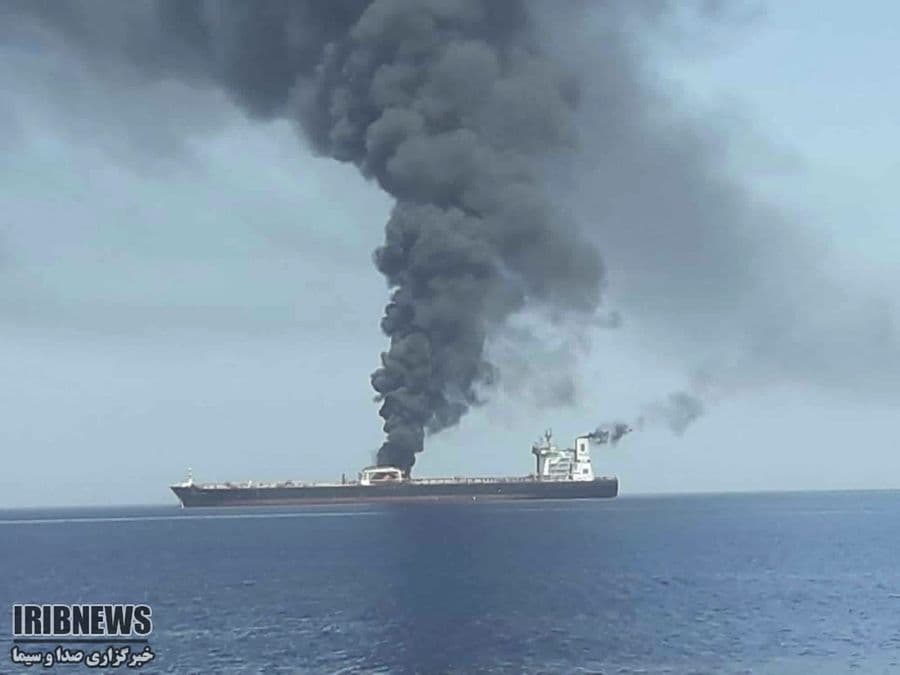
image: In this photo released by state-run IRIB News Agency, an oil tanker is on fire in the sea of Oman, Thursday, June 13, 2019. Two oil tankers near the strategic Strait of Hormuz have been reportedly attacked. The alleged assault on Thursday left one ablaze and adrift as sailors were evacuated from both vessels. The U.S. Navy rushed to assist amid heightened tensions between Washington and Tehran. (IRIB News Agency via AP)

In Pursuit of Nuclear Abolition
By Peter Huessy • RealClearDefense
Innovation Alone Won’t Prepare the U.S. for the Future Battlefield
By Joshua Segal • RealClearDefense
The sUAS Tactical Trifecta
By Bryan T. Woody • RealClearDefense
The Revolutionary War: When Strategic Options Share the Same Weakness
By Henry Yep • RealClearDefense
The Houthis Are Testing the Limits of Collective Defense
By Saima Afzal • RealClearDefense

Who Shoots Down the Drone Over the Shipyard?
By John Ferrari & Dillon Prochnicki • RealClearDefense
Northrop Grumman Breaks Out the Big Guns at AUSA
By Daniel Terrill, Defense News
Army Pursuing Diverse Array of New Anti-Air Interceptors
By Trevithick, The WarZoneWho Shoots Down the Drone Over the Shipyard?
By John Ferrari & Dillon Prochnicki, RCD
F-35C Lands for the First Time on a Ford-Class Aircraft Carrier
By The Aviationist