
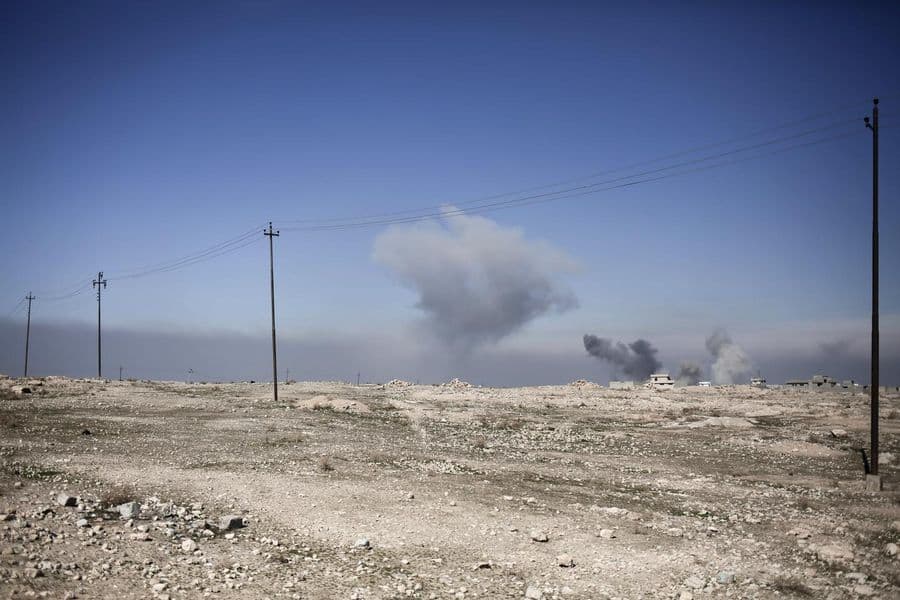
U.S. Has Launched Over 500 Strikes Against Islamic States Since May
Last updated 05:26 PM EDT • Read time: 4m
On May 1, the United States launched Operation Roundup to accelerate the defeat of the Islamic State in the Middle Euphrates River Valley and the Iraq-Syria border region. Over the past three months, the US-led Coalition has launched 529 strikes in Iraq and Syria, the majority of which hit the critical border crossing of Abu Kamal, Syria.
The Coalition conducted 225 strikes in May and a similar number in June, over three times as many as the 74 strikes launched in March, shortly before Operation Roundup began. Strikes declined by over half in July, when 81 were conducted.
The majority of Coalition strikes over the past three months have been concentrated in Abu Kamal, a critical border crossing on the southern border between Iraq and Syria. Since the start of Operation Roundup, the United States has conducted 365 strikes in Abu Kamal, representing nearly 70 percent of the total.
The next largest concentration of strikes occurred in Shadaddi, a town in Syria’s northeastern Hasakah province, although strikes here have dropped off precipitously. The Coalition launched 93 strikes (17 percent) in Shadaddi as part of Operation Roundup thus far. Strikes in Shadaddi peaked in the first week of June, in which the coalition conducted 33 strikes. Strikes have tapered off since, concluding on July 9.
Both Shadaddi and Abu Kamal are critical to the Islamic State’s operations, as demonstrated by the nature of the targets. Every command-and-control center and headquarters that the coalition targeted was located in either Abu Kamal or Shadaddi. Coalition airstrikes hit a total of 85 Islamic State command-and-control centers: 74 in Abu Kamal and 11 in Shadaddi. Strikes also hit a total of 18 Islamic State headquarters: 8 in Abu Kamal and 10 in Shadaddi. The coalition destroyed 133 Islamic State supply routes: 12 in Shadaddi, 117 in Abu Kamal, and the remaining 4 in nearby Qaim, on the Iraqi side of the border opposite Abu Kamal.
The remaining 71 strikes were conducted at 24 other locations across Iraq and Syria.
Operation Roundup successfully targeted and killed a number of high-level Islamic State leaders. On May 17, the Coalition killed Amed al-Hamdouni, who served as a courier for the Islamic State’s senior leadership, near Dashisha, Syria. On May 26, the Coalition killed Abu Khattad al-Iraqi, the leader of a revenue-generating oil and gas network, along with three associates in the Middle Euphrates River Valley in Syria.
Coalition strikes have also killed a number of Islamic State operatives involved in planning external attacks. The Coalition killed Soufiane Makouh, a Belgian who immigrated to Syria in order to plan attacks against the United States. In June, the Coalition killed four individuals associated with a Swedish terror cell, including an Islamic State intelligence official. Operation Inherent Resolve’s director of operations described the Islamic State as “desperately seeking to remain relevant through operations that threaten all the nations of the world” due to the pressure on their conventional forces in Syria.
The precision strike campaign is also coordinated with a Syrian Democratic Forces (SDF) ground offensive against the Islamic State. From May 1-15, the SDF successfully cleared Baghuz, Syria. On May 27, the SDF launched a second phase to capture Dashisha, Syria. On July 31, the Coalition announcedthat the second phase is complete, although the SDF will continue to clear IEDs from the area. Planning is underway for a final phase to clear Hajin, near Abu Kamal, which Coalition officials warn will be challenging due to the population density. Local Syrian activists reported clashes between the SDF and the Islamic State near Hajin earlier this week. The southern progression of the ground campaign may explain the cessation of strikes in the vicinity of Shadaddi.
Iraqi forces have also enhanced their presence at the border to ensure that Islamic State members cannot escape from Syria into Iraq, according to the Coalition.
The Islamic State’s “morale is low and its leaders are scurrying for their lives,” explained CJTF-OIR spokesman Army Col. Thomas Veale in early June. “There is no doubt momentum is on our side, but we’re facing a determined enemy and there is much work to do.”
Alexandra N. Gutowski is the Senior Military Affairs Analyst at the Foundation for Defense of Democracies. Follow her on Twitter @angutowski. Sarah Nadler is a research intern at FDD.
This article appeared originally at FDD's Long War Journal.

The U.S. Nuclear Deterrent Umbrella
By Peter Huessy • RealClearDefense
The Islamic Republic Can Lose the War and Still Win
By Nima Gholam Ali Pour • RealClearDefense
Talent Ecosystems: Building a Scalable National Security STEM Workforce
By Payuna Uday • RealClearDefense
The Underground Cloud
By Ben Poulin • RealClearDefense
Trump's Disrupt First, Negotiate Second: Greenland in Focus
By Meda Parameswara Reddy • RealClearDefense
U.S. Navy to Begin Testing for USS Lyndon B Johnson (DDG 1002)
By Naval-Technology
Marine Corps Moves To Expand Maven Smart System Account Access
By DefScoop
Navy F/A-18 Spotted With New AIM-174B And AIM-260 Long-Range Missiles
By TWZ
Pentagon’s 6th Generation Stealth Fighter Will Control Drone Swarms
By Warrior M.
Air Force Needs 1,509 Combat-Ready Jets by 2035
By Michael Marrow, Breaking Defense