
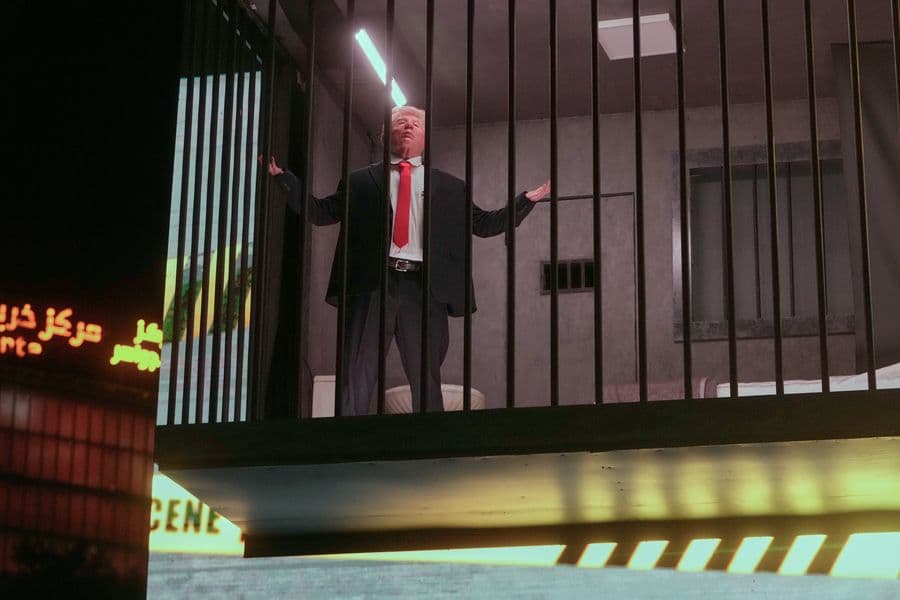
An actor portraying U.S. President Donald Trump sits behind bars in a billboard installation resembling a prison cell in Tajrish Square in Tehran, Iran, Wednesday, Oct. 21, 2026. (AP Photo/Vahid Salemi)
The Islamic Republic Can Lose the War and Still Win
Last updated 05:02 AM EDT • Read time: 5m
The military campaign launched by the United States and Israel against Iran on February 28—and which remains ongoing—has yet to produce a strategic victory.
The Islamic Republic remains in power. The nuclear issue is unresolved, and Iran retains sufficient missile capabilities and regional proxies to destabilize the region and prolong the conflict. Washington has no clear strategy for ending this war on terms that could plausibly be described as a victory.
Nor, however, can the Islamic Republic credibly claim to have won. The regime has suffered extensive military and economic losses. Yet its survival allows it to portray itself as the side that withstood the United States and Israel without being overthrown.
Because the regime remains in power and no part of Iran is under foreign occupation, the Islamic Republic can present its survival as successful resistance to “American imperialism.” The United States and Israel have enjoyed clear military superiority, struck targets across much of Iran and killed a significant share of the regime’s senior political and military leadership.
Yet, just as it did during the Iran–Iraq War, the regime has incorporated its dead leaders and commanders into its narrative of martyrdom. Their deaths are portrayed not as evidence of defeat but as symbols of sacrifice and resistance. This is not a new political narrative for the mullahs’ regime. It draws on the Shia religious tradition of martyrdom in the struggle against an overwhelmingly powerful enemy.
The same ideological and religious framework was employed during the Iran–Iraq War. It was expressed through visual imagery as well as religious retellings of the Battle of Karbala and the martyrdom of Imam Hussein.[i]
Regime propaganda cast the war as a new Karbala, Saddam Hussein as the Yazid of his time, and Iranian soldiers and Basij volunteers as followers of Hussein. Deaths, retreats and failed offensives could therefore be recast as martyrdom and steadfastness rather than as evidence of a failed military strategy.[ii]
It is far from certain that the Iranian people will once again embrace this religious narrative of war, 38 years after the Iran–Iraq War ended. Iranian society has changed, and the available research points to deep divisions between secular and religious segments of the population, as well as widespread opposition to clerical rule.
Sooner or later, the regime in Tehran will pose a simple question to both the Iranian people and the wider world: If the United States and Israel are so militarily superior, why does the Islamic Republic remain in power?
It is a legitimate question. The United States spends more on its military than any other country and is widely regarded as the most powerful nation in the world.[iii] Israel has a reputation for prevailing over its regional adversaries. If the Iranian regime survives a war against these two military giants and remains capable of waging proxy wars, conducting terrorist activities and expanding military capabilities that destabilize the global economy, then the mullahs’ political project will have succeeded.
Improving the lives of Iranians was never the purpose of that political project. Khomeini sought to export the Islamic Revolution that had taken place in Iran.[iv] When the Iranian regime spreads its own version of Islamism across the Middle East, it is acting in accordance with Khomeini’s injunction. That has always been the mullahs’ grand project.
Another pillar of the regime’s political project has been its confrontation with the United States and Israel. Year after year, the mullahs and their supporters have chanted “Death to Israel” and “Death to America.” If the foundations that allow the Iranian regime to export its revolution remain intact after a war against the United States and Israel, the regime will naturally regard its political project as a success.
All this means that the United States and Israel must bring the war they started to a decisive conclusion. In this case, that requires the regime in Iran to be defeated in one way or another.
The best outcome would be regime change and an Iran moving toward democratic government. Another option would be to support a credible Iranian political force in liberating part of the country and then continue backing it in the struggle to liberate all of Iran. A further option would be to force the regime to dismantle its entire network of proxies and terrorist organizations and abandon its missile program. There are many ways in which the United States and Israel could demonstrate that the regime’s political project has failed.
But leaving the war at a stalemate would amount to a victory for the Islamic Republic. It would all but guarantee that the mullahs remain in power for at least another 50 years, as their successful resistance to the United States and Israel would have legitimized the regime.
It would also allow the regime to continue its political project of exporting Islamism and serving as a hub of antagonism toward the West. A stalemate would not leave peace in America’s wake. It would leave behind the conditions for future wars.
Nima Gholam Ali Pour is a Swedish political commentator and former Member of Parliament.
notes:
[i] https://www.lib.uchicago.edu/collex/exhibits/graphics-revolution-and-war-iranian-poster-arts/new-battle-karbala/

The U.S. Nuclear Deterrent Umbrella
By Peter Huessy • RealClearDefense
The Islamic Republic Can Lose the War and Still Win
By Nima Gholam Ali Pour • RealClearDefense
Talent Ecosystems: Building a Scalable National Security STEM Workforce
By Payuna Uday • RealClearDefense
The Underground Cloud
By Ben Poulin • RealClearDefense
Trump's Disrupt First, Negotiate Second: Greenland in Focus
By Meda Parameswara Reddy • RealClearDefense
U.S. Navy to Begin Testing for USS Lyndon B Johnson (DDG 1002)
By Naval-Technology
Marine Corps Moves To Expand Maven Smart System Account Access
By DefScoop
Navy F/A-18 Spotted With New AIM-174B And AIM-260 Long-Range Missiles
By TWZ
Pentagon’s 6th Generation Stealth Fighter Will Control Drone Swarms
By Warrior M.
Air Force Needs 1,509 Combat-Ready Jets by 2035
By Michael Marrow, Breaking Defense