
Beyond Stealth: The Massive Logistical Challenge Behind the F-35
Last updated 06:37 AM EDT • Read time: 6m
The story of the F-35 Lightning II is no longer just about stealth or aerodynamic dominance; it has evolved into a monumental industrial and logistical campaign. As the global fleet surpasses 1,300 airframes across its three variants, the Joint Program Office (JPO) and operating services find themselves navigating a complex gauntlet. They are tasked with sustaining legacy systems, retrofitting current platforms, and laying the computational groundwork for the definitive future of allied airpower. Achieving universal combat readiness demands a synchronized, multi-billion-dollar strategy to harmonize overlapping hardware configurations, complex software iterations, and highly concurrent production lines.
The Generational Shift: TR-2, TR-3, and the Block 4 Divergence
To understand the sheer scale of this readiness challenge, one must look at the distinct technological eras existing simultaneously on the flight line.
The baseline is Technology Refresh 2 (TR-2), the legacy computational core of the current operational fleet. Running the stable Block 3F software on early-generation processors, the TR-2 remains highly capable. However, its architecture has hit a hard ceiling. It lacks the processing speed, memory bandwidth, and bus capacity necessary to host the advanced algorithms and electronic warfare (EW) libraries required to defeat future threats without massive depot-level interventions.
To bridge this computing gap, the program engineered Technology Refresh 3 (TR-3). TR-3 replaces the legacy hardware with an integrated core processor (ICP) that delivers 25 times the computing power of its predecessor, featuring an enhanced memory system and an open-architecture panoramic display. Despite severe initial delivery delays, including a year-long suspension that created a massive factory backlog, TR-3 is now the universal baseline for all new airframes rolling off global production lines.
Ultimately, TR-3 is the mandatory foundation for the program’s destination: Block 4. This modernization suite introduces a rolling wave of capabilities, including a modernized EW suite, an upgraded Electro-Optical Tracking System (EOTS), and expanded internal weapons capacity.
However, Block 4 introduces a critical divergence in how the global fleet is equipped:
- The U.S. Fleet: American TR-3/Block 4 models will receive the advanced AN/APG-85 active electronically scanned array (AESA) gallium nitride (GaN) radar.
- The International Fleet: International Foreign Military Sales (FMS) and cooperative partner nations will still transition to the TR-3 computing baseline and receive Block 4 sub-capabilities—such as the new EW suites and weapons capacity—but they will retain the legacy AN/APG-81 radar.
The Toll of Concurrency and the GSS Reset
Managing these overlapping eras of technology has exacted a harsh toll on fleet readiness. By mid-2026, Government Accountability Office (GAO) data illuminated a steep decline in operational availability. The broader Mission Capable (MC) rate dropped to approximately 44%, while the Full Mission Capable (FMC) rate—indicating an aircraft can execute every assigned mission—plummeted to roughly 25%.
This deficit was driven by a collision of factors. Initial TR-3 software struggled in flight tests, forcing the Pentagon to accept a "truncated tranche" of over 150 TR-3 aircraft running limited, interim software simply to clear the factory backlog at Fort Worth. Restricted to basic training flights, these jets sit outside the active combat pool until iterative software patches fix stability bugs and activate dormant EW suites. Simultaneously, the rapid scaling of the fleet outpaced organic depot capacity, leaving scores of aircraft grounded by shortages of specialized spares and component durability issues.
In a sweeping response, the JPO initiated the Global Support Solution (GSS) Reset. Backed by $13.7 billion through fiscal year 2031, this strategy targets an 80% MC rate and a 65% FMC rate by 2030. The Reset is an exercise in structural pragmatism: front-loading funding for depot spares, expanding regional maintenance capacity, and restructuring Lockheed Martin's contracts to explicitly penalize performance shortfalls rather than rewarding basic delivery milestones.
Synchronizing the Fleet and the "Radar-Less" Jets
Bringing order to this massive fleet requires a highly synchronized execution strategy.
Because older TR-2 airframes cannot natively run Block 4, the JPO has bifurcated its approach. A substantial portion of the TR-2 fleet will not receive hardware upgrades; instead, they will receive focused sustainment funding to maintain high readiness as conventional Block 3F strike platforms.
Concurrently, select blocks of newer TR-2 airframes are heading to depots like Fleet Readiness Center (FRC) East to swap their legacy processors for the TR-3 ICP, proving these operational conversions can be executed efficiently.
To mitigate extreme development concurrency, the JPO structurally re-baselined Block 4, prioritizing core advancements over a massive, simultaneous delivery. A stark example of this deliberate management emerged in mid-2026 with the U.S. military’s acceptance of brand new "radar-less" jets.
Because the U.S.-exclusive AN/APG-85 radar requires specific structural bulkheads and cooling conduits incompatible with the older AN/APG-81, new U.S. airframes are physically designed around the future system. With the GaN radar production scaling closer to the Lot 20 manufacturing window (expected between 2027 and 2028), installing the older radar was physically impossible without a total forward fuselage redesign. The U.S. military opted to accept these jets early to preserve assembly line momentum and bypass multi-million-dollar structural retrofits. In the interim, these aircraft utilize passive sensors and high-bandwidth data links to receive targeting tracks from wingmen, flying training missions until their native APG-85 units are installed during regular depot cycles.
The Final, Universal Hurdle: Thermodynamics
Even as software stabilizes and supply chains mend, the final obstacle to universal Block 4 readiness is purely physical. The advanced digital arrays and high-frequency EW transmitters of Block 4 draw significantly more electrical power and generate exponentially more heat than the original Pratt & Whitney F135 engine and its Power and Thermal Management System (PTMS) can handle. Operating the full suite today would rapidly overheat and degrade the engine's internal components.
Because of these hard thermodynamic and electrical limits, the Engine Core Upgrade (ECU) is a mandatory physical requirement for the entire global fleet transitioning to Block 4, not just U.S. jets. While the U.S. needs the ECU to power its exclusive radar, all international partners require the ECU to power the rest of the universal Block 4 computing and EW enhancements.
Slated for fleet-wide integration beginning in 2031, the ECU modernizes the F135's compressor, turbine, and combustor modules alongside an upgraded PTMS. Until the ECU arrives, the JPO is enforcing a strictly metered approach, clearing early Block 4 capabilities that fall within current thermal limits while delaying the highest-draw sensors. By perfectly aligning GSS Reset funding, phased software updates, pragmatic structural choices, and universal engine modernizations, the program is systematically building the industrial architecture necessary to finally deliver a fully combat-ready, fifth-generation force.
Bruce Allen Lubbering held several management positions with aerospace manufacturing companies in a career that lasted over 30 years.
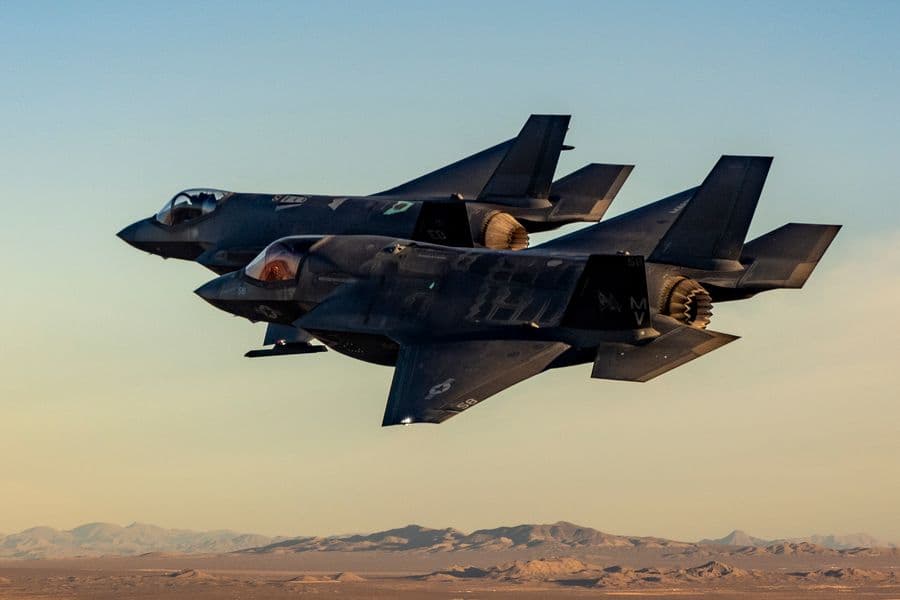
image: Test pilots with the 461st Flight Test Squadron, 412th Test Wing, return to Edwards Air Force Base, California, on January 21 after conducting a TR-3 AIM-120 live fire mission over the Pacific Test Range. The F-35 Integrated Test Force at Edwards is responsible for developmental testing of all three F-35 aircraft variants across the joint-services. (Courtesy Photo)

Innovation Alone Won’t Prepare the U.S. for the Future Battlefield
By Joshua Segal • RealClearDefense
The sUAS Tactical Trifecta
By Bryan T. Woody • RealClearDefense
The Revolutionary War: When Strategic Options Share the Same Weakness
By Henry Yep • RealClearDefense
The Houthis Are Testing the Limits of Collective Defense
By Saima Afzal • RealClearDefense
Radio Frequencies in the Intelligence Ecosystem
By Craig Brower • RealClearDefense

Who Shoots Down the Drone Over the Shipyard?
By John Ferrari & Dillon Prochnicki • RealClearDefense
Northrop Grumman Breaks Out the Big Guns at AUSA
By Daniel Terrill, Defense News
Army Pursuing Diverse Array of New Anti-Air Interceptors
By Trevithick, The WarZoneWho Shoots Down the Drone Over the Shipyard?
By John Ferrari & Dillon Prochnicki, RCD
F-35C Lands for the First Time on a Ford-Class Aircraft Carrier
By The Aviationist