
Little Bang Theory: Advanced Propulsion Shows Promise
Last updated 07:13 AM EDT • Read time: 7m
Wars have a habit of turning obscure industrial bottlenecks into massive strategic problems. In Ukraine, the constraint was artillery shells; more recent conflicts have exposed production shortfalls in missiles, interceptors, and, foundationally, the rocket motors that power them. That near-term pressure is translating into interest in long-horizon alternatives. Missile primes are reaching beyond the traditional rocket-motor industrial base to technologies (and companies) that originally specialized in everything from spacecraft to hypersonic passenger jets.
For decades, rotating detonation engines have occupied an awkward corner of the aerospace frontier: perpetually revolutionary and perpetually a few years away. Labs have generated impressive test results and inspired visions of hypersonic aircraft clearing continents in minutes. Yet they have not escaped from the experimental stage.
Lockheed Martin’s July 2026 agreement with rotating detonation startup Venus Aerospace suggests the technology may finally be preparing for liftoff. The companies will evaluate the potential of Venus’s rotating detonation rocket engine for use in future long-range precision-fires systems and connect Venus’s prototypes with Lockheed’s missile-integration work. Lockheed Martin’s venture capital arm also participated in Venus’s $91 million financing round earlier in July. The company has also established a relationship with a competitor; in January 2026, Lockheed and GE Aerospace jointly tested a liquid-fueled rotating detonation ramjet for hypersonic missiles.
What is Rotating Detonation?
There are two primary types of rocket propulsion systems. Solid-fuel rocket motors are easy to store and launch but unable to throttle or increase their thrust in-flight. Liquid-fuel rocket motors offer more precise thrust control but require pre-launch fueling and complex valve-pipe arrangements. In both, fuel and oxidizer burn in a controlled, subsonic flame, producing hot gases that accelerate through the nozzle to generate thrust. More range usually requires additional propellant—which itself demands a larger vehicle or smaller payload, or some combination of the three. Rotating detonation engines could mitigate such tradeoffs.
A rotating detonation engine injects fuel and oxidizer into a ring-shaped chamber where one or more supersonic detonation waves spin continuously. Each wave compresses and burns fresh propellant, generating high-pressure exhaust. This process theoretically enables higher efficiency and a more compact envelope than a conventional engine design in the same thrust class. Rotating detonation can be incorporated into rocket engines, ramjets, and turbines.
For missile designers, rotating detonation’s greater efficiency (in both fuel burn and size) could extend range within an existing form factor or free up volume for additional fuel, sensors, or payload. Engineers have also argued that rotating detonation missiles could feature more compact engine and exhaust systems that may be less detectable by adversary sensors.
Why Venus Matters
Venus, a Houston-based startup founded in 2020, has already publicized a series of milestones. In May 2025, the company launched a rotating detonation prototype at Spaceport America. The flight showed the company could integrate its engine into a vehicle and operate it in flight; the company described it as a first-of-its kind milestone.
While Venus’ initial research focused on passenger and space vehicles, Lockheed will assess the technology against missile-related operational requirements, including range, speed, manufacturability, cost, and integration with launch systems and precision-guidance architectures.
This investment also carries an industrial-base logic. The U.S. Military faces shortages of long-range missiles and interceptors—and has pressured major contractors to respond. The development of rotating detonation as a viable alternative to existing engines would provide additional capacity and diversification. Although rotating detonation engines still face substantial engineering barriers to widespread deployment, their lack of mechanical actuators and prospectively simple assembly could make them well suited to the Pentagon’s growing emphasis on lower-cost, attritable capabilities.
Other Players
Until Venus entered the scene, rotating detonation development was largely driven by in-house R&D at RTX and GE, alongside limited government-led efforts. GE Aerospace has researched detonation-based propulsion for more than a decade, initially through pulsed-detonation work with NASA and other partners. It shifted toward rotating detonation for hypersonic applications and, beginning in 2023, demonstrated a dual-mode ramjet prototype, followed by missile-scale and larger ramjet tests in 2025 and the liquid-fueled rotating-detonation ramjet jointly tested with Lockheed Martin in 2026, which it describes as currently in “maturation.”
Pratt & Whitney is also active. In 2023, the RTX subsidiary won the Defense Advanced Research Project Agency’s “Gambit” contract to design a rotating detonation rocket motor that could support affordable, long-range weapons launched from fourth-generation fighters. The company began full-scale testing in 2025 and said the results supported further investment toward an integrated engine and vehicle ground test.
In 2023, NASA ran a 3D-printed rotating detonation engine for 251 seconds at more than 5,800 pounds of thrust; the organization is developing a pump-fed engine in the 5,000-to-10,000-pound-thrust class. NASA’s work targets space propulsion, but its tests provide evidence that rotating detonation can sustain substantial thrust for operationally relevant durations.
Together, the Venus, GE, NASA, and RTX programs show that the field has expanded beyond academic work into competing industrial development efforts connected to missile applications.
Concurrently, China and Russia both maintain substantial rotating-detonation research programs. Chinese researchers at Tsinghua University’s Key Laboratory of Rotating Detonation Propulsion and Applications have published extensive work on the subject and concepts intended for hypersonic flight, while Russian institutions have conducted intermittent research on the subject for decades. Adding an additional international twist, Indian startup D-Propulse recently announced they had achieved approximately 1,100 pounds of thrust with their rotating-detonation prototype, which they have asserted could propel supersonic drones.
The Remaining Gap
Successful tests aside, considerable engineering difficulties await efforts to practically apply rotating detonation technology. The process creates intense detonation waves and extreme heat, placing immense demands on materials and cooling systems. Further development will depend on the ability of developers to maintain stable detonation while controlling injector backflow, extreme heat transfer, and chamber degradation during longer burns. Engine developers must also maintain stable injection and wave behavior across extreme pressures, temperatures, speeds, and maneuvers.
Rotating detonation has reached an inflection point. The duopoly has faded. Prototypes have sustained firings of over four minutes, generated thousands of pounds of thrust, and flown test craft. A leading integrator has entered the fray and committed both resources and credibility to the field’s development. The next threshold is a production-representative missile propulsion system that demonstrates storage life, repeatable manufacturing, thermal durability, controlled performance, and acceptable cost. Further advancement may require advances in computational fluid dynamics.
Whether the technology ultimately finds its enduring niche in defense (or a commercial application like a hypersonic commercial aircraft) remains uncertain. One possibility is that its trajectory will resemble that of low-Earth-orbit satellite constellations: a technology initially animated by ambitious commercial visions which became a critical military asset. Alternatively, rotating detonation may follow the path of supersonic flight, whose military utility outlasted initial attempts at commercialization.
More broadly, these efforts demonstrate how propulsion represents the final frontier for missile innovation. Conventional warhead performance is largely bounded by relatively unforgiving physical constraints, but advances in propulsion can still unlock gains in range, efficiency, manufacturability, decreased signature, and supply-chain resilience. Rotating detonation engines may or may not ultimately fulfill their promise, but even if they fail, the Pentagon should pursue an all-of-the-above approach to propulsion innovation, supporting new entrants and technologies that could augment today’s constrained missile and interceptor industrial base.
Aleksandar (Alek) Jovovic is deputy director of the Center for the Industrial Base and senior fellow in the Defense and Security Department at the Center for Strategic and International Studies (CSIS) in Washington, D.C. Oliver Buntin is research assistant at the Center for the Industrial Base at CSIS.
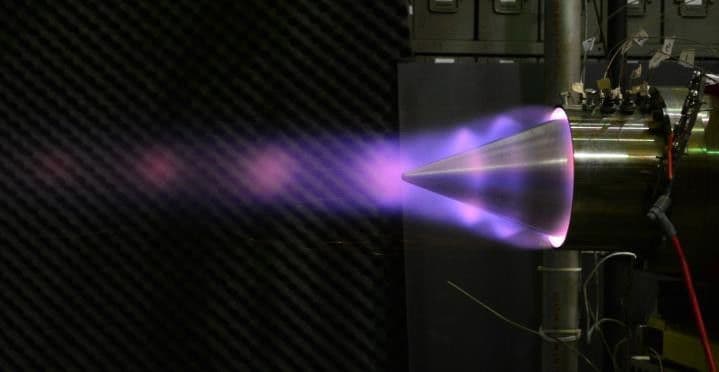
image: Rotating Detonation Engine rig test. Photo Credit: AFRL/RQT

Innovation Alone Won’t Prepare the U.S. for the Future Battlefield
By Joshua Segal • RealClearDefense
The sUAS Tactical Trifecta
By Bryan T. Woody • RealClearDefense
The Revolutionary War: When Strategic Options Share the Same Weakness
By Henry Yep • RealClearDefense
The Houthis Are Testing the Limits of Collective Defense
By Saima Afzal • RealClearDefense
Radio Frequencies in the Intelligence Ecosystem
By Craig Brower • RealClearDefense

Who Shoots Down the Drone Over the Shipyard?
By John Ferrari & Dillon Prochnicki • RealClearDefense
Northrop Grumman Breaks Out the Big Guns at AUSA
By Daniel Terrill, Defense News
Army Pursuing Diverse Array of New Anti-Air Interceptors
By Trevithick, The WarZoneWho Shoots Down the Drone Over the Shipyard?
By John Ferrari & Dillon Prochnicki, RCD
F-35C Lands for the First Time on a Ford-Class Aircraft Carrier
By The Aviationist