
The Military Needs Data Rights, Not an Intellectual Property Grab
Last updated 06:41 AM EDT • Read time: 4m
Imagine sitting in an airplane waiting hours to take off because it needs repairs. Passengers would lose confidence, airlines would lose money, and schedules would fall apart. Although commercial and defense aviation are extremely different, they both have one thing in common. An aircraft cannot complete its mission if it is sitting in the hangar. Military aircraft are not always able to get the repairs they need in a timely manner, reducing the number of aircraft available when they are needed most.
If an aircraft cannot fly, it cannot protect troops, respond to emergencies and deter enemies. Global tensions continue to rise, and it is important that aircraft are available and ready when they are needed. The issue surrounding military readiness focuses on who should have the ability to repair military equipment and how those repairs should be carried out.
The Right to Repair debate is the idea that the military should have access to information, software, tools, and instructions to fix equipment it has already purchased. Supporters of this idea believe that if the military has access to this information, they would not have to rely as heavily on defense contractors to make certain repairs. Supporters believe that this would improve military readiness. However, the issue is much more complicated than that.
Defense companies have many concerns regarding this debate. They have spent many years and major resources developing the world’s most advanced technology and believe it should be protected. These companies do not want to hand over the information and technology they spent years creating. They believe that protecting this information is important for future innovation, which is needed in this dangerous world. Ironically the government relies on the defense industrial base to invest capital and talent into developing new capabilities. However, the government must not assume that companies are doing this for charitable reasons. If the industrial base believes that doing business with the Department of War (DoW) creates uncertainty in terms of intellectual property, then this will discourage investment and innovation. In September 2025, the National Defense Industrial Association released an IP paper warning that uncertainty over data rights is discouraging companies from doing business with DoW. The report cited an industry survey which showed that 36% of companies reported declining to bid on defense contracts because it could put their IP at risk. This is up 14 percentage points from the previous year. This is not a trend that the United States can afford.
It is important to note that not all intellectual property is the same. There is a major difference between providing someone who is maintaining a platform with the tools to replace a component and providing detailed engineering drawings and proprietary source code.
The challenge is finding a compromise that increases military readiness while protecting national security. Allowing the military to have access to certain information while defense companies protect sensitive technology could allow for faster repairs without requiring companies to give up all of their intellectual property. Finding that balance would help ensure the military is prepared while still protecting the innovation that supports national defense.
DoW should determine its long-term sustainment requirements up front, when it buys a system or platform. More specifically, data rights should be negotiated up front, and DoW should pay for them. In 2024, the Navy’s final F/A-18 Super Hornet contract with Boeing included the purchase of a technical data package which allows the Navy to support long-term sustainment of the Super Hornet and Growler fleet. This is exactly how the process should work: determine what data rights are needed, negotiate that, and compensate the company. By doing it this way, DoW avoids using a broad mandate to capture a contractor’s IP.
Just as commercial airplanes cannot serve their passengers while sitting in the hangar, military aircraft cannot complete their mission. The solution is not about choosing a side; it is about giving the military what it needs to maintain readiness. Negotiate that at the outset. Pay companies for this information. And most importantly, do not use the Right to Repair as a way to take a contractor’s IP. As technology continues to advance, this debate will only become more important. When the nation's security is at stake, military aircraft can't afford to remain in the hangar.
Jeremy Bayer is Managing Partner of 202 Consulting and a 25-year veteran of Washington's business and public policy community.
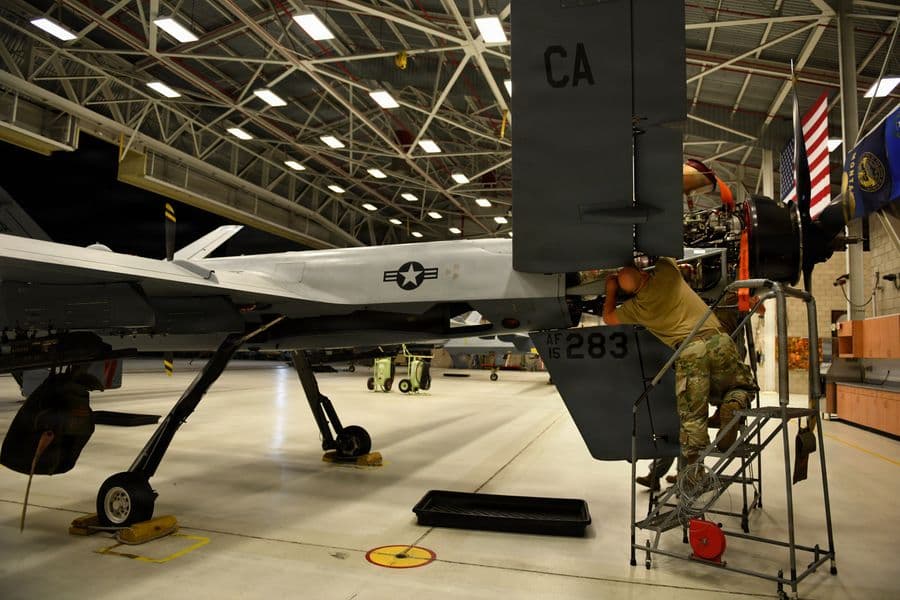
image: U.S. Air Force Staff Sgt. Giovanny Macias, 163d Aircraft Maintenance Squadron, California Air National Guard, reaches into the engine of an MQ-9 Reaper aircraft to perform routine maintenance, March Air Reserve Base, Calif., Aug. 19, 2026. After so many flying hours, crew chiefs complete prescribed maintenance on the MQ-9 Reaper aircraft to ensure all systems are fully mission-capable. (U.S. Air National Guard Photograph by Senior Master Sgt. Julianne Sitterding)

Innovation Alone Won’t Prepare the U.S. for the Future Battlefield
By Joshua Segal • RealClearDefense
The sUAS Tactical Trifecta
By Bryan T. Woody • RealClearDefense
The Revolutionary War: When Strategic Options Share the Same Weakness
By Henry Yep • RealClearDefense
The Houthis Are Testing the Limits of Collective Defense
By Saima Afzal • RealClearDefense
Radio Frequencies in the Intelligence Ecosystem
By Craig Brower • RealClearDefense

Who Shoots Down the Drone Over the Shipyard?
By John Ferrari & Dillon Prochnicki • RealClearDefense
Northrop Grumman Breaks Out the Big Guns at AUSA
By Daniel Terrill, Defense News
Army Pursuing Diverse Array of New Anti-Air Interceptors
By Trevithick, The WarZoneWho Shoots Down the Drone Over the Shipyard?
By John Ferrari & Dillon Prochnicki, RCD
F-35C Lands for the First Time on a Ford-Class Aircraft Carrier
By The Aviationist