
Getting Air Force Pricing Under Control
Last updated 08:01 AM EST • Read time: 5m
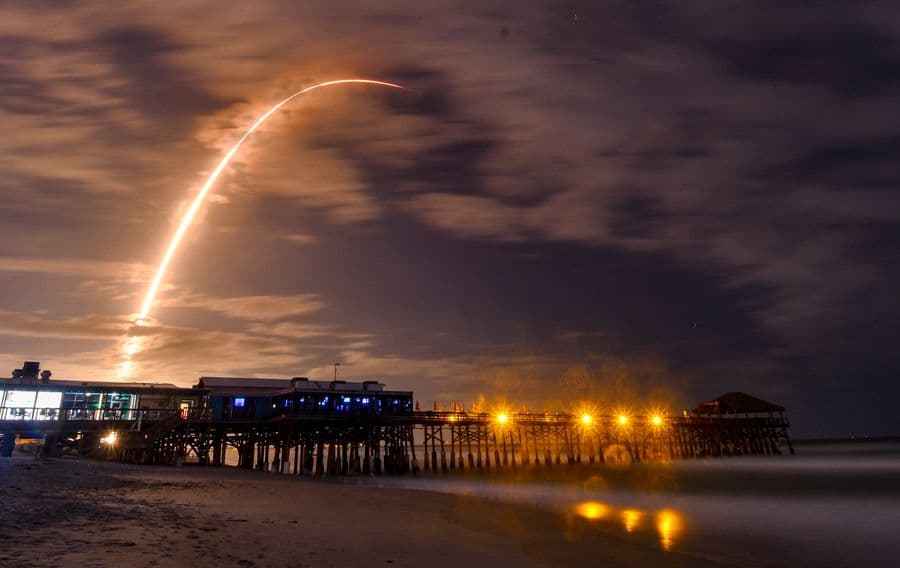
At 7:27 pm on November 16th, America marveled at four astronauts propelled into orbit by SpaceX's Falcon 9 rocket on their way to the International Space Station. Relying on pageantry and SpaceX's acclaimed innovation, NASA has proclaimed a "new era in spaceflight." Certainly, the company's CEO and founder, Elon Musk, remains peerless in his iconic branding enterprise and the accompanying media adulation. He is credited for resuscitating NASA's tarnished public image by his association with that agency. But the question is whether taxpayers are getting a competent launch service at a competitive price.
SpaceX's launch services are not competitively priced for taxpayers.
Gwen Shotwell, SpaceX's President and Chief Operating Officer, remarked to the press recently that the $316 million it recently charged the Air Force for a military launch service is "not that expensive" even though the company charged nearly half that price for a launch contract to NASA. The higher price, according to Ms. Shotwell, "reflects mostly the infrastructure" and other costs. She further added, "this one was front loaded because the Space Force wanted this capability deployed quickly." The point being, SpaceX may significantly raise its future launch service price for the Air Force, and this higher price may apply to NASA as well. And yet, the Air Force has remained assiduously silent on the pricing decision involving SpaceX's contract award.
It appears that SpaceX added surcharges to its $316 million bid just to have taxpayers further subsidize its operations.
The Air Force's Phase 1 contract award in 2018, for the development of vehicles and for infrastructure, granted $500 million to Blue Origin's New Glenn rocket, $792 million to Northrop Grumman's OmegA rocket, and $967 million to ULA's Vulcan Centaur rocket. Space X was dropped from the Phase 1 award for its failure to meet government requirements. The Phase 2 award in August 2020 dropped Northrup Grumman and Blue Origin but picked up SpaceX for $316 million instead. SpaceX CEO Shotwell claimed that because they did not win a Phase 1 award, "all the money that we needed to spend, we needed to put into our Phase 2 award." In other words, SpaceX's $316 million Phase 2 bid price included the surcharge of added development cost that the company failed to earn in the Phase 1 award for not submitting an attractive proposal.
Mr. Musk's ostensible desire to have taxpayers pick up his costs for his missed contract has been long in the making. In May of last year, he tried suing the Air Force, alleging that the Phase 1 award "wrongly awarded" the funds "to a portfolio of three unproven rockets based on unstated metrics." The complaint asserted that "by any reasonable measure, SpaceX earned a place in the LSA [Phase 1 award] portfolio." This complaint came despite Musk acknowledging in a private meeting with then Acting Secretary of Defense Patrick Shanahan that SpaceX had written: "a poor proposal" that had "missed the mark," according to a report from the Pentagon's inspector general.
In August 2019, U.S. District Court for the Central District of California dismissed the Space X lawsuit. The Court ruled that the Air Force's actions were "not arbitrary, capricious, or in violation of the law, and that SpaceX was not entitled to any relief in this action." So, since its suit didn't pan out, SpaceX seemingly attempted to make taxpayers foot the bill for its missed contract within the next one instead.
The Air Force's $316 million award to SpaceX, in this case, becomes even more troubling when the other provider selected by the Air Force's Phase 2 award — the United Launch Alliance (ULA), a joint venture of Boeing and Lockheed Martin — charged $169 million per launch for two missions. According to Tony Bruno, ULA CEO, the $316 million SpaceX price tag was a surprise: "We did not expect that to be their number at all."
According to Bruno, his company's Phase 2 bid price was competitive because of the "corporate transformation we undertook when I came on board in 2014." Moreover, Mr. Bruno explained that ULA cut overhead, shed facilities, eliminated staff, reorganized its supply chain, retired the Delta 2 and Delta 4 Medium vehicles, and reduced the number of Atlas 5 configurations. SpaceX, on the other hand, added surcharges to its Phase 2 bid price that is inexplicable and has promised to escalate future launch service pricing for the government. Why is SpaceX exempted from the necessary corporate reform to deliver competitive pricing to taxpayers?
Suffice it to say that taxpayers should be wary of Mr. Musk's offerings for the same reason that institutional investor confidence in his various companies is lagging: pervasive operational inefficiencies, poor financial controls, and Mr. Musk's mercurial management style. Most importantly, SpaceX's non-competitive pricing, quality control concerns, and anticipated price hikes for future launch service could leave taxpayers holding the bag for billions of dollars of contracted services, which may or may not be deliverable.
Sue Ghosh Stricklett is a widely published author on topical issues concerning National Security Law. A graduate of the Catholic University of America School of Law, she has practiced law for the past twenty five years.

Innovation Alone Won’t Prepare the U.S. for the Future Battlefield
By Joshua Segal • RealClearDefense
The sUAS Tactical Trifecta
By Bryan T. Woody • RealClearDefense
The Revolutionary War: When Strategic Options Share the Same Weakness
By Henry Yep • RealClearDefense
The Houthis Are Testing the Limits of Collective Defense
By Saima Afzal • RealClearDefense
Radio Frequencies in the Intelligence Ecosystem
By Craig Brower • RealClearDefense

Who Shoots Down the Drone Over the Shipyard?
By John Ferrari & Dillon Prochnicki • RealClearDefense
Northrop Grumman Breaks Out the Big Guns at AUSA
By Daniel Terrill, Defense News
Army Pursuing Diverse Array of New Anti-Air Interceptors
By Trevithick, The WarZoneWho Shoots Down the Drone Over the Shipyard?
By John Ferrari & Dillon Prochnicki, RCD
F-35C Lands for the First Time on a Ford-Class Aircraft Carrier
By The Aviationist