
The Air Force Needs to Rework Its Climate Campaign Plan with a Weather Eye
Last updated 05:15 AM EDT • Read time: 4m
Like previous climate-related strategic documents developed by the Pentagon under the Biden Administration, the recently released Air Force Climate Campaign Plan falls far short in directly addressing 21st century warfighting requirements. The dual threats of Russia’s invasion in Ukraine and China’s increasing provocations towards Taiwan have created a dire global security environment, yet the actions put forth in this plan do nothing to diminish or deter them.
Instead, the Air Force has unsurprisingly followed the same climate policy playbook as the Navy, Army, and other departments and agencies to prioritize green energy-based emission reductions and a blanket application of pointlessly vague “climate considerations” across a wide swath of organizational processes and programs.
Consider the plan’s first priority, to “maintain air and space dominance in the face of climate risks.” That is an important priority, and its subordinate goal to make Air Force installations resilient to the effects of climate change is indeed an essential objective. However, totally absent from the plan is any action to advance the Air Force’s operational capability under current and future climate risks. I have previously written about how to make the entire DoD climate ready for modern warfighting, and it applies equally here.
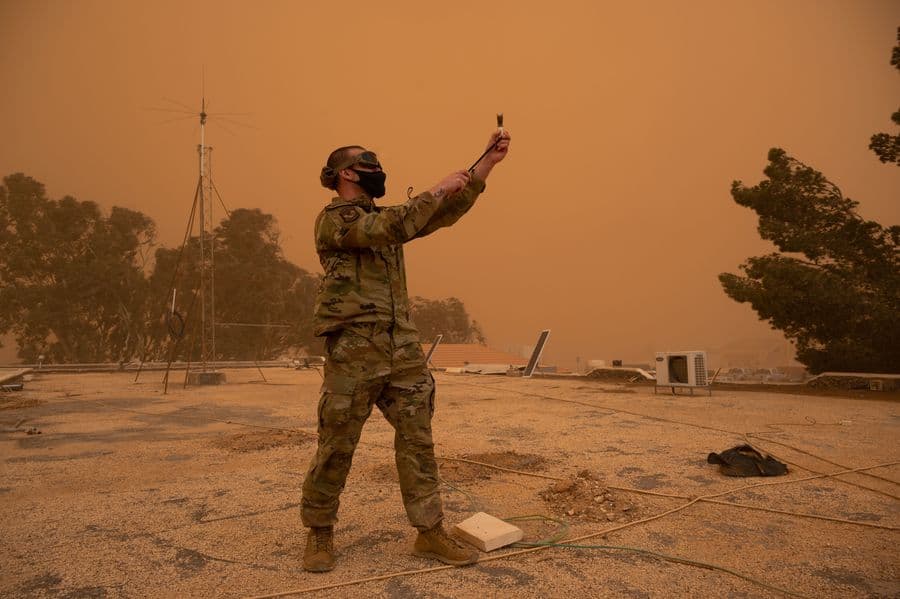
Such is the mission of the 14th Weather Squadron, which is given only lip service in the campaign plan. An even greater omission is the failure to include performance improvement goals for its parent organization, the Air Force Weather Agency. Curiously, the plan makes no mention of the Air Force Strategic Funding Increase (STRATFI) program’s recent award of $19.3 million to deploy the first commercial constellation of radar-equipped weather satellites. Because this constellation will be a critical asset in reducing operational climate risk, this initiative should be front and center in the climate plan.
Modernizing the Air Force’s weather observing systems will also support the second priority in the campaign plan, to “make climate informed decisions.” Again, the actions under this priority fail to directly advance operational capabilities. Instead, the plan directs the inclusion of inanely imprecise “climate considerations” in such wide-ranging efforts as military education, operational plans, war games, supply chains, and partner nation engagement.
For Air Force operations, the two top climate considerations are weather prediction and decision support, and both must be better than those of our adversaries. To that end, the Air Force should ditch its use of a foreign weather model and adopt the National Oceanic and Atmospheric Administration’s Unified Forecast System, which is on the path to become the global leader in numerical weather modeling. Additionally, the service should acquire any of the AI-enabled weather intelligence solutions available in the private sector that provide data, predictions, and insights tailored to specific aircraft, sensors, payloads, timelines, and flight tracks.
Lastly, the emissions-focused, alternative energy actions in the Air Force climate plan’s third priority should be discarded. I am all for reducing greenhouse gas emissions in the transportation and energy sectors, which are their greatest sources, but mandating our military to do so is a dangerous distraction that will do little to mitigate the changes to the planet’s climate that are already baked into the Earth system.
The Air Force climate plan makes the mistake of only viewing climate as a threat. A missing piece of the plan is to develop doctrine for leveraging the competitive advantage provided by superior knowledge of climate and weather. We know this from centuries of military history going back to Chinese strategist Sun-Tzu, who wisely advised that knowing the weather will assure complete victory. A better weather forecast allowed the Allies to catch the German occupiers off guard during the D-Day landings in 1944, while a more recent example was Ukraine’s exploitation of an atmospheric inversion to successfully target and sink the Russian Black Sea flagship Moskva. Looking forward, advanced atmospheric modeling will enable high precision prediction of electromagnetic energy propagation, which will be key to defeating China’s hypersonic missile threat.
In a widely publicized memorandum by Air Mobility Command commander General Mike Minihan earlier this year, he urged his airmen to be ready to fight and win a war with China as early as 2025. He clarified that more recently by stating that he did not think conflict would be inevitable or unavoidable, but that being ready now is what matters most. Such is the sense of urgency that needs to be injected into the Air Force climate plan, and the right flight path is to rework it with a weather eye.
Read Admiral Tim Gallaudet, Ph.D. (U.S. Navy ret.), is the CEO of Ocean STL Consulting, LLC. He is a former acting and deputy administrator at the National Oceanic and Atmospheric Administration (NOAA), acting undersecretary and assistant secretary of Commerce, and oceanographer in the Navy.

In Pursuit of Nuclear Abolition
By Peter Huessy • RealClearDefense
Innovation Alone Won’t Prepare the U.S. for the Future Battlefield
By Joshua Segal • RealClearDefense
The sUAS Tactical Trifecta
By Bryan T. Woody • RealClearDefense
The Revolutionary War: When Strategic Options Share the Same Weakness
By Henry Yep • RealClearDefense
The Houthis Are Testing the Limits of Collective Defense
By Saima Afzal • RealClearDefense

Navy Civilianizes Six Former Flag Billets, Reduces Six to Captains
By Mongilio, USNI N.
Raytheon's $8B Contract for Strategic Comms Terminal Modernization
By M+A El
America’s Maritime Moment Will Not Wait
By CDR Salamander
Armor Up?
By Marine Corps Compass Points
Who Shoots Down the Drone Over the Shipyard?
By John Ferrari & Dillon Prochnicki • RealClearDefense