
Resilience Under Fire: How U.S.'s WWII Airfield Upgrades Back Taiwan
Last updated 06:58 AM EST • Read time: 5m
In World War II, the United States built a western Pacific airfield here, another there, and more elsewhere, each intended to bring more Japanese targets into range. Now the abundance of old bases is becoming a resource for resilience: several are being brought back into service as places to disperse aircraft and to maintain operations even as other airfields are knocked out.
While major exercises using these facilities are not explicit rehearsals for such a war, they closely align with the U.S.’s projected operational requirements. They reflect an effort to ensure that, in the event of a Taiwan crisis or another regional emergency bringing Washington and Beijing into conflict, the U.S. and its allies can move forces into the theatre, fight as a coalition and sustain operations even under conditions of contested access and degraded infrastructure.
This underlying idea is intended not to guarantee a short war, but to shape an adversary’s calculations by reducing its confidence that it can decisively accomplish its goals.
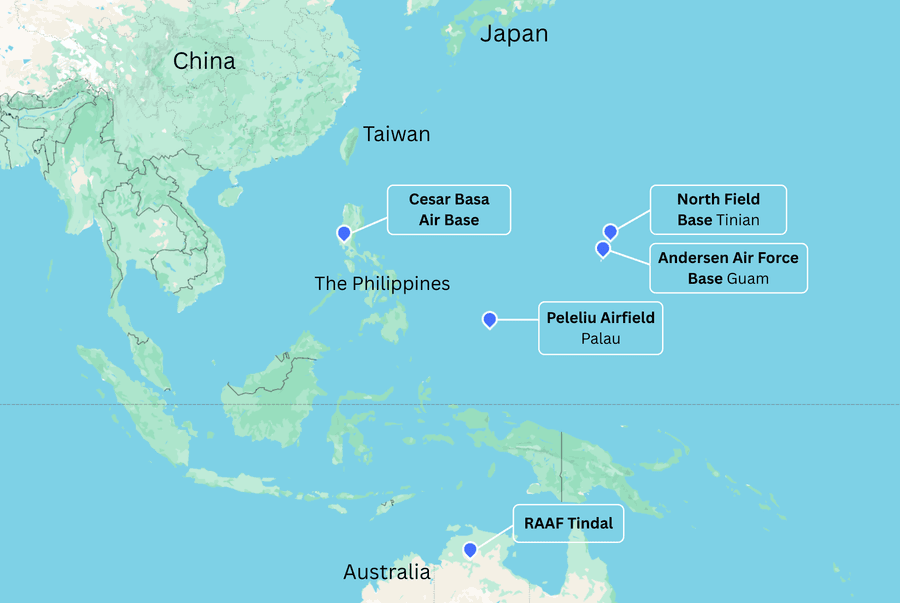
Tinian is part of the U.S. territory of the Commonwealth of the Northern Mariana Islands in the western Pacific and is best known for its Boeing B-29 bomber bases used against Japan late in WWII. The greatest of these, North Field, was abandoned at war’s end but is now being reactivated as a potential dispersal and logistics site to make it difficult for China to target U.S. forces with decisive effect.
This aligns with the U.S. Air Force’s Agile Combat Employment concept—dispersed, mobile air operations designed to survive and fight under attack. It also fits the requirement to sustain operations under an assumption of contested logistics, where supply lines and bases are under constant threat. Multiple smaller forward operating locations are more survivable than large central hubs and complicate an opponent’s targeting calculations.
The 2024 awarding of a rehabilitation contract for North Field builds on previous USAF clearance work and looks set to deliver a multi-runway base suitable for surge operations. Additionally, the capacity of Tinian International Airport, on the site of the former West Field B-29 base, is being expanded to make it a diversion airfield in case the main regional field, Andersen Air Force Base on Guam, is disabled. The airport should be able to support sustained operations.
Peleliu, an island of Palau southwest of that country’s main island, has seen its old WWII airstrip recertified for use, and improvements are being made to locations in the Philippines to which the U.S. has access, most notably Cesar Basa Air Base, which was also built in the war.
Australia is also receiving attention. RAAF Tindal, another airfield dating to WWII and now the Royal Australian Air Force’s main northern operational base, is being upgraded to better support U.S. aircraft, in part at U.S. expense. Australia played a critical basing role throughout WWII and has a comparable contemporary role. It sits outside the densest coverage of most Chinese regional strike systems but is close enough to support sustained coalition operations, offering greater depth, redundancy and recovery capacity than more exposed forward bases.
Tinian and Tindal, therefore, reflect different elements of the WWII basing system: the former forward, contested operating locations, and the latter deeper rear-area bases for regeneration and sustainment.
At the centre of this preparation lies the fate of Taiwan. As discussed in my book, War Plan Taiwan, the island has long been part of U.S. military planning in the Pacific. Despite the Trump administration’s attentions being diverted to the Western Hemisphere, the December 2025 U.S. National Security Strategy gave the intention to ‘deny any attempt to seize Taiwan or achieve a balance of forces so unfavourable to us as to make defending that island impossible.’ The January 2026 National Defense Strategy, while not naming Taiwan, called for the U.S. to ‘erect a strong denial defense along the First Island Chain’, of which Taiwan is a part.
The most recent major exercise to test this concept was Resolute Force Pacific. The USAF exercise took place in July-August 2025 and saw more than 400 aircraft and 12,000 personnel deployed to over 50 dispersed locations in the western Pacific. The logistics of the deployment of assets from the U.S. was rehearsed through exercise Mobility Guardian, which saw support aircraft and other assets deployed in a manner reflecting the Agile Combat Employment concept in a contested logistics environment. Both exercises are part of a series in which several are integrated as a drill for a broader operational deterrence scenario. Exercise Talisman Sabre—led by Australia and the U.S.—also ran in July-August 2025 and rehearsed coalition warfighting.
No publicly known exercise or basing initiative is explicitly framed as a Taiwan war rehearsal. Nevertheless, taken together, they reveal an emerging operational model that aligns closely with the requirements of a Taiwan contingency.
Rowan Allport is a deputy director at the Human Security Centre, a London-based foreign policy think tank.
AI contributed no ideas to this article—Rowan Allport.
This article appeared originally at The Strategist (ASPI).
Is It Déjà vu All Over Again: The 2012 Report on Global Zero
By Peter Huessy • RealClearDefense
As Private Investment Pours Into Defense, the Clock Is Ticking
By Elaine McCusker • RealClearDefense
The First Test of Peace Lies in Ukraine's Borderlands
By Dennis T. Cosgrove • RealClearDefense
The VFW’s Gambling Addiction Victimizes Veterans
By Jack Yoest • RealClearDefense
Superintelligence Exposes a Gap in the Law of Delegated Authority
By Sue Ghosh Stricklett • RealClearDefense
When Your Navy is too Small, the Bill Comes Due Bigly
By CDR Salamander
Quo Vadis MCU?
By Marine Corps Compass Points
When the Network Goes Dark, Who Controls the Battlefield?
By Jonathan K. Corrado • RealClearDefense
Air Force Should Buy 250 Blended-Wing Tankers, as 2027 Demo Looms
By A&SF Mag.
Long Deployments to Be Navy Standard For Next Couple Years
By Mongilio, USNI News