
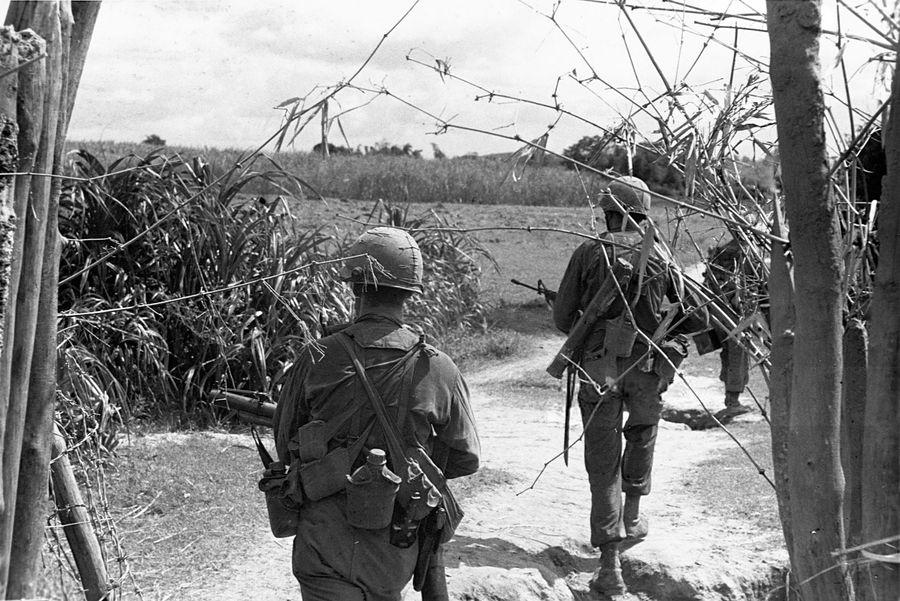
A Quiet Cadence
Published Dec. 25, 2021 • Read time: 16m
American voters never elected a Vietnam veteran as president of the United States, though a few came close. John Kerry was the Democratic nominee for president in 2004, and fellow Navy veteran John McCain won the Republican party’s nomination in 2008. Al Gore, the 45th vice president of the United States, received more electoral votes in the 2000 presidential election than any other runner-up in history. Gore enlisted in the Army and deployed to Vietnam in January 1971 as a journalist before being discharged months later.
But the Vietnam War retains its power to intrigue American readers, as proven by the popularity of books over the decades such as Robert Stone’s Dog Soldiers in 1974, Karl Marlantes' Matterhorn in 2009, and Viet Thanh Nguyen’s The Sympathizer in 2016. Into this tradition, author Mark Treanor introduces A Quiet Cadence (Naval Institute Press, 2020), his excellent new novel of young Marty “the Mick” McClure’s experiences fighting in Southeast Asia and the long journey home. The story is familiar. McClure drops out of college and enlists in the Marine Corps at age 19, joining “Bush Bravo” and a cast of eclectic, eccentric young men drawn to war and the camaraderie of a combat infantry unit. McClure participates in killing, of course, but it’s what he witnesses -- friends killed and maimed -- that haunts his memory. “I knew, even if I wouldn’t have been able to articulate the thought at the time, that a darkening brew was seeping into my soul,” McClure recalls of combat.
He returns to the States and graduates college, starts a family, and embarks on a teaching career as the “darkening brew” continues to swirl inside him. Like many veterans, McClure discovers the hardest part about going to war is coming home to face himself. Ultimately, he finds a way to honor the best memories of lost comrades while discovering purpose in a new life. The author’s depiction of war’s aftermath, the tug-of-war waged in the veteran’s mind between past and present, is especially engrossing. Treanor knows of what he writes, having served a year in Vietnam as a rifle platoon commander. “I’m sure many of the guys from World War II and Korea had the same experiences,” the author told me from his home in Edgewater, Maryland, “but they came back and got on with it. That’s what I wanted to say.”
Your Military Paycheck Has an End Date
Iron Raven: Remembering Colonel Joseph B. Conmy, Jr.
The Formation Left Us Behind
AI Should Speed Veterans’ Benefits, Not Decide Them
What follows is our conversation about the novel, Treanor’s time as a Midshipman at Annapolis, and his five years in the Marine Corps. He also shared memories of a couple of friends and veterans who ran for president, one of whom, Jim Webb, he fought alongside in Vietnam.
Let’s go back to where it began, Annapolis. You finish your second class year in May of 1967, just a week or so before the Beatles released Sgt. Peppers. You come back to the Yard for your final year, and the Battle of Hue City kicks off in January of 1968. Martin Luther King, Jr. is assassinated on April 4, 1968. You commission into the Marine Corps in late May of 1968. Tell me about that time.
That was an amazing and interesting time. I reported to Annapolis in June of 1964, and the Gulf of Tonkin incident took place that August, and then the First Marine Division went into Vietnam in January of 1965, I think. So, from the time I began at Annapolis, my classmates knew what was going to happen and that we would likely be going to war. I decided plebe year that I wanted to be a Marine. I had read the book Marine! The Life of Chesty Puller by Burke Davis, and thought it would just be a fascinating thing to do. But, yeah, it was a very different time in the United States. The Tet Offensive and the real overcast that threw on people’s thinking about Vietnam. Martin Luther King, Jr. was assassinated, and then Bobby Kennedy was assassinated in June of 1968. There were protests against the war in Washington, D.C., then all over the place after King was assassinated. I was dating a girl in Baltimore and remembered seeing National Guard encampments because part of the city had been burned in riots.
It was a fascinating time to go through service selection at Annapolis, which happened in February of 1968, if I recall, around the time of Tet. Starting plebe year, they put up the names of classmates who had been killed in Vietnam, and so by the time of service selection, there were a couple of different boards full of names. It got everybody's attention when guys from the classes of 1966 and 1967 were killed in Tet. I think my class was the first one that didn't make the quota for Marine Corps. About 10 percent of the class was allowed to go into the Marine Corps in my year, which is way up to 20 percent or more nowadays. I knew at least a couple of guys who were engaged, and their fiancées said something to them, like "it's me or the Marine Corps" kind of thing. But I graduated and went down to Quantico. The Basic School was usually six months long—we graduated in nineteen-and-a-half weeks. I got to Vietnam in January of 1969 and came back in January of 1970.
You graduated from Annapolis with a storied class, some of its members profiled in Bob Timberg’s terrific book The Nightingale’s Song. Tell me about your class.
Yeah, amazing class. I’ve forgotten how many flag and general officers came out of that class. Mike Hagee became Commandant of the Marine Corps. Mike Mullen was chairman of the Joint Chiefs of Staff. Jay Johnson was CNO. Chip Gregson. Joe Anderson. Charlie Bolden became NASA administrator. I was fortunate enough to know or meet all these guys. You mention Nightingale’s Song, and I knew John McCain from some Vietnam vet stuff that I was involved in during the late 1970’s and early 1980’s, and so I got to know him relatively well. I ended up traveling with Sen. McCain a bit as a volunteer during his presidential campaign, but didn’t know him in the Navy. I was on the boxing team, too, so I got to know Jim Webb and Ollie North. I was in Bravo 1/5 and Jim was a platoon commander in Delta Company. Phenomenal Marine. He and I kept in touch and got together over the years. I was really pleased when his book got the attention it received because Fields of Fire is just an incredible book, some of it based on Jim’s life and the rest his imagination. Back at the Academy, I never could have foreseen Jim as a political figure. I could have foreseen him as an appointee or someone in government, but never a senator. If he hadn’t been medically retired, he probably would have made a career in the Marines, and I believe he’s said that. Jim believed in the near-sanctity of being an officer in the Marine Corps. He had a strict sense of right and wrong.
As for Ollie, he was incredibly hard-charging and couldn’t wait to get out of the Academy and down to Quantico. He was so eager, in fact, I think he skipped leave after graduation so he could report early to The Basic School. He was on staff at TBS when I got there to be an instructor after my tour in Vietnam—Ollie, this larger than life hot dog.
Now, you’ve written a war novel that’s a little different from mainstream literary fiction about war. The story has a positive arc. Is there too much self-pity in war literature?
I think there’s a fair amount. I hope A Quiet Cadence is a counterpoint to that. We weren't victims, you know. When we came back, we certainly weren't treated how veterans ought to be treated, and that's the understatement of the week. But the majority of us were volunteers, and we went off and did what we were supposed to do.
In the 1980s, Reagan put together the "Vietnam Veterans Leadership Program" as an attempt to get some of us who'd been successful in helping out those who had challenges to get guys education and job opportunities. The program ended up with 50 chapters around the country, and I was the first chairman of the Maryland chapter. I got to meet and talk with a lot of guys who didn't have nearly the good fortune I had when I came back. So, fast forward to when I was writing the book in 2014-15, and one of the national newspapers on Veterans Day has a front page story of a guy whose photograph made him look like Keith Richards coming out of the crypt, and the story was how he overcame decades of heroin addiction. That pissed me off. Here we are 40 years after the war, and that's how they tell the story of America's veterans.
Is too much being written about PTSD?
I am a fairly strong believer that anyone who's been involved in ground combat will have some sort of post-traumatic stress. You can't go through the stress of a ground combat experience, what you saw and did, and not have something that stays with you afterward. But I'm also a strong believer that a lot of us don't have the "D" on PTSD. A person in that situation does has to be done and the overwhelming majority of guys come home and become productive, just get on with life. I wrote the novel in part to try and say something like that because I thought Vietnam vets hadn't gotten positive press. Eighty-five percent of Vietnam veterans went to war, got honorable discharges, and got on with life. There was a survey in the 1980s that said Vietnam veterans had a higher employment rate than people who hadn't gone to war. I think too many of us conflated the war with the warrior, and because it was such an unpopular war, the guys who got sent to fight took on too much of the blame back home. But foot soldiers don’t make policy decisions. When I was writing the book, I knew I had never seen a book that started with the authenticity of combat and then proceeded to follow that warrior home. My protagonist, Marty, comes home from war and becomes a teacher and continues wrestling with the war, but he carries on. I heard from any number of Iraq and Afghanistan veterans who said the book was written for them.
Let’s get into the book. You write of the combat experience as a “darkening brew” that seeps into the soul of your protagonist, Marty. Can he ever come back—can anyone ever come back?
Absolutely. Combat changes you, it does. It also makes you think differently about some things, but I wanted to depict Marty as this kind of naïve, nice guy when he gets to Vietnam. Then he spends weeks, months living in a hole in the ground. He eats food out of little green cans. He tries to kill people who are trying to kill him. This is a basic, good guy, but he gets pushed so hard by what he's seen and done and been through. He cares about the people he's with but tolerates bad things that they do, and he watches. The experience is made up of things he couldn't have conceived of when he left home. Marty wrestles with decisions that he never could have conceived of at the start of the narrative because all he cared about was taking care of his friends and trying to survive himself. When he gets home, these bad things don’t dominate his thoughts, but he is haunted by the ghosts of his dead friends. What I’m trying to say is that you can come back from the experience, but shooting at people and watching your friends get blown up by booby traps does something different to you.
How’d you find Marty’s voice, the enlisted Marine who goes to Vietnam and then comes home to get on with life?
The book started off in the third person but evolved by the second or third draft into a first-person narrative. I realized I could depict everything better, especially when Marty’s looking back as a 65 year-old guy, partly amazed, partly proud, at what he and others have experienced. I tried to depict what a smart young guy would say and think within the circumstances I placed around him.
The story divides into two parts: combat and life afterward. The afterwar period is especially compelling. I was struck by a dilemma Marty faces when applying for his first teaching job after graduating college. Explain what he goes through.
Despite all of what’s going on in Marty’s head with the occasional nightmares and his doubts about the war after it crashed in 1975 and even before that, Marty is still proud of being a Marine. He puts it on his resume. But when his college professor advises him to remove this from his resume, he has a quiet crisis about whether to deny this part of his life. On the one hand, he’s proud and wants to represent what he’s done. On the other hand, he needs a job and has been getting stonewalled, possibly because of the unpopularity of Vietnam. So, he removes it from his resume. Some of the impetus for this came from friends I knew who had a tough time finding a job after coming home. Everybody was thought to be a drug addict, another Lieutenant Calley, or a loose cannon. I wanted to put Marty in that position, where his choices sucked but he had to do what was necessary to get a job and support his family.
I had an interesting conversation about the book with another veteran. I asked him what he thought about the scene, and he understood completely that this was something Marty had to do to keep moving forward; he didn’t consider him a sell-out or anything like that. Another classmate from the Academy said he got turned down from one of the first jobs he applied for because of the Marine Corps, and so he wiped it from his resume.
Designer Louis Nelson told me the Vietnam Veterans Memorial “healed a Nation.” Tell me about the Wall.
I liked his interview, and I think it went quite a ways toward healing us as a country, but it’s an overstatement to say the Vietnam Veterans Memorial healed a Nation. Evidence of that in my head? The front page article depicting the Vietnam vet 40 years later, the one about him overcoming a heroin addiction. The Wall had a major healing effect, though. Vietnam vets were not a bad group of people. The Wall was healing but it did not heal the rift. While the Wall and the national salute were a major step in the right direction, a good dose of medicine, they were not a cure. The Wall makes its way into the novel because it was emblematic of memory in a way. Marty wrestled with tamping down his bad memories so he could remember the good things about Vietnam, and the Wall was the beginning of that healing. It took Marty’s friend’s enthusiasm for the Wall to make him enthusiastic, too.
I understand people are reading your novel in book groups, at colleges, and also at VA medical centers. What have you learned touring this book?
One of the things I mentioned earlier: the younger guys, the ones who served in Iraq and Afghanistan, saying that the book nailed some universal truths for them. We wrestle with the same thoughts and feelings across generations. Also, I’ve been fascinated by the number of women who have read the book, women in middle age or older who say they understood for the first time what family members have gone through in combat and afterward. That’s been interesting. I was talking with a woman who told me her brother never said a word after he came back from war. And yes, the book is being used in some of the VA centers and guys relate heavily to the combat parts of the book, but they see the second half of the book as showing a way to get through some of the feelings and thoughts that arise after coming home. The book tells a war story and a coming home story, about a normal way to process. I think I did a decent job on the war story part of it, but I don’t think what I attempted to do in the second half of the book had ever been done before. I’m proud of the second half, especially.
The book was a long time coming. You’ve been a lawyer, corporate executive, and a consultant, among other things. I understand you’re now retired from practicing law. How did this novel come about after such a long and varied career?
I had puttered away on various writings for 30 years, actually. This is the fourth novel I wrote. The first novel was absolutely horrid. The second novel wasn’t so bad. The third novel was halfway decent, but I couldn’t find an agent or publisher for it. All those books had a Vietnam theme, and they’re all gathering dust in my basement. They were different iterations with different voices, but none as good as A Quiet Cadence. Several years ago, I was having lunch with a guy named Skip Isaacs who was a correspondent in Vietnam. Skip lives in the Annapolis area and we had lunch one day and I told him I wanted to make a new attempt at the novel and asked his opinion. He told me don’t think about what somebody’s going to want to publish, but think instead about what I really wanted to say. I thought about that for some time afterward and decided I wanted to write about a Vietnam war veteran in a way that shows both the war part and the aftermath. Some of that came from my work with veterans after the war, my dissatisfaction with how veterans were treated. I actually thought that the stories about Afghanistan and Iraq were very similar to Vietnam. It was about guys with problems. I’m sure many of the guys from World War II and Korea had the same experiences, but they came back and got on with it – that’s what I wanted to say. This book applies to everyone who ever went to combat.
John Waters is a writer in Nebraska.

When Losing Control of AI Becomes a Weapon
By Yunus Emre Tumen • RealClearDefense
International Allied Reliability of States: Criteria and Evolution
By Sergey E. Ivashchenko • RealClearDefense
Your Military Paycheck Has an End Date
By Sean Ofeldt • RealClearDefense
Masters of Command
By Travis A. Karnes • RealClearDefense
A Sweet American Original
By Greg Maresca • RealClearDefense
Monty: Riding the Pendulum
By Zachery Thomas, DODReads
Sign of the Times: CCAs Dominate a Major Fighter Conference
By Bill Sweetman • The Strategist (ASPI)
Marines Want Naval Strike Missiles With Double The Range
By The WarZone
U.S. Navy Targets 79 New Cutter-Based FF(X) Frigates
By A. Servaes, Global Defense
The Hegseth Grenade: A Sea Change at Newport
By Robert C. Rubel, CIMSEC