
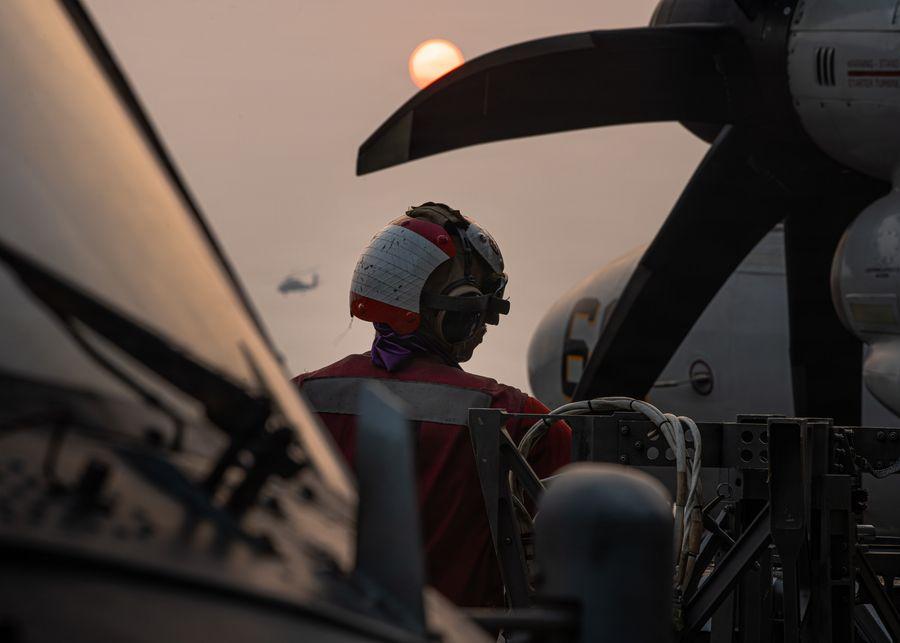
USS George Washington Conducts an Airpower Demonstration. George Washington, operating in the U.S. 7th Fleet area of operations, is the U.S. Navy’s premier forward-deployed aircraft carrier, a long-standing symbol of the United States’ commitment to maintaining a free and open Indo-Pacific, while operating alongside allies and partners across the U.S. Navy’s largest numbered fleet.
Masters of Command
How the United States Navy Must Seize Back the Indo-Pacific
Published Nov. 25, 2026 • Read time: 9m
They came in the gray light before dawn, the way predators always do.
A constellation of Chinese warships—Type 055 destroyers, Type 052Ds, and the new Type 076 amphibious carriers—slid out of the mist east of Taiwan. Behind them, the gray shadows of the Type 093B and 095 nuclear attack submarines ghosted through the depths. Overhead, J-20s and H-6K bombers with long-range anti-ship cruise missiles held station under the protective umbrella of the mainland’s integrated air defense network. The first salvos were not dramatic. They were precise. American satellites blinked. Undersea sensors went dark. A flight of MQ-4C Tritons vanished from the scope. By the time the first Tomahawk left its tube, the calculus had already shifted.
This is not fiction. This is the war plan the People’s Liberation Army Navy has been refining for twenty years while we congratulated ourselves on “rules-based order” and “integrated deterrence.” The Indo-Pacific is no longer a theater we dominate by birthright. It is a contested battlespace in which the United States Navy has lost the initiative. Regaining it will require more than budgets and talking points. It will require masters of command—officers, strategists, and industrial leaders who understand that sea power is not a polite diplomatic instrument. It is the iron fist that keeps the global commons open and the Chinese Communist Party’s ambitions in check.
The Reckoning We Refused to Face
For three decades the Navy allowed itself to be hollowed out by a combination of strategic arrogance, industrial atrophy, and political correctness dressed up as “transformation.” We retired the Spruance-class destroyers and the Los Angeles-class submarines faster than we built their replacements. We watched the Chinese shipyards pour out hulls at a rate that would have made the Arsenal of Democracy blush. We accepted the fiction that distributed lethality and unmanned systems could substitute for numbers, while Beijing built the world’s largest navy by hull count and the densest anti-access/area-denial network on the planet.
South Korea's OPCON Debate Is a Test of Alliance Readiness
Washington Built the Hub-and-Spokes – Australia and Japan Are Rewiring It
By Prodding Taiwan, Russia Takes Its Alignment With China to New Heights
Watch What Trump Does in Asia, Not What He Says
The result is measurable. Chinese anti-ship ballistic missiles—DF-21D and DF-26—now cover the Western Pacific with ranges that force our carrier strike groups to operate at the outer edge of their effectiveness or risk catastrophic loss. Their quiet submarines and advanced mines threaten the approaches to the first island chain. Their coast guard and maritime militia have normalized gray-zone aggression from the South China Sea to the East China Sea. Every day that passes without decisive American response teaches Beijing that the cost of probing is low and the reward is high.
Admirals who still speak in the language of “managing competition” are not masters of command. They are caretakers of decline.
The Arsenal That Will Decide the Fight: Missiles and Drones
Hardware is the foundation. In the Indo-Pacific, the side that fields the longer reach, the denser magazine, and the more adaptive unmanned systems will dictate the terms of engagement. The United States Navy must stop treating missiles and drones as supporting players and elevate them to the center of the battle plan.
The missile fight begins with range and volume. The Maritime Strike Tomahawk and the Long Range Anti-Ship Missile must be produced in wartime quantities and fielded across surface combatants, submarines, and land-based launchers along the first island chain. These weapons give American forces the ability to strike Chinese surface groups from outside the densest layers of the adversary’s air defense envelope. But range alone is insufficient. The next generation of hypersonic strike weapons—boost-glide and air-breathing systems already in advanced testing—must be accelerated into the fleet. A hypersonic weapon that can cover a thousand miles in minutes and maneuver unpredictably in the terminal phase changes the geometry of the Western Pacific. It forces Chinese commanders to disperse their forces, complicates their targeting cycle, and places their high-value assets at continuous risk.
Defensive missiles are equally critical. The SM-6 family, already the most versatile surface-to-air and anti-ship missile in the inventory, must be procured at rates that refill magazines after the first week of high-intensity combat. The Navy cannot afford another peacetime acquisition posture that leaves destroyers and cruisers short of interceptors when the first wave of Chinese ballistic and cruise missiles arrives. Layered defense—SM-3 for the exo-atmospheric threat, SM-6 for the endo-atmospheric and sea-skimming threat, and electronic warfare systems that can break the kill chain before the missile ever leaves the rail—must become standard across the surface force.
Drones complete the equation. The era of exquisite, expensive, manned platforms operating alone is over. The Navy must field large numbers of attritable unmanned aerial systems that can saturate Chinese air defenses, provide persistent targeting data, and deliver their own kinetic effects. Collaborative combat aircraft—loyal wingmen that fly alongside F-35Cs and the future air dominance platform—must move from prototype to operational squadrons. These systems extend the sensor and shooter range of the carrier air wing without exposing additional pilots to the densest threat rings.
Under the surface, extra-large unmanned undersea vehicles and advanced mobile mines turn the approaches to Taiwan and the Philippine Sea into a lethal maze. These systems can loiter for weeks, share acoustic data across distributed networks, and strike without warning. When paired with Virginia-class submarines carrying larger payloads of maritime strike weapons, they create an undersea barrier that Chinese amphibious and surface forces cannot cross without catastrophic losses.
Swarm tactics must be mastered, not merely discussed. Coordinated groups of aerial and surface drones can overwhelm shipboard defenses through sheer volume and adaptive behavior. The Navy that learns to command these swarms—assigning missions, adjusting to losses, and integrating their effects with manned platforms in real time—will hold a decisive edge. The technology exists. What has been lacking is the institutional will to treat unmanned systems as primary combatants rather than experimental adjuncts.
None of this works without magazines that can sustain the fight. Precision-guided munitions stockpiles calibrated for short conflicts against lesser adversaries will be exhausted in days against China. Production lines for every critical missile and drone system must be placed on a surge footing now. War reserve stocks must be measured in months of high-intensity combat, not weeks. The industrial base will require expansion, dual-sourcing, and prioritization of military output over commercial convenience. That is the price of relevance.
The Path Back to Command of the Sea
Restoring American naval supremacy in the Indo-Pacific is not a matter of incremental reform. It is a matter of strategic ruthlessness.
First, numbers matter. A navy that cannot generate mass cannot generate options. The United States must accelerate production of Virginia-class attack submarines to a sustained rate of three per year and move the Columbia-class ballistic-missile submarine program onto a wartime footing. Surface combatants must follow: Arleigh Burke Flight III destroyers in greater numbers, the Constellation-class frigate accelerated and expanded, and a new class of large surface combatant designed from the keel up for the high-end fight—heavy vertical launch capacity, advanced radar, and the ability to carry hypersonic weapons. The industrial base will complain about capacity. The answer is simple: expand the yards, dual-source critical components, and treat shipbuilding as the strategic industry it once was.
Second, the undersea domain is decisive. The side that owns the depths owns the tempo of the war. We must field large numbers of extra-large unmanned undersea vehicles, advanced mobile mines, and acoustic superiority systems that turn the first island chain into a killing ground for Chinese surface and submarine forces. The goal is not merely to defend Taiwan. The goal is to make any Chinese attempt to cross the strait or dominate the Philippine Sea so costly that the decision itself becomes unthinkable.
Third, the carrier remains the centerpiece—but it must evolve. The Ford-class must be fully realized with its electromagnetic catapults, advanced arresting gear, and vastly increased sortie generation. More importantly, the air wing must be rebuilt around penetrating capabilities: the F-35C in greater numbers, a next-generation air dominance platform that can operate inside the Chinese threat ring, and long-range unmanned strike aircraft that can launch from the deck and hold targets at risk deep into the mainland. A carrier that cannot reach out and touch the adversary’s logistics and command nodes is a vulnerable target, not a center of gravity.
Fourth, alliances are weapons, not talking shops. Japan, Australia, the Philippines, and South Korea must be integrated into a true combined maritime force under American operational command in crisis. Shared targeting data, pre-positioned munitions, and joint undersea warfare networks are not optional. They are the price of relevance. Nations that prefer neutrality or hedging will discover that the Chinese sphere of influence is not a comfortable place for free peoples.
Fifth, the arsenal must be restocked and expanded. Precision-guided munitions stockpiles are currently calibrated for short, sharp conflicts against lesser adversaries. A war against China will consume missiles at a rate not seen since 1945. Production lines for SM-6, Maritime Strike Tomahawk, LRASM, and the coming hypersonic weapons must be placed on a surge footing now. War reserve stocks must be measured in months of high-intensity combat, not weeks.
The Character of Command
Hardware is necessary. It is not sufficient. The Navy needs officers who understand that the purpose of the fleet is to fight and win, not to manage risk to career or budget. The culture of risk aversion that has settled over the officer corps since the end of the Cold War must be burned out. Promotion boards should favor those who have demonstrated competence in high-end warfighting, not those skilled at PowerPoint and political navigation. The fleet must train the way it will fight—against a peer adversary that will not grant us sanctuary, time, or second chances.
There will be those who say this is too aggressive, that it risks escalation, that diplomacy and economic interdependence remain the preferred tools. They are the intellectual descendants of those who believed the Japanese would never attack Pearl Harbor and that the Soviet Union could be managed indefinitely without military strength. History is unkind to such men. The Chinese Communist Party has made its ambitions clear: the expulsion of American power from the Western Pacific, the subordination of Taiwan, and the establishment of a Sino-centric order enforced by naval and aerospace power. Pretending otherwise is not prudence. It is self-deception.
The masters of command who will restore American naval supremacy will not be found among the managers of decline. They will be the officers and civilian leaders who look at the map of the Indo-Pacific, see the Chinese navy for what it is—an instrument of coercion and conquest—and decide that the United States will not yield the seas that underwrite our prosperity and our alliances. They will build the ships, train the crews, stock the magazines, and accept the risks that come with the exercise of power.
The gray hulls are already moving. The only question left is whether America can still produce men who know how to command them.
Travis A. Karnes is a strategic analyst who was the former lead editor of the Peace Through Strength Institute.

When Losing Control of AI Becomes a Weapon
By Yunus Emre Tumen • RealClearDefense
International Allied Reliability of States: Criteria and Evolution
By Sergey E. Ivashchenko • RealClearDefense
Your Military Paycheck Has an End Date
By Sean Ofeldt • RealClearDefense
Masters of Command
By Travis A. Karnes • RealClearDefense
A Sweet American Original
By Greg Maresca • RealClearDefense

Monty: Riding the Pendulum
By Zachery Thomas, DODReads
Sign of the Times: CCAs Dominate a Major Fighter Conference
By Bill Sweetman • The Strategist (ASPI)
Marines Want Naval Strike Missiles With Double The Range
By The WarZone
U.S. Navy Targets 79 New Cutter-Based FF(X) Frigates
By A. Servaes, Global Defense
The Hegseth Grenade: A Sea Change at Newport
By Robert C. Rubel, CIMSEC