
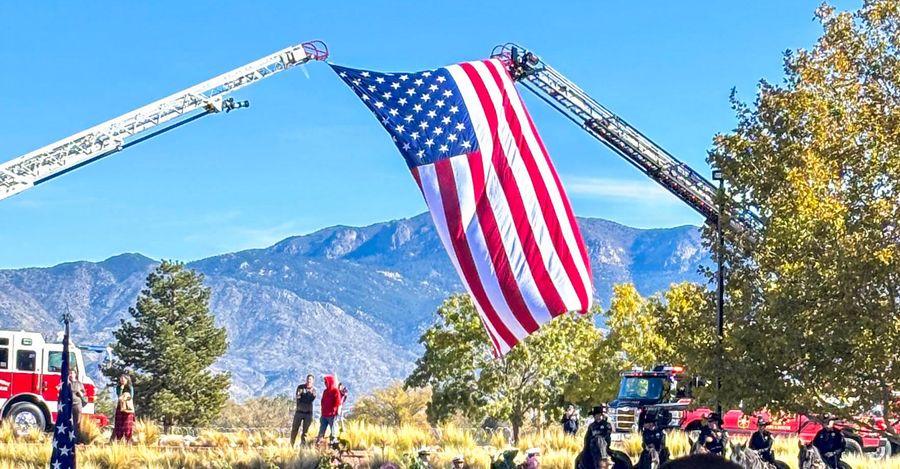
A U.S. Flag hangs between two fire trucks during the Veterans Day ceremony at the New Mexico Veterans Memorial, Albuquerque, New Mexico, Nov. 11, 2026. The annual event honors the service and sacrifice of U.S. service members by bringing together veterans, active service members, and the local community.
The Formation Left Us Behind
Life without the uniform, and the search for the clarity we had in it
Published Nov. 17, 2026 • Read time: 9m
I was walking down the hall at work when I saw a friend I hadn't seen in years. We said hello. How are you? That was about it. We barely talked, and I felt uncomfortable the whole time.
He was wearing the unit crest. He's still in.
I walked away thinking about everything we had shared, and I knew that part of my life was over. I was out here trying to find purpose and peace without it.
Nothing bad happened in that hallway. But the unit had kept going without me, and I had nowhere to stand. The uniform told you where you belonged and who was counting on you. Take it off and the desire to serve is still there. The structure that organized it isn't.
It doesn't take a person, either. It can be a Wesley Willis song you played in the TOC (tactical operations center) when things were miserable. A few notes and you're right back there.
What came back to me wasn't a memory of war. It was a memory of who I used to be.
Leaving the military can cost you your identity, your belonging, and your purpose, not just a job. This isn't only a Global War on Terror (GWOT) story. Our Vietnam brothers and sisters have carried it for fifty years, and many of them got less of a welcome home than we did.
Some retire. Some are hurt. Some are pushed out. The formation moves on without you either way, and the question afterward is often the same:
What do you do with the desire to serve when the identity that organized your adult life is gone?
Transition programs cover education, health care, disability compensation, housing, and job placement. Those matter. But a paycheck is not belonging, and a good civilian job doesn't end the need to serve.
Losing the Formation
Here's the part that's hard to explain to anyone who hasn't lived it. We miss people we'd never have picked as friends, and places we never want to see again.
Picture the Joint Readiness Training Center (JRTC) in a Louisiana summer. We had been there for almost a month and had slept very little. Then word came that a four-star general was coming to visit. As he walked in, someone on the team noticed a giant crude drawing sitting on top of the map we had laid out to orient him. Everyone went to work at once, doing whatever it took to get it out of sight before he saw it. We got it done. He still looked around the room and asked, "What the hell are you guys doing?"
When he left, we laughed until we couldn't breathe. We talked about it for years. Nobody wanted to be in that TOC, but nobody would trade that moment or those people.
Then there was the day my first sergeant told everyone in the field they had better have eye protection, ear protection, gloves, and Kevlar on while shooting. Later, when we served the unit breakfast, one soldier walked up wearing exactly that: eye protection, ear protection, gloves, and Kevlar. Nothing else. It was awkward, it was ridiculous, and we still talk about it.
It was not all laughing. We lost friends. We carried each other through breakups, and through family illness. Nobody had to explain. Somebody was just there.
Then there was Katrina. We worked on the ground in our own city, seeing our homes devastated and worried sick about our loved ones, and some of us didn't know where our families were. We did the job anyway, and we did it next to each other.
The mission made the relationships non-optional. You didn't have to like each other. You had to rely on each other. Civilian life almost never asks that of you.
That is why it hurts. We are not longing for the hardship. We are longing for what the hardship made possible: a mission that mattered and people who made it worth enduring.
I'm not saying it was perfect. It cost us time with our families and it wore us down. Some of us were treated badly on the way out. Both things are true. The formation could create belonging and still fail people.
This is where I believe the Department of War falls short. The institution that built the identity doesn't design a bridge out of it. It designs an exit. Benefits and job help don't fix being cut off from the people and the institution that made you who you are.
Calling this nostalgia misses the point. It's not just missing the past. It's wondering where a part of you belongs now.
The Burdens We Carry Home
The Department of Veterans Affairs' (VA) 2026 annual suicide report counted 6,488 veteran suicides in 2024, about 17.7 a day. Sixty-two percent had not received VA care in the year they died or the year before. Depression, PTSD, and chronic pain follow many of us out the gate. So does the quieter sense that there is nowhere left to belong.
These numbers don't say how many of those veterans felt cut off from their old lives. But clinical care can't be the only door.
Identity loss isn't another diagnosis, and it doesn't take anything away from PTSD, depression, or traumatic brain injury. Grief, shame, betrayal, and lost belonging can overlap with them without being the same thing.
Social identity theory explains some of this. We take part of who we are from the groups we belong to, and service made that identity unusually strong. Leaving can take that away all at once.
A 2026 scoping review by Walters, Miller-Lewis, and Johnson, "Transitioning to Civilian Life: How Are Life Meaning, Purpose and Identity Related to Wellbeing for Veterans?", found that identity disruption and loss of purpose went along with poorer well-being. The task isn't to replace the uniform with a job. It's to stay the person service helped make while becoming someone who can belong somewhere else.
The loss also leaves stories behind. I'm not useful anymore. I was thrown away. Nobody out here understands. They show up on their own, they feel like facts, and they shape what we do next.
If this sounds like you, you're not broken, and you're not alone. This week, please reach out to one person from your past, or say yes to one thing where someone is counting on you. If it's heavier than that, dial 988 and press one for the Veterans Crisis Line, or text 838255. You don't need to be enrolled in VA care. The Vet Center Call Center, 877-927-8387, is open around the clock and staffed by combat veterans.
The Reconnection Paradox
We tell isolated veterans to reconnect with people who understand. Usually that's good advice. But what if the people who understand us best are tied to the hardest time of our lives?
An old friend from the unit can bring back belonging and remind you of a career that ended badly. Someone who remembers how good you were can also show you how far away that version of you feels.
When it hurts, we pull away. Clinicians call that avoidance. It brings relief, so we do it again. Distance can be the right call, especially after mistreatment. Sometimes the answer is people who understand the past and will build something new with us.
Maybe reconnecting starts with giving us something worth doing together now. Part of this is behavioral activation: acting before you feel ready. Purpose doesn't always come back first. Sometimes it comes back because we act. Mentoring, food banks, youth programs, and disaster recovery all count. None of this replaces treatment when treatment is needed.
What the Department of War and the VA Could Do
The Department of War and VA shouldn't stop at handing us off. They should give us somewhere to come back to. I recommend peer-led discussion groups on Department of War and VA campuses, at Vet Centers, or in community spaces, wherever veterans will actually show up. Some of us will not want to walk back onto an installation.
This isn't therapy. It's connection. Sit with people who understand, talk honestly about what leaving felt like, and be treated as part of something again. Three things would make it work:
· Led by peers, not briefers. Veterans who have been through it lead the discussion. Nobody lectures.
· Open to everyone who left. Retired, separated, injured, or pushed out, nobody has to explain why they are there.
· Ongoing, not one and done. A meeting that continues after separation tells veterans the relationship did not end when the paperwork did.
A lot of peer support is organized around a diagnosis or a benefit. This would be organized around the fact that the group is gone and the desire to serve is not. The goal isn't another meeting. It's a place where you have a reason to show up and someone notices when you don't.
Meet monthly, with ten to fifteen people. No rank, and nobody has to speak. Peer leaders get just enough training to know when someone needs more than conversation, and who to call. After six months, ask whether people feel more connected, less isolated, and better able to find purpose than when they started. The evidence on peer programs is promising but mixed, so start small and test it.
I'm not only asking others to build this. I'm working on something like it myself. It is early, but I believe in it enough to start.
The Mission Changes
Nobody should tell us the most important period of our lives is behind us. A good transition should leave room to belong, to build real relationships, and to do work that matters alongside other people. The mission changes. The desire to serve can remain. And if you've got nothing left to give right now, you still belong. Raising your family, finishing school, or building a few friendships counts.
My friend from the hallway still wears the crest. It's on my daughter's license plate and across the back of my father-in-law's truck. It's on three guidons hidden in my home. "Try us." What does that mean when the guns go silent? We don't have to answer that alone.
Mark W. Castillon served in the Army National Guard from 2004 to 2024, including deployments in support of Operations Iraqi Freedom and New Dawn and emergency responses from Hurricane Katrina through COVID-19. He writes on veteran mental health, whistleblower protection, leadership accountability, and due-process reform.

Why Iran Cannot Simply Surrender
By Eric Garland • RealClearDefense
The Formation Left Us Behind
By Mark W. Castillon • RealClearDefense
Can Commanders Tell When Artificial Intelligence Is Wrong?
By Jonathan K. Corrado • RealClearDefense
The Summit as Mirror
By Stephen Blank • RealClearDefense
The False Choice That Could Get Us Killed
By Adam Strickland • RealClearDefense
Why Iran Cannot Simply Surrender
By Eric Garland • RealClearDefense
U.S. Navy Cuts Submarine Maintenance Delays by 40%
By Ethan Gossrow, Naval News
Air Force Bets on Hybrid-Electric Aircraft for Transport
By L.C. Williams, Defense One
Roosevelt Joins 2 Other Carriers in Mideast As Pressure on Iran Rises
By Stars & Stripes
Fight Now? Time to beef up III MEF
By Marine Corps Compass Points