
We Mustn't Cede the Middle East to China
Last updated 07:00 AM EST • Read time: 4m
A year into his presidency and Joe Biden is reeling on the foreign-policy front. The Afghanistan debacle, justified as part of a reorientation toward Asia, begat increased Chinese pressure on Taiwan, Iranian escalation in the Gulf, and a likely invasion of Ukraine.
The Biden administration's emphasis on the Sino-American rivalry in general and the Asian theater, in particular, is correct. However, his administration has especially foundered in the Middle East, which will damage America’s China strategy more than any other mistake.
Team Biden seems content washing its hands of the region, and where it has engaged, it has alienated longtime partners Israel and Saudi Arabia in favor of appeasing Iran, a longtime adversary. Yet why care about the Middle East at all when China is the pacing problem? Sino-American competition may play out principally in Asia, but the U.S. cannot neglect the Middle East. It is the strategic pivot point in Chinese strategy, and in turn, a region of vital importance for the U.S. if it hopes to blunt China's aggression. For that reason, the Biden administration's negligence there is most unsettling.
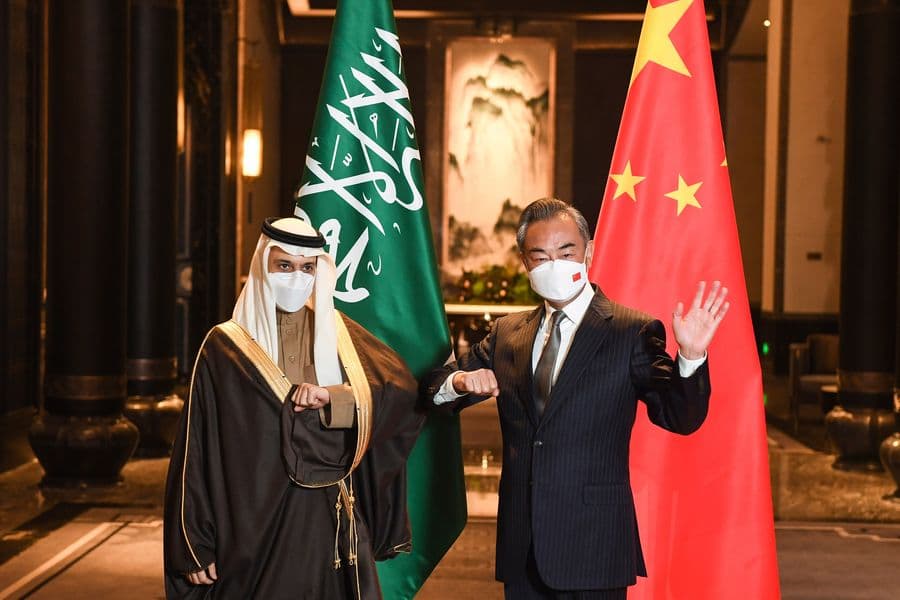
The CCP's tendrils are hard at work all over the region. Just last month, the United Arab Emirates (UAE) halted plans to buy F-35 fighters rather than cave toU.S.. pressure over Chinese spying in the latest sign that the road to the Middle East runs through Beijing, not Washington. Saudi Arabia has prioritized ties with China, courting Chinese investment in its NEOM smart-city, reportedly seeking a license to buy stocks on the Shanghai Stock Exchange, and purchasing Chinese-built UAVs for use in Libya. Elsewhere, Israel has opened its Chinese-operated Haifa port co-located to the U.S. Navy's Eastern Mediterranean supply hub.
Yet the United States is asleep at the wheel. President Biden’s Afghanistan pull-out has substantiated the view that America is leaving the Middle East. Many supporting withdrawal want to shift almost all of our resources to the Indo-Pacific, where they can be harnessed to contain China.
Paradoxically, a declining U.S. Middle Eastern presence will undermine America's China strategy.
Absent Middle Eastern petrochemicals, the Chinese economy would sputter. Around a fifth of Chinese energy is oil and natural gas-based, and in 2020, China imported 73% of its oil. Saudi Arabia, Iraq, the UAE, Oman, and Kuwait accounted for half of the country's crude oil imports in 2021, while Russia's supply share contracted. China also eyes the Middle East's ample proven natural gas reserves.
Additionally, American allies and partners in Asia rely on Middle Eastern energy. Japan, South Korea, the Philippines, Vietnam, and Indonesia all consume oil that transits the South China Sea. A Chinese-dominated Middle East would allow Beijing to hold these states hostage, threatening to starve them of vital economic supplies if they oppose Chinese ambitions.
The Belt and Road Initiative and 5G infrastructure development are intended to make satellites of the Middle East’s wealthiest oil exporters. TheU.S. must avoid that outcome.
To that end, Washington should capitalize on China’s energy dependence. With our Middle Eastern alliances and global naval presence, we can turn off the metaphorical tap. The precedent is promising: a blockade-based strategy was central to Allied victory in both world wars. In Europe, theU.S. and U.K. outproduced their landlocked enemies, while in Asia, the U.S. cut off Japan from critical raw materials, hamstringing the imperial war machine.
The Middle East, not somewhere in Asia as often claimed, is the cornerstone of an American far blockade, which forces the adversary to fight at a distance while allowing the defender to accept engagements on favorable terms. If too entangled with China, America's Middle Eastern allies would reject calls for blockade support and likely deny the U.S. basing access.
To address this challenge, Washington should modify U.S. and allied force deployments in the region. Although a major naval presence is unnecessary, the U.S. must build and maintain the port infrastructure needed to conduct an economic blockade. Their European allies can play a central role. Directing the U.K., France, and other European allies to emphasize the Middle East, rather than deploying their few ships to the Pacific, would mobilize European capabilities and lessen strain on U.S. logistical support.
The United States cannot let the Middle East fall even more into China’s orbit. Mr. Biden’s team must keep its focus on America’s greatest adversary. But it must recall the linkages between U.S. policy everywhere in Eurasia. Whatever gains will accrue to the United States from leaving the Middle East will be dramatically offset by losses for China to exploit. Let’s prevent this geostrategic own goal.
Harry Halem is a Research Associate at the Middle East and North Africa Forum specializing in maritime and naval strategy. Daniel J. Samet is a Ph.D. student at the University of Texas at Austin. Both are Krauthammer Fellows at the Tikvah Fund.

Iranian Cyber Operations
By Michael Groen • RealClearDefense
Reflecting on an Epic Horse Campaign in the Mountains of Afghanistan
By Brian Glyn Williams • RealClearDefense
The Godfather of American Foreign Policy Realism Speaks to Today’s World
By Francis P. Sempa • RealClearDefense
In Pursuit of Nuclear Abolition
By Peter Huessy • RealClearDefense
Innovation Alone Won’t Prepare the U.S. for the Future Battlefield
By Joshua Segal • RealClearDefense

26th MEU – U.S. Needs Crisis Response MAGTF
By Marine Corps Compass Points
The Influence of History on a Sea Power
By CDR Salamander
Navy Civilianizes Six Former Flag Billets, Reduces Six to Captains
By Mongilio, USNI N.
Raytheon's $8B Contract for Strategic Comms Terminal Modernization
By M+A El
America’s Maritime Moment Will Not Wait
By CDR Salamander