
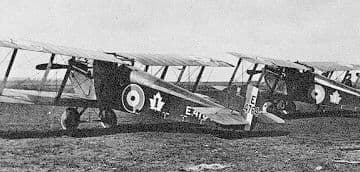
Is Captain Eddie Rickenbacker Overrated?
Last updated 07:37 PM EDT • Read time: 4m
I have mentioned the famous American fighter pilot Captain Eddie Rickenbacker in my writings from time to time over the years, and I always wanted to write an article specifically about him because it is quite common for American militarists to boast of his fighting record in World War I. Indeed, Rickenbacker’s friend Colonel Hans Christian Adamson says that the man did receive great recognition: “On October 30 [1918], Captain Rickenbacker landed after downing a Fokker and a balloon, within five minutes, shortly before sunset. These turned out to be his last victories in the war. When the Armistice was signed on November 11, the 94th [Squadron] had a total of sixty-nine [Germans] to its credit, twenty-nine more than the famous Lafayette Escadrille had downed in some three years of fighting. Captain Rickenbacker’s score was twenty-six victories in seven months. His tunic bore such brave ribbons as the Cross of the Legion of Honor, the Distinguished Service Cross with nine Oak Leaves, the Croix de Guerre with four Palms. A decade later, he was awarded the Congressional Medal of Honor.” (p. 306).
All these accolades, combined with the widespread belief in American Exceptionalism, have given Rickenbacker a large following in the U.S. and created the belief that he was not just on par with, but better than allied fighter pilots. The Military Industrial Complex, Hollywood, and the tendency of many Americans to exaggerate their country’s prowess on the battlefield have made Rickenbacker seem almost superhuman as a pilot. Furthermore, some American writers, bloggers and editors like to put Rickenbacker right next to The Red Baron, the top ace of the war, implying they were equals.
However, the eminent British military historian Denis Winter, in his excellent book The First of The Few: Fighter Pilots of The First World War, has a very different view. He says there were allied pilots who achieved significantly more victories than Rickenbacker did: “By the end of the war Canadian pilots had the lion’s share of killings: Bishop 72, Collishaw 60, Barker 59, Maclaren 54, McEvoy 46, Claxton 39, McCall 37, Quigley 34, Carter 31, McKeever 30 – without such scores the RAF list would have been thin gruel, and such precocity was noted even during the war. In June 1918, the Secretary of State remarked on the ‘very high standards of the semi-trained Canadians’ as ‘a most striking feature.’ Like the performance of the Australian Corps on the ground, superior Dominion [Canadian] achievement is not easily accounted for.” (p. 22).
There you have it; the great Canadian aces (plus British and French aces) outscored the great American ace Rickenbacker, most by a wide margin, yet unlike the U.S. “Ace of aces,” quite a few of them are all but forgotten now. Acclaim from foreign historians like Winter are usually more credible than praise from the domestic variety, and I think that is the case with Rickenbacker. American militarists love a hero, and will go to great lengths to promote them, even if it means giving too much admiration whilst ignoring the contributions of foreign heroes who were objectively more accomplished. Many Americans believe that Rickenbacker was a great pilot, and I agree with that, but facts are facts.
If the militarists in the U.S. were to think about the pro-war propaganda they are constantly exposed to, the world would be a much better and safer place. If they knew that America didn’t win the world wars singlehandedly, they would be far less receptive to the kind of brainwashing that I observed when I attended high school in California. And finally, they might come to realize that some heroes, like Rickenbacker, don’t really deserve all the kudos that generations of Americans, young and old, have lavished on them.
Roger Thompson is a Fellow of the Inter-University Seminar on Armed Forces & Society, a Research Fellow at Dalhousie University’s Centre for the Study of Security and Development, the author of Lessons Not Learned: The U.S. Navy’s Status Quo Culture, a former researcher at Canada’s National Defence Headquarters, and Korea’s first Star Trek professor.
Notes:
Roger Thompson. “Reforming America’s Overhyped Airpower”. Project On Government Oversight, September 17, 2013.
Colonel Hans Christian Adamson. Eddie Rickenbacker. Tannenberg Publishing. Kindle Edition.
Denis Winter. The First of The Few: Fighter Pilots of The First World War. London: Allen Lane, 1982.
The Services Do Not Need a Four-Star Autonomous Warfare Command
By Steven Wills • RealClearDefense
Honor Them While There Is Still Time
By Jeffrey Rosales • RealClearDefense
From Siberia to Fairford: How Operation Spider’s Web Has Changed the Rules of Airpower
By Frank A. Rose • RealClearDefense
Faster Simulations, Better Defense Decisions
By Rut Lineswala • RealClearDefense
Will HASC Have an Oversight Subcommittee in the Next Congress?
By Christopher J. Bright • RealClearDefense
Hegseth Barred Trans Troops. Military Boards Are Rejecting Those Orders.
By NYT
Closing the Sea: Lessons from Ancient Mediterranean Blockades
By DeCasien, CIMSECFrom Siberia to Fairford: How Operation Spider’s Web Has Changed the Rules of Airpower
By Frank A. Rose • RealClearDefenseFaster Simulations, Better Defense Decisions
By Rut Lineswala • RealClearDefense
Bombers Could Have a Major Air-to-Air Combat Role
By Joseph Trevithick, The WarZone