
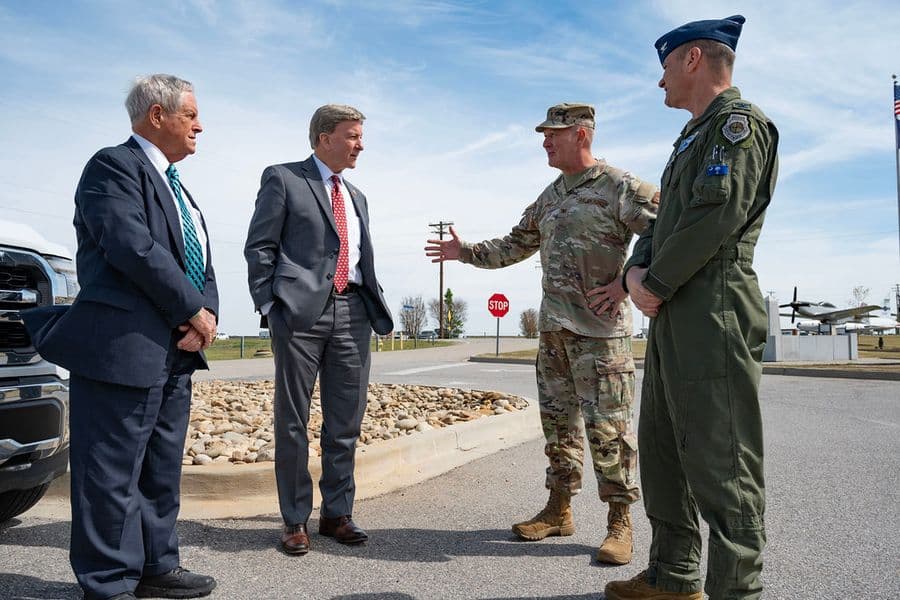
U.S. Rep. Mike Rogers, chairman of the House Armed Services Committee, and U.S. Rep. Joe Wilson meet with base leadership...
Will HASC Have an Oversight Subcommittee in the Next Congress?
Based upon the Past, Here’s What to Expect
Last updated 02:14 AM EDT • Read time: 5m
News reports suggest that the House Armed Services Committee is considering reestablishing an Oversight and Investigations Subcommittee in the next Congress. That’s unsurprising. Each session brings new topics and different approaches, especially with the prospect of a partisan turnover. As the leader of the last HASC O&I staff who was there with many of the current members, I suspect these are the interrelated aspects of a reconstituted O&I that HASC is likely contemplating:
Staffing and bureaucratic limitations.
Recreating an Oversight & Investigations subcommittee necessarily requires altering prevailing rules or reducing or combining other subcommittees. That invokes all sorts of complicated and difficult equities. A reorganization also means reallocating staff slots. The Armed Services staff is the only one in the House which manages an annual authorization process. It is already too small for all the tasks before it. Setting up an O&I team means shifting some of the too few staff slots to a new assignment. Deciding which subcommittee or defense topic will receive reduced support is difficult. At the same time, choosing the right balance of O&I staff competencies has its own challenges. Lawyers are a necessary part of the process, of course, but they are trained to craft briefs zealously supporting a client’s preferred position. It is better to have a preponderance of analysts and researchers—generalists who are prepared to sift through evidence and fairly assess large volumes of information.
Conducting careful and balanced evaluations rather than partisan and ideological hatchet jobs.
Seventeen years ago, journalist Josh Rogin wrote in Foreign Policy that HASC “shies away from” “thorny oversight issues.” Even if that was true at one time, that wasn’t the case in more recent years. But, too often on the Hill, oversight activities are political cudgels: inquiries into controversial subjects reaching preordained conclusions. Indeed, in 2015, Foreign Affairs asked the late famed Columbia University political scientist Robert Jervis to review several reports produced by other Congressional investigation panels. Jervis lamented that all of the reports failed “to present any evidence that could undermine their cases, express any uncertainty, or acknowledge any alternative interpretations.” But, long before Jervis’ article, HASC embraced the opposite approach. HASC’s reports were replete with nuance and caveats (i.e., “the Secretary may have . . . acquiesced,” “although others suggested,” “it may be” “either they were not transmitted . . . or they were but are remembered differently”). And contrary opinions were surfaced. HASC’s assessments were also carefully argued and sourced. For example, determining that senior Defense leadership hid important activities from Congressional overseers requires precisely sifting through documents, emails, public statements, and interviews with oversight staff. (This isn’t hypothetical. HASC learned that for nearly four months the Department did not disclose to HASC—even when specifically asked—endeavors of direct relevance to the Committee. Some Administration officials relied on “crabbed parsing” of queries —like the meaning of the word “direct”—and Department leaders kept their actions secret from the Committee’s primary Departmental interlocutors so the interlocutors could not convey complete and fulsome details to the Committee. As HASC concluded, this misdirection and obfuscation posed a “grave” threat to the Committee’s important oversight role.)
Understanding that some inquiries will miss the mark, even if others succeed.
HASC O&I’s work garnered praise. For example, CBS News described one HASC inquiry as “hard-hitting” and “revealing.” MSNBC called another “a really important report” while a New York Times journalist described it as “valuable,” in part because it “adds a lot to the publicly available history.” A third was among twenty “documents of distinction” honored by the American Library Association. Yet another investigation seems to have caused the Government Accountability Office to revisit a draft report it had prepared about US Central Command intelligence activities because a HASC assessment issued on the eve of GAO’s release apparently surfaced aspects that GAO had overlooked. But there were also HASC missteps. For example, not long after finishing an exhaustive inquiry it became apparent HASC had failed to fully evaluate a significant element: the extent to which the Executive Branch was using prisoner or hostage swaps as a diplomatic tool in general, and specifically as a way to advance a rapprochement with the Taliban. This is a reminder of investigatory limitations, no matter how diligent an inquiry might endeavor to be.
Being prepared for political attacks.
There is nothing to be done to prevent accusations driven by partisan animus. Opponents in one case praised a HASC Committee report comporting with their preferred narrative as among the “fact-based approaches” which “command respect.” In an instance which did not, they decried the evaluation to be “an expression of shrill demagoguery, contrary to the interests of national security, and beneath the dignity of the House Armed Services Committee.” That’s strong stuff, but emblematic of what the future likely holds.
Christopher J. Bright led the House Armed Services Committee staff from 2012-2019. A diplomatic historian, he teaches U.S. grand strategy at the Elliott School of International Affairs at George Washington University and is a Fellow at the National Security Institute at George Mason University.
From Siberia to Fairford: How Operation Spider’s Web Has Changed the Rules of Airpower
By Frank A. Rose • RealClearDefense
Faster Simulations, Better Defense Decisions
By Rut Lineswala • RealClearDefense
Will HASC Have an Oversight Subcommittee in the Next Congress?
By Christopher J. Bright • RealClearDefense
The U.S. is Overpaying for Missiles
By Alex Lee • RealClearDefense
The U.S. Nuclear Deterrent Umbrella
By Peter Huessy • RealClearDefense
From Siberia to Fairford: How Operation Spider’s Web Has Changed the Rules of Airpower
By Frank A. Rose • RealClearDefenseFaster Simulations, Better Defense Decisions
By Rut Lineswala • RealClearDefense
Bombers Could Have a Major Air-to-Air Combat Role
By Joseph Trevithick, The WarZone
Pentagon, Lockheed Agree to 10-Year Deal for 850 F-35 Jets
By M. Scanlon, Military T.
The Marine Corps Has a Boot Problem
By Travis Pike, Sandboxx News