
From Siberia to Fairford: How Operation Spider’s Web Has Changed the Rules of Airpower
Last updated 02:06 AM EDT • Read time: 8m
Join the Conversation
0Last June, Ukraine demonstrated that inexpensive drones launched from inside an adversary’s territory could threaten some of the most valuable aircraft in the Russian strategic arsenal.
This week, the United States demonstrated that it had absorbed the lesson.
The United States abruptly removed 12 B-1 bombers from RAF Fairford in the United Kingdom amid concerns about a potential Iranian-backed attack on the base. According to reporting in The Wall Street Journal, U.S. and European officials had received intelligence concerning a potentially complex operation involving drones that could target both the aircraft and American personnel.
Whatever ultimately emerges from the continuing investigation—and Iran has denied involvement—the American response is strategically significant.
The United States was not prepared to leave a concentration of extraordinarily valuable strategic aircraft exposed to the possibility that relatively inexpensive drones launched from nearby could destroy or damage them on the ground.
That is one of the most important lessons of Ukraine’s Operation Spider’s Web.
And it suggests that drone warfare is beginning to change not merely how militaries fight wars, but how they base, disperse and protect military power before the shooting even starts.
Spider’s Web was a strategic warning
On June 1, 2025, Ukraine launched one of the most audacious military operations of the war.
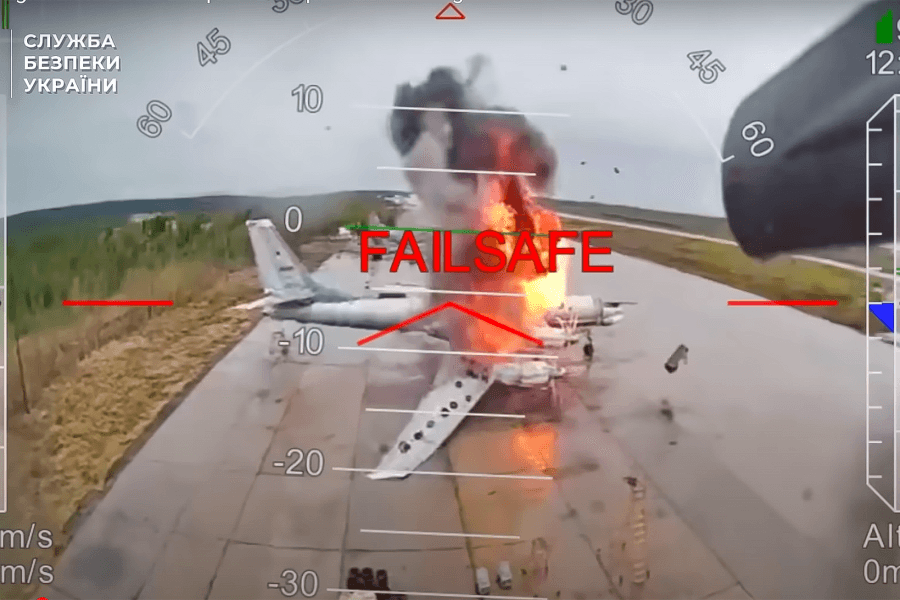
After approximately 18 months of preparation, Ukrainian intelligence reportedly smuggled drones and supporting equipment deep inside Russia. The drones were concealed in specially constructed containers transported by trucks and positioned near Russian military airfields.
When the moment came, the roofs opened and small first-person-view drones emerged.
Their targets were not tanks or infantry positions.
They were Russian strategic bombers and other high-value aircraft sitting thousands of miles from Ukraine.
The precise damage remains debated, but the larger point is indisputable: Ukraine demonstrated that relatively inexpensive unmanned systems could place enormously valuable strategic assets at risk far behind what had traditionally been considered the front line.
The operation inverted one of the traditional assumptions of airpower.
For decades, militaries have invested enormous resources in aircraft capable of penetrating increasingly sophisticated enemy air defenses. But Spider’s Web largely bypassed those defenses.
The drones did not fly thousands of miles through Russian airspace.
They were brought close to their targets and launched locally.
The problem was therefore no longer simply one of defending national airspace against aircraft and missiles approaching from hundreds or thousands of miles away.
The threat could already be inside the defensive perimeter.
From Siberia to Fairford
That is why the events at RAF Fairford deserve attention.
The B-1 is an enormously capable long-range bomber. But sitting on the ground, it faces a radically different problem.
A relatively inexpensive drone launched from a van, truck, warehouse or field several miles from an air base does not need intercontinental range, stealth technology or an advanced guidance system to threaten a multimillion-dollar aircraft.
It merely needs to get through once.
This creates an extraordinary asymmetry.
The attacker can potentially risk systems costing thousands or tens of thousands of dollars against aircraft worth hundreds of millions—and, perhaps more importantly, against scarce military capabilities that cannot quickly be replaced.
The United States therefore made a rational decision at Fairford: disperse the aircraft rather than leave them concentrated at a location facing a credible threat.
But the broader implication is uncomfortable.
If the United States concluded that B-1s at a well-established British air base could potentially be vulnerable to this type of attack, military planners should assume that virtually every major air base could face a similar problem in a future conflict.
That includes bases in Europe.
It includes American bases in the Middle East.
It includes facilities in Japan, South Korea and Guam.
And ultimately, it includes military installations inside the continental United States.
Distance from the battlefield no longer necessarily means distance from the threat.
The democratization of strategic strike
Operation Spider’s Web illustrates something larger that has been unfolding across Ukraine and the Middle East.
Precision strike is being democratized.
Capabilities that once required sophisticated aircraft, cruise missiles or special-operations forces can increasingly be achieved—at least against some targets—with commercially derived drones, satellite communications, software, artificial intelligence and relatively inexpensive explosives.
That does not make traditional military power obsolete.
Far from it. The United States will continue to need bombers, fighters, aircraft carriers, submarines and sophisticated missile defenses.
But the enormous investment represented by these platforms increasingly needs to be matched by investment in protecting them from systems costing a tiny fraction of their value.
The economic imbalance is striking.
An adversary does not need to destroy an entire bomber force. Damaging several aircraft, disrupting operations, forcing dispersal and compelling the United States to devote significant resources to base defense may itself constitute strategic success.
Indeed, the events at Fairford demonstrate that drones do not necessarily have to strike their targets to have strategic effect.
The threat itself can force an adversary to move.
That is deterrence and operational disruption achieved at potentially very low cost.
Air bases must become combat positions
For much of the post-Cold War period, the United States operated from bases where the principal threats were missiles, aircraft and terrorism.
The drone revolution adds another dimension.
Air bases must increasingly be treated as combat positions requiring layered defenses.
That means better surveillance around their perimeters. It means electronic warfare. It means inexpensive kinetic interceptors. It means directed-energy systems as those technologies mature. It means hardened shelters, decoys and rapid dispersal.
And critically, it means looking outward as well as upward.
A Spider’s Web-style attack may originate not hundreds of miles away but from a truck parked several miles from the runway.
That creates a security problem extending well beyond the traditional perimeter fence.
The challenge is particularly acute for allied bases. American forces operate from facilities embedded in civilian communities, transportation networks and commercial infrastructure. Protecting those facilities therefore requires much closer integration among military security forces, intelligence organizations, local law enforcement and allied governments.
The traditional distinction between homeland defense and battlefield defense is becoming increasingly blurred.
Dispersal must return to the center of airpower strategy
There is another lesson.
Concentration creates vulnerability.
The United States spent much of the Cold War thinking seriously about dispersal, redundancy, hardened infrastructure and the ability to continue operating after attack.
Those concepts need renewed attention.
The objective cannot be to build an impenetrable dome around every American military installation. That would be prohibitively expensive and probably impossible.
Instead, the United States and its allies need to make their forces harder to find, harder to target and less rewarding to attack.
That means dispersing aircraft across larger numbers of operating locations.
It means developing the logistics necessary to operate from austere facilities.
It means expanding hardened shelters.
It means deploying convincing decoys.
And it means ensuring that command-and-control, fuel, maintenance and munitions infrastructure do not create single points of failure.
The Air Force’s Agile Combat Employment concept already moves in this direction. Spider’s Web and Fairford demonstrate why that effort should accelerate.
This is a global phenomenon
It would also be a mistake to view these developments exclusively through the lens of Ukraine.
Drone warfare is becoming a global phenomenon.
Iran and its partners have demonstrated extensive use of unmanned systems across the Middle East. Drone technologies are spreading across Africa.
Criminal organizations and armed groups in Latin America are experimenting with them.
And innovations move quickly.
Techniques pioneered in one conflict can be studied, copied and modified elsewhere in a matter of months.
That is perhaps the most important connection between Spider’s Web and Fairford.
Ukraine demonstrated what was possible. Others watched.
Now the United States is adjusting its behavior because it must assume that others may attempt something similar.
The lesson of Spider’s Web
Military revolutions are sometimes obvious only in retrospect.
Operation Spider’s Web may eventually be remembered as one of those moments.
Its significance was not simply that Ukrainian drones damaged Russian aircraft.
It demonstrated that relatively inexpensive systems, combined with intelligence, creativity and operational surprise, could threaten strategic assets thousands of miles behind the front.
Four months later, the United States moved a dozen B-1 bombers from a major European air base amid concern about precisely this type of threat.
That does not mean every military installation is suddenly defenseless.
It does mean that the assumptions underlying the protection of high-value military assets need to change.
The central question for the United States is therefore no longer simply how to build the world’s most capable aircraft, ships and missiles.
It is also: How do we prevent an adversary’s $10,000 drone from destroying our $100 million platform while it is sitting on the ground?
Operation Spider’s Web posed that question.
The decision at Fairford suggests the United States has begun to understand just how seriously it needs to answer it.
Frank A. Rose is president of Chevalier Strategic Advisors. He previously served as principal deputy administrator of the National Nuclear Security Administration, assistant secretary of state for arms control, verification and compliance, a professional staff member on the House Armed Services Committee, and a policy official in the Office of the Secretary of Defense.
From Siberia to Fairford: How Operation Spider’s Web Has Changed the Rules of Airpower
By Frank A. Rose • RealClearDefense
Faster Simulations, Better Defense Decisions
By Rut Lineswala • RealClearDefense
Will HASC Have an Oversight Subcommittee in the Next Congress?
By Christopher J. Bright • RealClearDefense
The U.S. is Overpaying for Missiles
By Alex Lee • RealClearDefense
The U.S. Nuclear Deterrent Umbrella
By Peter Huessy • RealClearDefense
From Siberia to Fairford: How Operation Spider’s Web Has Changed the Rules of Airpower
By Frank A. Rose • RealClearDefenseFaster Simulations, Better Defense Decisions
By Rut Lineswala • RealClearDefense
Bombers Could Have a Major Air-to-Air Combat Role
By Joseph Trevithick, The WarZone
Pentagon, Lockheed Agree to 10-Year Deal for 850 F-35 Jets
By M. Scanlon, Military T.
The Marine Corps Has a Boot Problem
By Travis Pike, Sandboxx News